Many English learners become confused when they hear words like lectern, podium, pulpit, and rostrum. These words all seem to describe a place where someone stands to speak. Lectern vs Podium vs Pulpit vs Rostrum.
Because they are often used in similar situations, people sometimes think they all mean the same thing. However, they have different meanings and different uses.
You may hear a news reporter say a president spoke from a podium. Then, in a church, someone may mention a pulpit. At school, a teacher may tell a student to stand behind the lectern. In another event, a speaker may be invited to the rostrum. It is easy to see why learners mix these words up.
Knowing the difference helps you choose the right word in speaking and writing. It also makes your English sound more natural and accurate.
If you are preparing for an English exam, writing an essay, giving a speech, or simply trying to improve your vocabulary, understanding these terms is useful.Lectern vs Podium vs Pulpit vs Rostrum.
The good news is that the differences are not difficult once you learn the purpose of each word. With simple explanations, everyday examples, and clear grammar tips, you can remember them with confidence.
By the end of this guide, you will know when to use each word, why they are different, and how to avoid common mistakes that many English learners make.Lectern vs Podium vs Pulpit vs Rostrum.
What Does “Lectern” Mean?
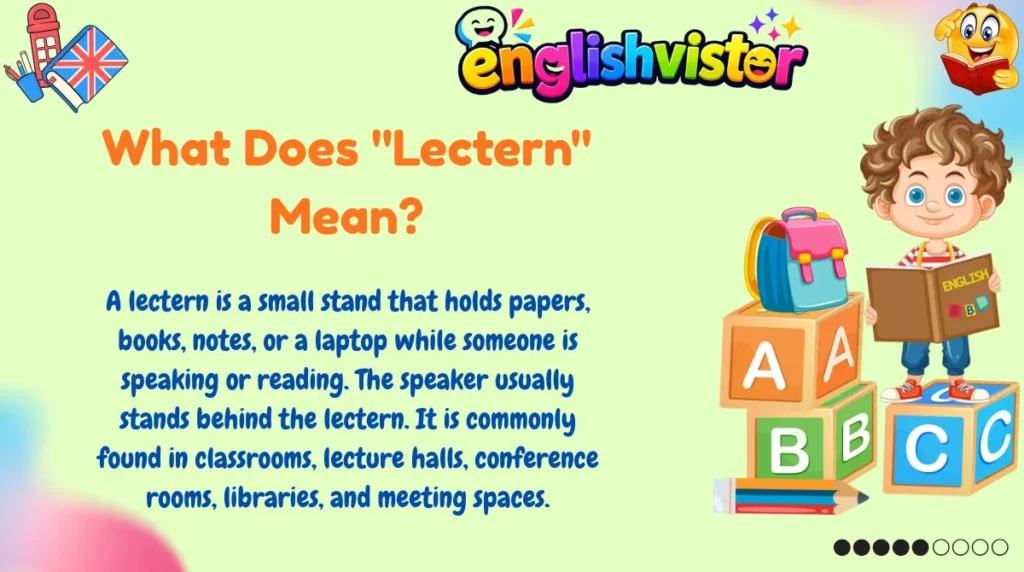
A lectern is a small stand that holds papers, books, notes, or a laptop while someone is speaking or reading. The speaker usually stands behind the lectern. It is commonly found in classrooms, lecture halls, conference rooms, libraries, and meeting spaces.
The most important job of a lectern is to support reading or speaking materials. It is designed for convenience, allowing the speaker to keep their notes at a comfortable height.Lectern vs Podium vs Pulpit vs Rostrum.
Simple Definition
Lectern (noun): A stand with a slanted top used to hold notes or books while a person gives a speech, lecture, or presentation.
When to Use “Lectern”
Use lectern when talking about:
- Classroom lectures
- Business presentations
- Academic speeches
- Conferences
- Reading from notes or books
- Formal presentations
Grammar Rule
Lectern is a countable noun.
Examples:
- a lectern
- the lectern
- two lecterns
- this lectern
It is usually used with verbs such as:
- stand at the lectern
- speak from the lectern
- walk to the lectern
- place notes on the lectern
Example Sentences
- The professor walked to the lectern before starting the lecture.
- Please leave your notes on the lectern.
- Lectern vs Podium vs Pulpit vs Rostrum.
- The speaker smiled as he stood behind the lectern.
- Every classroom has a wooden lectern.
- The presenter kept her laptop on the lectern.
- He returned to the lectern after answering a question.
- The guide read the announcement from the lectern.
Common Learner Confusion
Many learners call every speaking stand a podium because they hear that word in movies or on television.Lectern vs Podium vs Pulpit vs Rostrum.
In careful English, however, the object that holds the speaker’s notes is usually a lectern.
For example:
❌ The teacher placed her notebook on the podium.
✅ The teacher placed her notebook on the lectern.
Although many native speakers also say podium, especially in American English, lectern is the more accurate word when referring to the stand that supports papers or books.Lectern vs Podium vs Pulpit vs Rostrum.
Where You Usually See a Lectern
A lectern is common in places such as:
- Schools
- Universities
- Libraries
- Conference halls
- Meeting rooms
- Training centers
- Seminar rooms
It is designed mainly for reading and presenting, not for standing on.
What Does “Podium” Mean?
The word podium has two common meanings, and understanding both is important.
The traditional meaning is a raised platform that someone stands on. This is the meaning used in architecture and sports.
The modern meaning, especially in American English, refers to the stand behind which a speaker gives a speech. This modern use has become very common in newspapers, television, politics, and everyday conversation.
Simple Definition
Podium (noun):
- A raised platform for a speaker, winner, or performer.
- In common modern English, especially American English, a speaking stand.Lectern vs Podium vs Pulpit vs Rostrum.
When to Use “Podium”
Use podium when talking about:
- Award ceremonies
- Political speeches
- Public events
- Press conferences
- Stage presentations
- Sports competitions
Grammar Rule
Podium is also a countable noun.Lectern vs Podium vs Pulpit vs Rostrum.
Examples:
- a podium
- the podium
- several podiums
Common verb combinations include:
- stand on the podium
- step onto the podium
- approach the podium
- leave the podium
Example Sentences
- The gold medal winner stood on the highest podium.Lectern vs Podium vs Pulpit vs Rostrum.
- The mayor walked toward the podium before speaking.
- Reporters gathered around the podium.
- She waited beside the podium until her name was announced.
- The candidate delivered his speech from the podium.Lectern vs Podium vs Pulpit vs Rostrum.
- Cameras focused on the podium during the announcement.
- The singer thanked the audience from the podium.
- Security officers stood near the podium.Lectern vs Podium vs Pulpit vs Rostrum.
Common Learner Confusion
One reason learners become confused is that podium has changed in everyday English.
Traditionally:
- Podium = platform
- Lectern = speaking stand
Today, especially in American English, many people use podium to mean lectern.Lectern vs Podium vs Pulpit vs Rostrum.
Because of this, both of these sentences may be heard:
- The speaker walked to the podium.
- The speaker walked to the lectern.
In formal writing, architecture, or precise English, many language experts still prefer to use lectern for the speaking stand and podium for the raised platform.Lectern vs Podium vs Pulpit vs Rostrum.
Where You Usually See a Podium
A podium is commonly seen at:
- Olympic medal ceremonies
- Political events
- Government announcements
- Press briefings
- Public speeches
- Television broadcasts
- Award shows
Difference Between Lectern and Podium (Detailed)
Although these two words are often used as if they mean the same thing, they describe different things in their original meanings.Lectern vs Podium vs Pulpit vs Rostrum.
| Feature | Lectern | Podium |
|---|---|---|
| Main purpose | Holds notes or books | Raised platform for standing |
| Speaker position | Behind the lectern | On the podium |
| Common places | Schools, conferences, classrooms | Sports events, political events, stages |
| Traditional meaning | Speaking stand | Raised platform |
| Modern American usage | Correct | Also commonly used for the speaking stand |
| Holds papers? | Yes | Not necessarily |
Usage Difference
Think about what the object is doing.Lectern vs Podium vs Pulpit vs Rostrum.
If it is holding papers, books, or a laptop, the correct word is usually lectern.
If it is lifting a person above the floor, it is traditionally called a podium.
For example:
- The professor placed his textbook on the lectern.
- The Olympic champion stood on the podium.
However, language changes over time. In American English, many people say:
- Lectern vs Podium vs Pulpit vs Rostrum.
Even though the object may actually be a lectern, this usage is now very common and widely accepted in everyday conversation.
Grammar Logic
A useful way to remember the grammar is to focus on the action.Lectern vs Podium vs Pulpit vs Rostrum.
You usually:
- stand behind a lectern
- place notes on a lectern
- speak from a lectern
With a traditional podium, you usually:
- stand on the podium
- step onto the podium
- climb onto the podium
Notice how the prepositions change because the objects have different purposes.Lectern vs Podium vs Pulpit vs Rostrum.
Sentence Structure Difference
Lectern
Subject + verb + at/from/behind + the lectern
Examples:
- The teacher stood behind the lectern.Lectern vs Podium vs Pulpit vs Rostrum.
- The speaker read from the lectern.
- She returned to the lectern after the break.
Podium
Subject + verb + on/onto + the podium
Examples:
- The athlete stood on the podium.
- The winner stepped onto the podium.
- The champion smiled from the top of the podium.Lectern vs Podium vs Pulpit vs Rostrum.
Meaning Comparison
Imagine a university lecture.
The professor walks into the room carrying notes. They place the notes on a stand and begin teaching. That stand is a lectern.
Now imagine the Olympic Games.
Three athletes stand on platforms to receive medals. Those raised platforms are podiums.
At a political press conference, the object holding the microphones and speech notes is technically a lectern, although many news reports simply call it a podium.Lectern vs Podium vs Pulpit vs Rostrum.
Understanding this difference will help you recognize both the traditional meanings and the modern everyday usage, making your English more accurate and more natural.
What Does “Pulpit” Mean?
A pulpit is a raised stand or enclosed platform in a church where a priest, pastor, minister, or preacher gives a sermon or reads from the Bible. Unlike a lectern, which can be used almost anywhere, a pulpit has a religious purpose.
Many churches have both a lectern and a pulpit. The lectern may be used for Bible readings, announcements, or scripture lessons, while the pulpit is often reserved for preaching. The exact use depends on the traditions of the church.Lectern vs Podium vs Pulpit vs Rostrum.
Simple Definition
Pulpit (noun): A raised platform or stand in a church from which religious leaders preach or deliver sermons.
When to Use “Pulpit”
Use pulpit when talking about:
- Churches
- Religious services
- Sermons
- Christian worship
- Lectern vs Podium vs Pulpit vs Rostrum.
Grammar Rule
Pulpit is a countable noun.
Examples:
- a pulpit
- the pulpit
- two pulpits
Common verb combinations include:
- stand at the pulpit
- Lectern vs Podium vs Pulpit vs Rostrum.
- speak from the pulpit
- return to the pulpit
Example Sentences
- The pastor preached from the pulpit every Sunday.
- The priest stood at the pulpit to deliver the sermon.
- Flowers decorated the pulpit for the holiday service.
- The minister walked toward the pulpit after the choir finished singing.
- The church built a new wooden pulpit.
- Everyone listened carefully as the preacher spoke from the pulpit.
- The Bible rested near the pulpit.Lectern vs Podium vs Pulpit vs Rostrum.
- The congregation became quiet when the pastor approached the pulpit.
Common Learner Confusion
Some learners think pulpit means any place where a person gives a speech. That is not correct.
A pulpit is mainly connected with religious speaking, especially in churches.Lectern vs Podium vs Pulpit vs Rostrum.
For example:
❌ The company manager gave a meeting from the pulpit.
✅ The company manager gave a presentation from the lectern.
Or:
✅ The pastor preached from the pulpit.Lectern vs Podium vs Pulpit vs Rostrum.
The setting is the biggest clue. If the event is religious, pulpit is often the right choice.
Where You Usually See a Pulpit
You will commonly find a pulpit in:
- Churches
- Cathedrals
- Chapels
- Religious gathering places
Outside these places, the word is rarely used literally.Lectern vs Podium vs Pulpit vs Rostrum.
What Does “Rostrum” Mean?
A rostrum is a raised platform or stage where a speaker, conductor, judge, or important person stands while addressing an audience. It is often used in formal or official situations.Lectern vs Podium vs Pulpit vs Rostrum.
The word comes from ancient Rome, where public speakers addressed large crowds from a raised platform. Today, rostrum is still common in British English, academic settings, government meetings, and formal ceremonies.
In some contexts, it can also refer to a platform used by an orchestra conductor.Lectern vs Podium vs Pulpit vs Rostrum.
Simple Definition
Rostrum (noun): A raised platform used by a speaker or leader during a formal event.
When to Use “Rostrum”
Use rostrum for:
- Government meetings
- Universities
- Formal ceremonies
- Public debates
- Official speeches
- Orchestra conductors
Grammar Rule
Rostrum is a countable noun.
Examples:
- a rostrum
- the rostrum
- several rostrums
Common verb combinations include:
- step onto the rostrum
- address the audience from the rostrum
- stand on the rostrum
- leave the rostrum
Example Sentences
- The judge walked onto the rostrum.
- The conductor raised his baton from the rostrum.Lectern vs Podium vs Pulpit vs Rostrum.
- The professor addressed the audience from the rostrum.
- The mayor stood on the rostrum during the ceremony.
- Reporters watched the speaker approach the rostrum.
- The chairman returned to the rostrum after the discussion.
- The award presenter stood proudly on the rostrum.
- Everyone looked toward the rostrum when the meeting began.
Common Learner Confusion
Many learners think rostrum and podium always mean the same thing.Lectern vs Podium vs Pulpit vs Rostrum.
They are similar, but rostrum is generally more formal and is used more often in British English. It also appears in government, legal, academic, and ceremonial settings.Lectern vs Podium vs Pulpit vs Rostrum.
Where You Usually See a Rostrum
A rostrum may be found at:
- Parliament buildings
- Universities
- Concert halls
- Courtrooms
- Formal conferences
- Official ceremonies
Difference Between Lectern, Podium, Pulpit, and Rostrum
Although all four words relate to public speaking, their purpose and location are different.
| Feature | Lectern | Podium | Pulpit | Rostrum |
|---|---|---|---|---|
| Main purpose | Hold notes | Raised platform or speaking stand (modern use) | Religious preaching | Formal speaking platform |
| Common place | Classroom, conference | Sports, politics, public events | Church | Government, universities, ceremonies |
| Religious use | Rare | No | Yes | Rare |
| Holds papers | Yes | Sometimes | Sometimes | Sometimes |
| Traditional meaning | Reading stand | Raised platform | Church preaching stand | Formal platform |
Usage Difference
The easiest way to choose the correct word is to think about where the speaker is.
- In a classroom, choose lectern.
- At the Olympics, choose podium.
- In a church, choose pulpit.
- During a formal ceremony or government meeting, choose rostrum.Lectern vs Podium vs Pulpit vs Rostrum.
The location often tells you which word fits best.
Grammar Logic
Each noun describes a different object or place.
- A lectern supports reading materials.Lectern vs Podium vs Pulpit vs Rostrum.
- A podium raises a person above others or, in modern American English, may also refer to the speaking stand.
- A pulpit is connected with religious preaching.
- A rostrum is linked with formal public speaking.
These nouns are all countable, so they can be used with articles like a, an, and the, and they have plural forms.
Examples:
- The lectern is made of wood.
- The podium is in the center of the stage.
- The pulpit is beside the choir.
- The rostrum overlooks the audience.
Sentence Structure Comparison
Lectern
Subject + verb + behind/from + the lectern
- The teacher spoke from the lectern.
- She placed her notebook on the lectern.
Podium
Subject + verb + on/onto + the podium
- The champion stood on the podium.
- The speaker walked to the podium.
Pulpit
Subject + verb + from/at + the pulpit
- The pastor preached from the pulpit.
- The minister stood at the pulpit.
Rostrum
Subject + verb + from/on + the rostrum
- The chairman addressed everyone from the rostrum.
- The conductor stood on the rostrum.
Grammar Rules You Must Remember
Rule 1: All Four Words Are Countable Nouns
Use articles such as a, an, and the.
Correct:
- The speaker walked to the lectern.
- A new pulpit was installed.
- The athlete climbed onto the podium.
- The chairman stood on the rostrum.
Rule 2: Use the Correct Preposition
Different objects use different prepositions.
Examples:
- Stand behind the lectern.
- Place notes on the lectern.
- Stand on the podium.
- Preach from the pulpit.
- Speak from the rostrum.
Choosing the right preposition makes your English sound more natural.
Rule 3: Match the Word to the Situation
Think about the place.
- School → lectern
- Church → pulpit
- Olympic medals → podium
- Government ceremony → rostrum
This simple habit helps you avoid many mistakes.
Rule 4: Remember Modern American English
In American English, many people use podium instead of lectern.
This is common in news reports and everyday conversation.
For example:
- The president walked to the podium.
Technically, it may be a lectern, but modern usage accepts podium in many speaking situations.
Common Mistakes Students Make
These four words are close in meaning, so mistakes are common. The good news is that most errors are easy to fix once you understand the setting.
Mistake 1: Calling Every Speaking Stand a Podium
Wrong:
The teacher placed her books on the podium.
Better:
The teacher placed her books on the lectern.
Tip: If the object mainly holds books or notes, lectern is usually the better word.
Mistake 2: Using “Pulpit” Outside a Church
Wrong:
The office manager spoke from the pulpit.
Correct:
The office manager spoke from the lectern.
Tip: Save pulpit for religious settings.
Mistake 3: Confusing Podium with Olympic Awards
Some learners think a podium only means a speaking stand.
Remember that the original meaning is a raised platform, especially for medal ceremonies.
Correct:
The runners celebrated on the podium.
Mistake 4: Using Rostrum in Casual Conversation
Although rostrum is correct, it sounds more formal than the other words.
Instead of saying:
“The teacher stood on the rostrum.”
Most people would naturally say:
“The teacher stood behind the lectern.”
Easy Trick to Remember the Difference
A simple memory trick can make these words much easier to remember.
L = Lectern = Learning
Think of a teacher in a classroom.
Teachers use a lectern while teaching.
Learning = Lectern
P = Podium = Prize
Imagine Olympic winners standing proudly with their medals.
Prize = Podium
P = Pulpit = Prayer
Picture a pastor preaching in a church.
Prayer = Pulpit
R = Rostrum = Royal Meeting
Imagine an important leader speaking during a formal ceremony.
Royal or official meeting = Rostrum
These small word links are easy to remember and help you choose the correct term quickly.
Daily Life Examples
Here are some simple examples you might hear in everyday English.
The mayor thanked the crowd from the podium during the public event.
The professor placed his laptop on the lectern.
Please walk to the lectern when your name is called.
The Olympic champion smiled on the podium.
Reporters waited near the podium before the speech began.
The pastor welcomed everyone from the pulpit.
The minister returned to the pulpit after the choir finished singing.
The chairman spoke from the rostrum during the meeting.
The conductor stepped onto the rostrum and raised his baton.
The guest speaker adjusted the microphone on the lectern.
Practice Section
Now it’s time to check your understanding. Choose the correct word from the options:
(Lectern / Podium / Pulpit / Rostrum)
1. The Olympic gold medal winner stood proudly on the ________.
A. Lectern
B. Podium
C. Pulpit
D. Rostrum
2. The pastor delivered a powerful sermon from the ________.
A. Lectern
B. Podium
C. Pulpit
D. Rostrum
3. The professor placed her notes on the ________ before beginning the lecture.
A. Lectern
B. Podium
C. Pulpit
D. Rostrum
4. The chairman addressed the audience from the ________ during the formal ceremony.
A. Lectern
B. Podium
C. Pulpit
D. Rostrum
5. During the press conference, the president walked to the ________ before answering questions.
A. Lectern
B. Podium
C. Pulpit
D. Rostrum
Answers
1. B — Podium
Olympic winners stand on a podium to receive medals.
2. C — Pulpit
A pulpit is the place in a church where a pastor or minister preaches.
3. A — Lectern
A lectern holds books, papers, or a laptop during a lecture or presentation.
4. D — Rostrum
A rostrum is commonly used for formal speeches, ceremonies, and official meetings.
5. B — Podium
In modern American English, podium is the most common word for the speaking stand used during political speeches and press conferences, although lectern is the traditional technical term.
Frequently Asked Questions
1. What is the difference between a lectern and a podium?
A lectern is a stand that holds notes, books, or a laptop while someone speaks. A podium traditionally means a raised platform that people stand on. However, in modern American English, podium is also widely used to mean a speaking stand.
2. What is the difference between a pulpit and a lectern?
A pulpit is used mainly in churches for preaching sermons. A lectern is used in schools, universities, conferences, and meetings for lectures or presentations. The biggest difference is the purpose and location.
3. What is a rostrum used for?
A rostrum is a raised platform used for formal speeches, official ceremonies, government meetings, debates, or by an orchestra conductor. It is more common in formal British English than in everyday conversation.
4. Can “podium” and “lectern” be used interchangeably?
In everyday American English, many people use them interchangeably, especially in politics and the media. In careful or technical English, they have different meanings. A lectern holds the speaker’s notes, while a podium is traditionally a raised platform.
5. Is “pulpit” only used in churches?
Yes, the literal meaning of pulpit refers to a speaking stand in a church or another place of worship where religious leaders preach. Outside religious contexts, it is rarely used literally, although it may sometimes appear in figurative expressions.
6. Which word should English learners use most often?
For most learners, lectern is the best choice when talking about a classroom, lecture, presentation, or meeting. Use podium for sports, award ceremonies, and modern political speeches, pulpit for churches, and rostrum for formal ceremonies or official events.
Conclusion
The words lectern, podium, pulpit, and rostrum all relate to public speaking, but they are not exactly the same. A lectern is mainly a stand that supports books, notes, or a laptop during a lecture or presentation.
A podium traditionally refers to a raised platform, although it is also commonly used in modern American English for a speaking stand. A pulpit belongs to a religious setting and is used for sermons in churches.
A rostrum is a formal platform often found in official ceremonies, government buildings, universities, and concert halls.
The easiest way to remember these words is to think about where the speaker is. If the setting is a classroom, think lectern. If it is an Olympic medal ceremony, think podium.
If it is a church, think pulpit. If it is a formal public event or official meeting, think rostrum.
Learning these small differences will make your English more natural and precise. Keep reading, listening, and using these words in your own sentences. The more you practice, the easier it will become to choose the right word with confidence.

Hi, I’m Isabella Foster, an English language writer passionate about making grammar, vocabulary, and communication skills easy to understand. At EnglishVistor, I create clear, practical, and engaging learning resources to help learners improve their English with confidence.