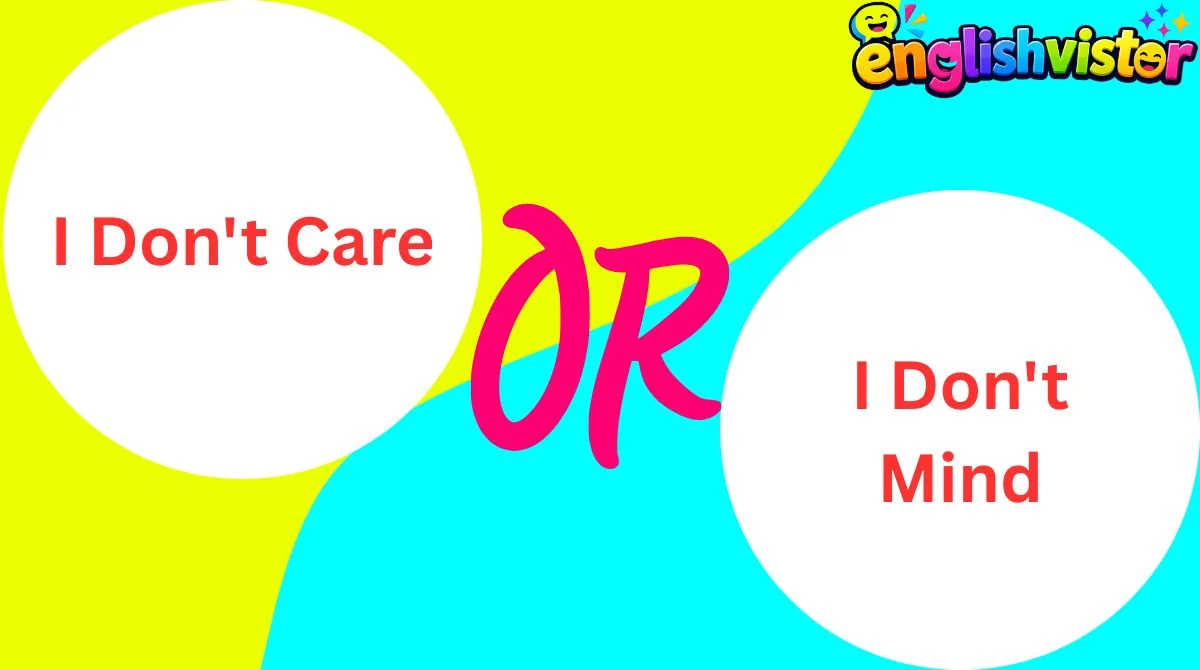
“I don’t care” and “I don’t mind” can look almost identical to English learners. Both expressions can sometimes mean that something is not important to you. However, they do not always communicate the same feeling I Don’t Care or I Don’t Mind.
This small difference matters because your choice of words can change how your listener feels. If someone asks, “Do you want tea or coffee?” and you say, “I don’t mind,” you usually mean that either choice is fine. You are being relaxed and showing that you have no strong preference.I Don’t Care or I Don’t Mind.
But if you say, “I don’t care,” the sentence can sound much stronger. Depending on your voice and the situation, it may mean that the choice is completely unimportant to you. It can also sound cold, annoyed, or even rude.I Don’t Care or I Don’t Mind.
That is why learners often ask about I don’t care or I don’t mind. The grammar is not the only issue. The real question is about meaning, feeling, politeness, and context.I Don’t Care or I Don’t Mind.
Once you understand the difference, everyday conversations become much easier. You will know when to say “I don’t mind,” “I don’t care,” “I don’t mind if…,” and “I don’t care if…” without worrying about sounding impolite.I Don’t Care or I Don’t Mind.
What Does “I Don’t Care” Mean?
“I don’t care” means that something is not important to you, or that you have no interest, concern, or preference about it.I Don’t Care or I Don’t Mind.
The exact meaning depends heavily on context and tone.I Don’t Care or I Don’t Mind.I Don’t Care or I Don’t Mind.
For example:
“Which movie should we watch?”
“I don’t care.”
Here, the speaker may simply mean, “You can choose. Any movie is fine.”
However, the same words can sound rude in another situation:
“I worked hard on this project. Do you like it?”
“I don’t care.”
Here, the speaker sounds dismissive. The meaning is closer to “It is not important to me.”I Don’t Care or I Don’t Mind.
When Should You Use “I Don’t Care”?
You can use I don’t care when you genuinely have no concern about something. It is common in everyday spoken English.I Don’t Care or I Don’t Mind.
For example:
- I don’t care which restaurant we choose.
- I don’t care what time we leave.
- I don’t care about the price.
- I don’t care what people think.
- I don’t care if you come late.
- I don’t care who wins the game.
- I don’t care where we sit.
- I don’t care what we eat tonight.
The grammar pattern changes depending on what follows the expression.I Don’t Care or I Don’t Mind.
Common Grammar Patterns
You can say:
I don’t care + wh-word clause
- I don’t care what you choose.
- I don’t care where we go.
- I don’t care when we leave.
- I don’t care who comes.
You can also use:
I don’t care + about + noun
- I don’t care about money.
- I don’t care about his opinion.
Another common pattern is:
I don’t care + if/whether + clause
- I don’t care if you stay.
- I don’t care whether we go today or tomorrow.
The Important Feeling Behind “I Don’t Care”
The expression often suggests lack of concern or interest. It can be perfectly normal, but it can also sound harsh.I Don’t Care or I Don’t Mind.
Imagine your friend asks:
“Which shirt should I wear?”
You say:
“I don’t care.”
Your friend may think you are not interested in helping.I Don’t Care or I Don’t Mind.
A softer answer would be:
“I don’t mind. You can choose.”
This is one of the most important points when learning I don’t care or I don’t mind.I Don’t Care or I Don’t Mind.
What Does “I Don’t Mind” Mean?
“I don’t mind” usually means “I am okay with it” or “It is not a problem for me.”I Don’t Care or I Don’t Mind.
It often shows that you have no objection or no strong preference.I Don’t Care or I Don’t Mind.
For example:
“Would you like to sit inside or outside?”
“I don’t mind.”
This normally means:
“Either option is okay with me.”
That is different from simply saying that you have no interest.
When Should You Use “I Don’t Mind”?
Use I don’t mind when you want to say that something is acceptable to you.I Don’t Care or I Don’t Mind.
Examples:
- I don’t mind waiting for a few minutes.
- I don’t mind if you use my phone.
- I don’t mind which seat we take.
- I don’t mind walking home.
- I don’t mind helping you.I Don’t Care or I Don’t Mind.
- I don’t mind working late today.
- I don’t mind what we eat.
- I don’t mind if you bring your friend.
Notice something important: I don’t mind often has a friendly or neutral feeling.
Grammar After “I Don’t Mind”
A very common structure is:
I don’t mind + -ing
- I don’t mind waiting.
- I don’t mind helping.
- I don’t mind walking.
- I don’t mind sharing.
You can also use:
I don’t mind + if + clause
- I don’t mind if you come early.
- I don’t mind if she sits here.
You can use whether in appropriate situations:
- I don’t mind whether we go by bus or train.I Don’t Care or I Don’t Mind.
You can also use a noun:
- I don’t mind the noise.
- I don’t mind the rain.
Why “I Don’t Mind” Can Sound Polite
When someone offers you a choice, I don’t mind often tells them that they are free to decide.
For example:
“Do you want tea or coffee?”
You could say:
“I don’t mind. You choose.”
This sounds relaxed and cooperative.
So, when comparing I don’t care or I don’t mind, remember that I don’t mind often communicates acceptance, while I don’t care can communicate a lack of interest or concern.
Difference Between “I Don’t Care” and “I Don’t Mind”
The biggest difference is attitude.
I don’t care usually means:
“This is not important to me.”
I don’t mind usually means:
“This is okay with me.”
These meanings can overlap, but they are not always interchangeable.
| Expression | Basic meaning | Common feeling | Example |
|---|---|---|---|
| I don’t care | It is not important to me | Neutral to strong | I don’t care what he says. |
| I don’t mind | It is acceptable to me | Usually neutral/polite | I don’t mind what he says. |
1. Difference in Preference
Suppose someone asks:
“Do you want pizza or burgers?”
You say:
“I don’t mind.”
You mean either choice is acceptable.
If you say:
“I don’t care.”
You may also mean either choice is acceptable, but your answer can sound less warm.
This is why I don’t care or I don’t mind is not simply a grammar question. It is also a question of social meaning.
2. Difference in Interest
Consider:
“Do you care about football?”
You can answer:
“No, I don’t care about football.”
This means football does not interest or concern you.
But:
“I don’t mind football.”
usually means football is acceptable to you. You do not necessarily dislike it.
That is a meaningful difference.
3. Difference in Objection
I don’t mind is especially useful when someone asks whether an action is acceptable.
“Do you mind if I open the window?”
You can say:
“No, I don’t mind.”
That means:
“No problem. You can open it.”
I don’t care if you open the window has a different feeling. It may sound like:
“Your action is not important to me.”
It can sound much less friendly.
4. Difference in Tone
Tone is extremely important.
“I don’t care” said gently can be harmless:
“I don’t care which color you choose. They both look nice.”
But said sharply:
“I don’t care!”
can clearly show anger, frustration, or dismissal.
“I don’t mind” is generally safer when you want to sound polite.
Grammar Rules You Must Remember
Rule 1: Use “I don’t mind” for something acceptable
When you are happy with either option, I don’t mind is often the best choice.
“Window seat or aisle seat?”
“I don’t mind.”
You are saying that both options are okay.
Rule 2: Use “I don’t mind + -ing”
After mind, a gerund is very common.
Correct:
I don’t mind waiting.
Not:
I don’t mind to wait.
More examples:
- I don’t mind helping.
- I don’t mind staying.
- I don’t mind sharing.
This is an important grammar rule for learners.
Rule 3: “I don’t care about” takes a noun or noun phrase
Use about before a noun when talking about a subject or thing.
I don’t care about money.
I don’t care about his opinion.
I don’t care about the result.
Do not automatically put about before every sentence containing care. With clauses, other structures are possible:
I don’t care what he thinks.
Rule 4: Both expressions can be followed by clauses
You can say:
I don’t care what happens.
You can also say:
I don’t mind what happens.
But the feeling is different.
The first can show lack of concern. The second can show that the situation is acceptable.
Rule 5: Be careful with “Do you care?” and “Do you mind?”
These questions are not the same.
Do you care? asks whether something is important to someone.
Do you care about this problem?
Do you mind? asks whether something causes a problem or objection.
Do you mind if I sit here?
Understanding this difference makes I don’t care or I don’t mind much easier.
Common Mistakes Students Make
Mistake 1: Thinking the two expressions are always identical
Many learners think:
I don’t care = I don’t mind.
Sometimes they can communicate a similar result, especially when choosing between two things. But the emotional meaning can be different.
Compare:
“Where should we eat?”
“I don’t mind.”
This sounds cooperative.
“Where should we eat?”
“I don’t care.”
This may sound impatient, depending on your voice.
Mistake 2: Using “I don’t care” when trying to be polite
Imagine your teacher asks:
“Would you like to work with Ali or Ahmed?”
If you say:
“I don’t care.”
The teacher may hear it as rude.
A better answer is:
“I don’t mind. Either one is fine.”
Mistake 3: Saying “I don’t mind to do”
This is a common grammar error.
Incorrect:
I don’t mind to help you.
Correct:
I don’t mind helping you.
After mind, use the -ing form in this common structure.
Mistake 4: Thinking “I don’t mind” means “I dislike it”
It does not.
If someone says:
“I don’t mind the rain.”
They normally mean:
“The rain is not a problem for me.”
They are not necessarily saying they dislike rain.
Mistake 5: Ignoring tone
English meaning is not always found only in dictionary definitions.
For example:
“I don’t care.”
The same words can sound calm, sad, angry, or dismissive depending on voice, facial expression, and situation.
That is why learners should practice the expressions in complete conversations.
Easy Trick to Remember the Difference
Here is a simple classroom trick.
Think about CARE = importance.
If you care, something matters to you.
So:
I don’t care = It does not matter to me.
Now think about MIND = objection/problem.
If you mind something, it bothers you or you object to it.
So:
I don’t mind = It does not bother me. It is okay.
This little trick makes the difference much easier.
Imagine your friend asks:
“Can I sit here?”
You say:
“I don’t mind.”
You are giving permission or saying that it is not a problem.
Now imagine someone asks:
“Do you care what other people think?”
You say:
“I don’t care.”
You mean their opinions are not important to you.
So remember:
CARE → importance
MIND → objection
That is the easiest way to understand I don’t care or I don’t mind.
Daily Life Examples
Real Conversations You Can Use
Here are natural examples from everyday English.
Example 1: Choosing Food
Sam: What should we have for dinner?
Tom: I don’t mind. You choose.
Sam: Okay, let’s order pizza.
Here, I don’t mind sounds friendly and flexible.
Example 2: Choosing a Movie
Anna: Do you want to watch a comedy or an action movie?
Mike: I don’t care. Pick one.
Anna: Okay, comedy it is.
Here, I don’t care means Mike has no strong preference.
Example 3: Asking Permission
Ali: Do you mind if I use your laptop?
John: No, I don’t mind.
Ali: Thanks!
This is a very common conversational pattern.
Example 4: Other People’s Opinions
I don’t care what people say. I know I did my best.
Here, the speaker means other people’s opinions are not important to them.
Example 5: Waiting
I don’t mind waiting for you.
This means waiting is not a problem.
Example 6: A Choice
“Do you want the blue one or the black one?”
“I don’t mind. Both are nice.”
This is a natural use of I don’t mind.
Example 7: A Strong Opinion
“What does he think about your decision?”
“I don’t care what he thinks.”
Here, the speaker is clearly saying that the person’s opinion does not matter to them.
Example 8: A Small Problem
“Sorry, I’m five minutes late.”
“I don’t mind.”
This means the delay is not a problem.
Example 9: An Unimportant Detail
I don’t care what color the walls are.
The speaker does not consider the color important.
Example 10: A Flexible Plan
“Should we leave at six or seven?”
“I don’t mind. Either time works for me.”
This is a polite and natural response.
These conversations show why I don’t care or I don’t mind should be learned through situations, not just word-for-word translation.
Practice Section
Choose the Correct Option
Choose I don’t care or I don’t mind.
1. “Can I open the door?”
“Sure, ______.”
2. “Do you want tea or coffee?”
“_______. You can choose.”
3. “Do you care what strangers think about you?”
“No, ______.”
4. “Can you wait for ten minutes?”
“Sure, ______.”
5. “Does his opinion matter to you?”
“No, ______ what he thinks.”
Answers
1. I don’t mind.
The person is saying that opening the door is not a problem.
2. I don’t mind.
Either drink is acceptable.
3. I don’t care.
The speaker is saying that strangers’ opinions are not important.
4. I don’t mind.
Waiting is acceptable.
5. I don’t care.
The speaker says the other person’s opinion does not matter.
A useful habit is to ask yourself: “Am I saying something is okay, or am I saying it is unimportant?” If you mean “okay,” I don’t mind is often the better choice. If you mean “unimportant,” I don’t care is usually more suitable.
FAQs
What is the difference between “I don’t care” and “I don’t mind”?
I don’t care usually means something is not important to you or you have no concern about it. I don’t mind usually means something is acceptable and does not bother you. They can overlap, but I don’t mind often sounds more polite.
Can we use “I don’t care” in questions?
Yes, but the question usually uses Do you care…?
For example:
“Do you care what people think?”
This asks whether someone’s opinion is important to you. You can answer, “No, I don’t care.”
Is “I don’t care” rude?
Not always. The meaning depends on the situation and your tone. However, I don’t care can sound rude or dismissive when used as a short answer. If you want to sound softer, try “I don’t mind,” “Either is fine,” or “You can choose.”
Is “I don’t mind” polite?
Yes. I don’t mind is commonly used to show that something is not a problem. For example, “I don’t mind if you sit here” sounds like you are comfortable with the person’s action.
Can “I don’t mind” mean “I don’t care”?
Sometimes the two expressions can lead to a similar practical answer, especially when choosing between options. However, the feelings are different. I don’t mind usually focuses on acceptance, while I don’t care often focuses on lack of importance or interest.
Should I say “I don’t mind to wait” or “I don’t mind waiting”?
The natural grammar is “I don’t mind waiting.” After mind, use the -ing form in this structure. For example, say “I don’t mind helping you,” not “I don’t mind to help you.”
Conclusion
Understanding I don’t care or I don’t mind is more than memorizing two dictionary definitions. The important difference is the feeling behind the words.
I don’t care usually means that something is not important to you, or you are not concerned about it. Depending on your tone, it can sound neutral, strong, or even rude.
I don’t mind usually means that something is okay with you. It is especially useful when someone asks for permission or gives you a choice. It often sounds softer and more polite.
Remember the simple trick: care is about importance, while mind is about objection. If something does not matter to you, you can say I don’t care. If something does not bother you, I don’t mind is often the better choice.
The best way to learn the difference is to use these expressions in real conversations. Pay attention not only to grammar, but also to tone and situation. With a little practice, choosing between I don’t care or I don’t mind will become natural.

Hi, I’m Isabella Foster, an English language writer passionate about making grammar, vocabulary, and communication skills easy to understand. At EnglishVistor, I create clear, practical, and engaging learning resources to help learners improve their English with confidence.