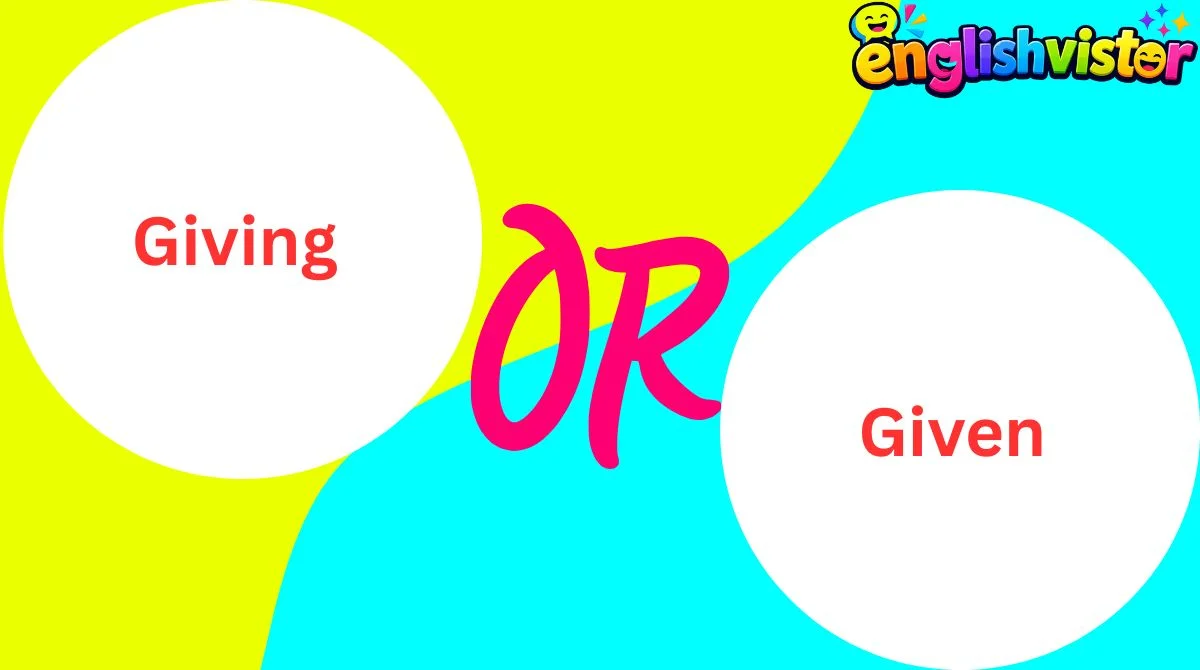
Giving or given can be confusing because both words come from the same verb: give. They look similar, but they do not always work in the same way. A small change from giving to given can change the grammar and meaning of a sentence Giving or Given.
For example, we say, “She is giving me a gift.” Here, the action is happening now. But we say, “She has given me a gift.” In this sentence, the action has already happened.
Many English learners also become confused when they see given before a noun, after has/have/had, or in phrases such as “given the situation.” At the same time, giving is commonly used after forms of be, such as am, is, are, was, and were.Giving or Given.
Understanding giving or given is useful because both forms appear frequently in everyday English, school writing, workplace communication, conversations, and online messages.Giving or Given.
The easiest way to understand giving or given is to look at the job each word performs in a sentence. Once you know whether you are talking about an action in progress, a completed action, or a condition, choosing the correct form becomes much easier.
What Does “Giving” Mean?
Giving is the -ing form of the verb give. It can be used as a present participle, and it can also work as a gerund in some sentences.Giving or Given.
The basic verb is:
give → giving
We normally use giving when the action of giving is happening at a particular time or when we are talking about giving as an activity.Giving or Given.
Giving With “Be”
One of the most common patterns is:
am/is/are/was/were + giving
Examples:
- I am giving my brother some money.
- She is giving her teacher a thank-you card.
- They are giving free samples today.
- He was giving me useful advice.
- We were giving food to the children.
- The company is giving employees more time.
- You are giving me a great idea.Giving or Given.
- The teacher was giving instructions to the students.
In these sentences, giving describes an action that is happening or was happening.
Giving as an Activity
Giving can also act like a noun.
For example:
- Giving is better than receiving.
- Giving to others can make people happy.
- Giving your time is often more valuable than giving money.
Here, giving is not simply showing an action happening at this moment. It refers to the activity or idea of giving.
Giving After a Preposition
We can also use giving after a preposition in certain structures.
For example:
- She thanked me for giving her a chance.
- He apologized for giving the wrong answer.Giving or Given.
- They are interested in giving students more opportunities.
The important point is that giving often focuses on the action itself.
Common Confusion With Giving
A common mistake is to use giving after has, have, or had.
Incorrect:
She has giving me a book.Giving or Given.
Correct:
She has given me a book.
After has, have, or had, we normally need the past participle given, not giving.Giving or Given.
Another common mistake is using given when an action is happening right now.
Incorrect:
She is given me a present.
Correct:
She is giving me a present.
So, when you see is/am/are + ___, and you mean an action happening now, giving is usually the correct choice.Giving or Given.
What Does “Given” Mean?
Given is the past participle of give.
The three main forms are:
| Base Form | Past Form | Past Participle |
|---|---|---|
| give | gave | given |
So:
give → gave → given
The word given has several important uses in English.Giving or Given.
Given With Has, Have, or Had
The most common structure is:
has/have/had + given
Examples:
- She has given me good advice.
- I have given him the information.
- They have given us enough time.
- He had given the money to his sister.
- We have given the students extra work.
- The manager has given me permission.
- You have given me a reason to try.Giving or Given.
- The doctor had given him some useful advice.
In each sentence, given is the past participle.
Given in the Passive Voice
Given is also used in passive sentences.
For example:
- The students were given extra time.
- I was given a second chance.
- She was given a prize.
- They were given clear instructions.
Notice the difference:
Active:
The teacher gave the students extra time.Giving or Given.
Passive:
The students were given extra time.
The passive sentence focuses on the people who received something rather than the person who gave it.Giving or Given.
Given Meaning “Considering”
Sometimes given is used to mean considering or taking something into account.Giving or Given.
Examples:
- Given the weather, we decided to stay home.
- Given his experience, he should get the job.
- Given the circumstances, your decision was reasonable.
- Given the amount of work, the deadline is difficult.
Here, given does not mean someone physically handed something to someone. It introduces a fact or condition that should be considered.
Common Confusion With Given
Learners sometimes use gave when they need given after has, have, or had.
Incorrect:
I have gave him the book.
Correct:
I have given him the book.
Why? Because have + past participle is the present perfect structure.
We say:
have given
not:
have gave
The same rule applies to has and had.
Difference Between Giving and Given
The main difference between giving or given is grammatical form and the time or role expressed by the word.
| Feature | Giving | Given |
|---|---|---|
| Basic verb | Give | Give |
| Form | -ing form | Past participle |
| Common pattern | am/is/are + giving | has/have/had + given |
| Main idea | Action in progress/activity | Completed action or passive meaning |
| Example | She is giving me a gift. | She has given me a gift. |
| Passive use | Not normally used this way | Very common |
| Special meaning | Giving as an activity | Given = considering a fact |
Giving Shows an Ongoing Action
Look at this sentence:
Tom is giving Mary a present.
The action is happening now or around the present time.
The structure is:
Subject + be + giving + object
For example:
My father is giving me some advice.
The act of giving is in progress.
Given Shows a Completed Action
Now compare it with:
Tom has given Mary a present.
The action has already happened, and the sentence uses the present perfect.
The structure is:
Subject + has/have + given + object
For example:
My father has given me some advice.
The advice has already been given.
Giving vs. Given in a Simple Comparison
Think about these two sentences:
She is giving me a book.
She has given me a book.
The first sentence presents the action as happening now.
The second presents the action as completed.
This simple difference solves many questions about giving or given.
Grammar Logic
English verbs often change form depending on the grammar around them.
The verb give is irregular:
give → gave → given
The -ing form is:
giving
So you should not choose a form simply because it sounds familiar. Look at the words before the verb.
If you see:
is/am/are/was/were → giving
If you see:
has/have/had → given
This is a very useful shortcut, although the exact sentence structure still matters.
Grammar Rules You Must Remember
1. Use “Giving” After Forms of “Be” for Continuous Actions
When an action is happening at a particular time, use:
am/is/are/was/were + giving
Examples:
She is giving a speech.
They are giving away free food.
He was giving me directions.
Do not say:
She is given a speech.
if you mean that she is performing the action.
2. Use “Given” After Has, Have, and Had
For perfect tenses, use given.
Examples:
I have given him the answer.
She has given me permission.
They had given us enough information.
Avoid:
I have giving him the answer.
and:
She has gave me permission.
The correct form is given.
3. Use “Given” in Passive Sentences
The past participle given commonly appears in passive constructions.
Examples:
He was given a warning.
We were given two hours.
She was given a chance.
The receiver becomes the focus of the sentence.
4. “Given” Can Introduce a Condition
When given means considering, it often appears at the beginning of a sentence.
Examples:
Given the situation, we should wait.
Given his age, he runs very well.
Given the cost, I decided not to buy it.
This use is slightly more formal than ordinary conversation, but it is very common in writing.
5. “Giving” Can Be a Noun-Like Form
When giving refers to an activity, it can function as a gerund.
Examples:
Giving is an important part of friendship.
Giving people your time can make a difference.
Giving without expecting anything back can feel rewarding.
Here, giving names an activity.
6. Do Not Confuse “Gave” and “Given”
This is especially important.
Gave is the simple past:
She gave me a book yesterday.
Given is the past participle:
She has given me a book.
So:
Yesterday, she gave me a book.
but:
She has given me a book.
Common Mistakes Students Make
Mistake 1: “Has Giving”
Incorrect:
He has giving me a present.
Correct:
He has given me a present.
The word has requires the past participle in the present perfect structure.
Mistake 2: “Is Given” When You Mean “Is Giving”
Incorrect:
Sarah is given her friend a gift.
Correct:
Sarah is giving her friend a gift.
Is giving means Sarah is performing the action.
However, is given can be correct in a passive sentence:
Sarah is given a gift every year.
Here, Sarah receives the gift. She does not perform the giving.
That difference is extremely important.
Mistake 3: “Have Gave”
Incorrect:
They have gave me permission.
Correct:
They have given me permission.
Remember:
gave = past
given = past participle
Mistake 4: Using “Giving” After “Had”
Incorrect:
She had giving him the money.
Correct:
She had given him the money.
The past perfect uses:
had + past participle
Therefore:
had given
Mistake 5: Thinking “Given” Always Means “Already Gave”
Although given often refers to a completed action, it can also be used in passive structures and expressions such as given the situation.
For example:
Given the traffic, we left early.
This does not mean somebody gave traffic to us. It means considering the traffic.
Easy Trick to Remember the Difference
Here is a simple classroom trick for remembering giving or given.
Think about the helper verb.
See “is/am/are/was/were”?
Think:
ACTION HAPPENING → GIVING
She is giving me advice.
See “has/have/had”?
Think:
ACTION COMPLETED → GIVEN
She has given me advice.
This trick works in many everyday sentences.
You can also remember the three forms:
GIVE → GAVE → GIVEN
And separately:
GIVE → GIVING
Try saying them aloud:
Give, gave, given, giving.
If you remember the verb family, choosing between giving or given becomes much easier.
Another useful trick is to ask yourself:
“Is the person doing the giving now?”
If yes, giving may be needed.
“Has the person already given something?”
If yes, given may be needed.
Of course, always check the complete grammar structure rather than relying only on meaning.
Daily Life Examples
1. At Home
Mom is giving my little brother some medicine.
The action is happening now.
2. At School
The teacher has given us a difficult assignment.
The assignment has already been given.
3. At Work
My manager is giving me new instructions.
The manager is giving the instructions now.
4. Talking About the Past
She had given me the keys before she left.
The giving happened before another past event.
5. Receiving a Gift
I was given a beautiful birthday card.
This is passive. I received the card.
6. Talking About Advice
My father has given me good advice.
The advice has already been given.
7. Helping Someone
We are giving the new students some help.
The helping action is happening now.
8. Considering a Situation
Given the weather, we should cancel the picnic.
Here, given means considering the weather.
9. In a Conversation
“Why are you giving him your phone?”
“He needs to make an important call.”
Here, giving describes an action happening now.
10. Talking About Experience
She has given several speeches at our school.
The speeches have already happened.
Practice Section
Choose the Correct Word: Giving or Given
Choose giving or given in each sentence.
1. She is ________ me some useful advice.
2. He has ________ his brother a new phone.
3. They are ________ free food to visitors.
4. We have ________ the students enough time.
5. I was ________ a second chance.
Answers
1. giving
She is giving me some useful advice.
The structure is is + giving.
2. given
He has given his brother a new phone.
The structure is has + given.
3. giving
They are giving free food to visitors.
The structure is are + giving.
4. given
We have given the students enough time.
The structure is have + given.
5. given
I was given a second chance.
This is a passive construction.
FAQs
What is the difference between giving and given?
Giving is the -ing form of give, while given is the past participle. We commonly use giving with forms of be for ongoing actions, such as “She is giving.” We use given after has, have, and had, and in passive structures.
Can we use giving in questions?
Yes. Giving can be used in questions when the action is happening or being described as ongoing.
For example:
“Are you giving him the money?”
“Why is she giving away her old clothes?”
The grammar depends on the complete sentence.
Can we use given in questions?
Yes. Given can appear in questions, especially with perfect tenses or passive structures.
For example:
“Have you given him the message?”
“Was she given enough time?”
The helper verb tells you why given is correct.
Is giving formal or informal?
Giving is neither simply formal nor informal. It is a normal grammatical form used in everyday English.
You can use it in casual conversation, school writing, business communication, and many other situations.
Is given formal or informal?
Given is also used in both formal and informal English. Its use after has, have, and had is completely normal.
The expression given the circumstances can sound somewhat formal, but it is still common and natural.
Which is correct: “has given” or “has giving”?
The correct form is has given.
For example:
She has given me the book.
We use the past participle after has in the present perfect tense. Has giving is not correct in standard English.
Which is correct: “is giving” or “is given”?
Both can be correct, but they have different meanings.
She is giving me a book means she is handing the book to me.
She is given a book is passive and means someone gives a book to her.
More Examples to Make the Difference Clear
Sometimes seeing several pairs together makes the rule much easier.
Pair 1
John is giving Mary a gift.
John is doing the action now.
John has given Mary a gift.
The action has been completed.
Pair 2
The teacher is giving the students homework.
The teacher is doing the action.
The students have been given homework.
The students are receiving the homework.
Pair 3
They are giving us directions.
They are explaining the directions now.
They have given us directions.
They already explained the directions.
Pair 4
The company is giving workers more benefits.
The company is performing the action.
The workers have been given more benefits.
The workers are the receivers.
Pair 5
She is giving her friend a chance.
The action is happening now.
She has given her friend a chance.
The action has already happened.
Giving or Given: A Quick Grammar Chart
When you are unsure about giving or given, look at the grammar around the word.
Use “giving” in patterns such as:
- I am giving.
- She is giving.
- They are giving.
- He was giving.
- We were giving.
Use “given” in patterns such as:
- I have given.
- She has given.
- They have given.
- He had given.
- We had given.
- She was given.
- They were given.
There are other grammatical uses, but these patterns cover many common situations.
Why “Giving or Given” Causes So Much Confusion
The problem is that both forms come from the same verb.
English learners often learn:
give — gave — given
but then they see:
giving
and wonder which form they should use.
The answer depends on the grammar structure, not just the basic meaning.
For example:
I am giving him money.
The helper verb am is followed by the -ing form.
But:
I have given him money.
The helper verb have is followed by the past participle.
And:
I gave him money yesterday.
The simple past uses gave.
These three sentences describe related actions, but the verb forms are different because the grammar is different.
A Simple Classroom Test
When students ask about giving or given, a useful classroom test is to remove the confusing word and look at what comes before it.
Example:
She is ________ me a present.
The word before the blank is is.
For an ongoing action, use the -ing form:
She is giving me a present.
Now try:
She has ________ me a present.
The word before the blank is has.
Use the past participle:
She has given me a present.
This method is simple, quick, and useful when writing or speaking.
Giving or Given in Everyday English
Native speakers use both forms naturally throughout the day.
You might hear:
“What are you giving him for his birthday?”
“I’ve already given him his gift.”
Or:
“Why are you giving me that look?”
“You have given me a lot to think about.”
These examples show why context matters.
The words around giving or given usually provide the clue you need.
Final Tips for English Learners
Do not try to memorize every possible sentence separately. Learn the basic verb forms and the structures that control them.
Remember:
Give = base form
I give him advice.
Gave = simple past
I gave him advice yesterday.
Given = past participle
I have given him advice.
Giving = -ing form
I am giving him advice.
Once these four forms become familiar, questions about giving or given become much easier.
Also pay attention to passive sentences:
I was given a chance.
Here, given is correct even though the action is not presented as something I performed.
Finally, remember that given can have another meaning:
Given the situation, we should wait.
In this expression, it means considering the situation.
Conclusion
Choosing between giving or given becomes much easier when you stop looking only at the words themselves and start looking at the grammar around them.
Giving is the -ing form of give. It is commonly used with am, is, are, was, and were when an action is ongoing, such as “She is giving me a book.”
Given is the past participle. It is commonly used after has, have, and had, as in “She has given me a book.” It is also widely used in passive sentences, such as “I was given a chance.”
Remember the basic family:
give → gave → given → giving
When you see is/am/are and need an ongoing action, think of giving. When you see has/have/had, think of given. Then check the full sentence to make sure the meaning is correct.
With a little practice, giving or given will stop feeling confusing. Try making your own sentences, read them aloud, and compare the grammar patterns. That small habit can make your English much more natural and accurate.

Hi, I’m Isabella Foster, an English language writer passionate about making grammar, vocabulary, and communication skills easy to understand. At EnglishVistor, I create clear, practical, and engaging learning resources to help learners improve their English with confidence.