Many English learners feel confused when they see the words experienced and seasoned. At first, they seem to mean the same thing. Both words describe someone who has done something for a long time and has learned valuable skills.
Because of this, many students think they can use these words in exactly the same way.Experienced vs Seasoned.
The truth is a little different. While both words are related to knowledge, skill, and practice, they are not always interchangeable.
One word is more common in everyday English, while the other often adds a special meaning. Choosing the right word can make your English sound more natural and accurate.Experienced vs Seasoned.
Imagine two people who have worked as teachers for many years. One person has ten years of teaching experience. The other has taught for thirty years, solved many classroom problems, and guided new teachers.
Would you describe both people in the same way? Not always. This is where understanding the difference becomes important.
Learning the correct meaning of experienced and seasoned will help you speak with more confidence. It will also improve your writing, job applications, conversations, and exam answers.
Native English speakers often notice the small differences between similar words, and using the right one can make your English sound smoother.
By the end of this guide, you will clearly understand when to use experienced, when to use seasoned, the grammar rules behind both words, and how to avoid the mistakes that many English learners make.Experienced vs Seasoned.
What Does “Experienced” Mean?
Simple Definition
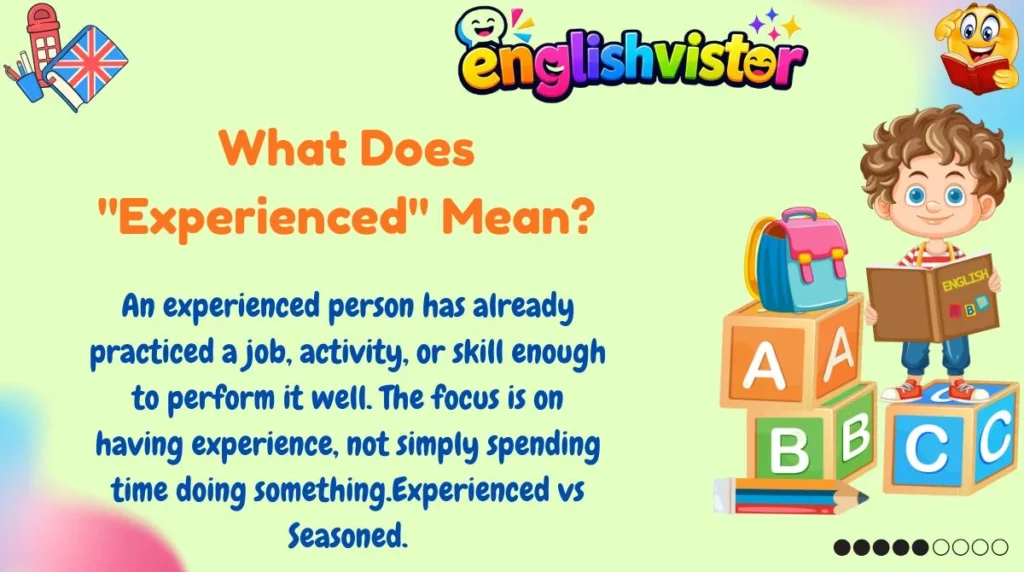
The word experienced describes a person who has gained knowledge or skill by doing something over time.
An experienced person has already practiced a job, activity, or skill enough to perform it well. The focus is on having experience, not simply spending time doing something.Experienced vs Seasoned.
Simple Meaning
Experienced = Having enough practice and knowledge because you have done something before.Experienced vs Seasoned.
For example:
- An experienced teacher knows how to explain difficult lessons.
- An experienced driver stays calm in heavy traffic.
The word tells us that someone has learned through real-life practice.Experienced vs Seasoned.
When to Use “Experienced”
Use experienced when talking about someone who has developed skill through work, study, training, or repeated practice.
It is commonly used with:
- Jobs
- Professions
- Sports
- Education
- Business
- Daily skills
- Hobbies
Examples include:
- an experienced nurse
- an experienced chef
- an experienced writer
- an experienced traveler
- an experienced engineer
- an experienced pilot
This is the most common word in everyday English for describing someone with skill.Experienced vs Seasoned.
Grammar Rule for “Experienced”
Experienced is usually an adjective.
Structure 1
Subject + be verb + experienced
Examples:
- She is experienced.
- They are experienced.
- Our coach is experienced.Experienced vs Seasoned.
Structure 2
Experienced + noun
Examples:
- an experienced doctor
- an experienced designer
- an experienced player
- an experienced manager
Structure 3
Experienced in + noun/gerund
Examples:
- She is experienced in marketing.Experienced vs Seasoned.
- He is experienced in solving technical problems.
- They are experienced in teaching young children.
Notice that we usually say experienced in, not experienced at when talking about professional knowledge or a field of work.
Correct:
- She is experienced in customer service.Experienced vs Seasoned.
Less common:
- She is experienced at customer service.
How “Experienced” Sounds
The word experienced sounds neutral.
It does not tell us exactly how much experience someone has. It simply tells us that the person has enough knowledge or skill.
Someone with five years of work experience can be experienced.
Someone with twenty years of work experience can also be experienced.Experienced vs Seasoned.
The word leaves the exact amount open.
Examples of “Experienced”
Here are several examples to show how naturally the word is used.
- The company hired an experienced accountant to manage its finances.
- My grandfather is an experienced farmer who knows every season of the year.
- We need an experienced guide for the mountain trip.
- Sarah is experienced in dealing with difficult customers.Experienced vs Seasoned.
- An experienced cook can prepare delicious meals without following every recipe.
- The school is looking for experienced science teachers.
- He became an experienced speaker after giving hundreds of presentations.
- Even experienced swimmers should be careful in rough water.Experienced vs Seasoned.
These examples show that the word works well for many different situations.
Common Expressions with “Experienced”
English speakers often use experienced in common phrases.Experienced vs Seasoned.
Some examples include:
- highly experienced employee
- experienced professional
- experienced worker
- experienced lawyer
- experienced teacher
- experienced nurse
- experienced leader
- experienced traveler
- experienced technician
- experienced team
These combinations are very common in newspapers, business writing, and everyday conversation.
For example:
- We need a highly experienced engineer for this project.
- She is one of the most experienced doctors in the hospital.
- Our experienced staff can answer all your questions.Experienced vs Seasoned.
Common Learner Confusion About “Experienced”
Many learners believe experienced simply means old.
That is not true.
A young person can be experienced if they have practiced a skill for many years.Experienced vs Seasoned.
For example:
A 28-year-old software developer who has worked since college may be an experienced programmer.
On the other hand, an older person is not automatically experienced in every field.
Age and experience are different ideas.
Another common mistake is using experienced for every situation involving skill.
Sometimes English speakers choose seasoned, skilled, qualified, trained, or expert because each word has a slightly different meaning.
Knowing these differences helps your English sound more natural.Experienced vs Seasoned.
Is “Experienced” Formal or Informal?
One reason experienced is so popular is that it fits almost every situation.Experienced vs Seasoned.
You can use it in:
- Everyday conversations
- School writing
- Business emails
- Job applications
- News articles
- Academic writing
For example:
Conversation
“I want an experienced mechanic to repair my car.”
Job Advertisement
“We are looking for an experienced sales manager.”
Business Meeting
“Our experienced team will complete the project on time.”
Because it works well in both formal and informal English, experienced is often the safest choice when you are unsure which word to use.Experienced vs Seasoned.
What Does “Seasoned” Mean?
Simple Definition
The word seasoned describes a person who has many years of experience and has become especially skilled, wise, and confident because of it.Experienced vs Seasoned.
While experienced simply means someone has gained knowledge through practice, seasoned often suggests long experience combined with maturity and good judgment.
Simple Meaning
Seasoned = Very experienced because of many years of practice and real-life learning.
Think of someone who has faced many challenges, solved many problems, and learned valuable lessons over time. That person can be called seasoned.Experienced vs Seasoned.
Why Is the Word “Seasoned” Used?
The word originally came from the idea of something becoming better over time.
Just as wood becomes stronger after proper seasoning or food develops richer flavor with seasoning, people become wiser and more capable after years of experience.
Today, English speakers use seasoned to describe people whose long experience has shaped their skills and judgment.
When to Use “Seasoned”
Use seasoned when you want to emphasize that someone has a long history of experience and has become calm, confident, and highly capable.Experienced vs Seasoned.
The word is often used for:
- leaders
- professionals
- business owners
- military officers
- politicians
- athletes
- journalists
- managers
- consultants
- travelers
It often carries a sense of respect.Experienced vs Seasoned.
Grammar Rule for “Seasoned”
Like experienced, seasoned is usually an adjective.Experienced vs Seasoned.
Structure 1
Subject + be verb + seasoned
Examples:
- She is seasoned.
- He is seasoned.
- They are seasoned professionals.
Structure 2
Seasoned + noun
Examples:
- seasoned lawyer
- seasoned journalist
- seasoned pilot
- seasoned traveler
- seasoned manager
- seasoned leader
Unlike experienced, we do not commonly say:
- seasoned in marketing ❌
- seasoned in teaching ❌
Instead, English speakers usually place seasoned directly before a noun.Experienced vs Seasoned.
Correct:
- a seasoned engineer
- a seasoned negotiator
- a seasoned business owner
This is the most natural pattern.
How “Seasoned” Sounds
Compared with experienced, seasoned sounds stronger.Experienced vs Seasoned.
It suggests:
- many years of practice
- confidence
- wisdom
- calm decision-making
- respect from others
A seasoned person has usually seen many different situations before.
For this reason, newspapers and business writing often use seasoned when describing respected professionals.
Examples of “Seasoned”
Here are several natural examples.Experienced vs Seasoned.
- The company hired a seasoned executive to lead the new project.
- She is a seasoned journalist who has reported from many countries.
- A seasoned traveler knows how to handle unexpected delays.
- The team depended on a seasoned captain during the difficult match.
- The conference invited several seasoned business leaders to speak.
- He is a seasoned lawyer with decades of courtroom experience.
- The young players learned a lot from the seasoned coach.
- Investors trusted the seasoned financial adviser during the market changes.
Notice that these examples often describe people with many years of practical experience and sound judgment, not just basic skill.
Common Expressions with “Seasoned”
English speakers often combine seasoned with nouns that describe respected professionals.Experienced vs Seasoned.
Some common examples include:
- seasoned professional
- seasoned leader
- seasoned executive
- seasoned journalist
- seasoned politician
- seasoned investor
- seasoned traveler
- seasoned manager
- seasoned coach
- seasoned negotiator
These phrases appear frequently in newspapers, magazines, books, and business communication because they express both experience and credibility.Experienced vs Seasoned.
For example:
- The company appointed a seasoned executive to guide its expansion.
- A seasoned investor knows that markets go up and down.
- Our team is led by seasoned professionals who understand the industry.
Common Learner Confusion About “Seasoned”
A common mistake is thinking that seasoned and experienced always mean exactly the same thing.Experienced vs Seasoned.
Although they are close in meaning, seasoned usually adds the idea of long-term experience, maturity, and proven judgment. It often sounds more complimentary and is used to highlight someone who has handled many real-world situations over the years.
Another source of confusion is the word seasoning in cooking. While seasoned can indeed mean that food has spices or flavor added, the meaning changes with the context. When describing people, seasoned refers to experience, not cooking.
Understanding this difference will help you choose the right word naturally in both speaking and writing.
Difference Between Experienced and Seasoned (Detailed Explanation)
The words experienced and seasoned are very close in meaning, but they are not exactly the same. Both describe people who have learned skills through time and practice. However, the feeling behind each word is different.Experienced vs Seasoned.
Experienced focuses on the fact that someone has gained knowledge or ability by doing something before.
Seasoned focuses on the idea that someone has gained deep knowledge, wisdom, confidence, and maturity after many years of experience.Experienced vs Seasoned.
A beginner English learner can remember it this way:
Experienced = Has done it before.
Seasoned = Has done it for a long time and has learned from many situations.
For example:
- An experienced teacher can teach a class well.Experienced vs Seasoned.
- A seasoned teacher can teach well, handle difficult students, solve unexpected problems, and guide other teachers.
Both sentences are correct, but the second one gives a stronger picture.Experienced vs Seasoned.
Comparison Table: Experienced vs Seasoned
| Point | Experienced | Seasoned |
|---|---|---|
| Basic meaning | Someone who has knowledge from practice | Someone with long experience and deep understanding |
| Main focus | Skill gained through doing something | Wisdom gained through many years and situations |
| Strength of meaning | General | Stronger and more impressive |
| Common use | Everyday English | Professional and formal situations |
| Time idea | Can be a short or long period | Usually suggests many years |
| Feeling | Neutral | Respectful and positive |
| Common examples | experienced worker, experienced driver | seasoned leader, seasoned expert |
| Grammar pattern | experienced in + activity | seasoned + noun |
Usage Difference Between Experienced and Seasoned
1. Experienced Is More General
The word experienced can describe anyone who has enough practice in something.
The person does not need to be extremely old or have decades of experience.Experienced vs Seasoned.
Examples:
- Maria is an experienced graphic designer.
This means Maria knows how to design well because she has practiced and worked in this field.
She may have three years, five years, or fifteen years of experience.Experienced vs Seasoned.
The sentence does not tell us the exact amount.Experienced vs Seasoned.
2. Seasoned Suggests Long-Term Experience
The word seasoned usually creates an image of someone who has spent many years in a field.Experienced vs Seasoned.
Examples:
- Maria is a seasoned graphic designer.
This sounds like Maria has worked for a long time, faced many challenges, and developed strong professional judgment.
A seasoned person is often someone others trust because of their past experiences.
Grammar Logic: How the Words Work
Both words are adjectives, but they follow slightly different patterns.
Experienced Grammar Pattern
Pattern 1:
Experienced + noun
Examples:
- an experienced doctor
- an experienced teacher
- an experienced employee
Pattern 2:
Be + experienced in + activity
Examples:
- He is experienced in web development.
- She is experienced in teaching children.
- They are experienced in customer service.
This pattern is very common.
Seasoned Grammar Pattern
Pattern:
Seasoned + noun
Examples:
- a seasoned professional
- a seasoned manager
- a seasoned traveler
The word is usually placed directly before the person or job title.
We normally do not use:
- He is seasoned in business. ❌
Instead:
- He is a seasoned businessman. ✅
Sentence Structure Difference
Look at these examples:
Experienced:
She is experienced in marketing.
Meaning:
She has knowledge and skill because she has worked in marketing before.
Seasoned:
She is a seasoned marketing professional.
Meaning:
She has spent many years in marketing and has developed strong knowledge and judgment.
Another example:
Experienced:
“The company hired an experienced driver.”
Meaning:
The driver knows how to drive safely.
Seasoned:
“The company hired a seasoned driver.”
Meaning:
The driver has many years of driving experience and has probably handled many different road conditions.
Meaning Comparison in Different Situations
Workplace
Experienced:
“An experienced employee can complete tasks correctly.”
This focuses on ability.
Seasoned:
“A seasoned employee can train others and solve complex workplace problems.”
This focuses on wisdom and leadership.
Sports
Experienced:
“She is an experienced tennis player.”
Meaning:
She has played tennis for some time and has developed skills.
Seasoned:
“She is a seasoned tennis player.”
Meaning:
She has years of competition experience and knows how to handle pressure.
Travel
Experienced:
“He is an experienced traveler.”
Meaning:
He has traveled before and knows basic travel skills.
Seasoned:
“He is a seasoned traveler.”
Meaning:
He has traveled widely, dealt with many situations, and knows how to manage unexpected problems.
Grammar Rules You Must Remember
1: Use “Experienced” for Skills Gained Through Practice
When you want to say someone has learned a skill by doing something, use experienced.
Examples:
- She is an experienced nurse.
- He is an experienced photographer.
- They are experienced teachers.
The focus is on ability and practice.
2: Use “Seasoned” When You Want to Show Deep Experience
Use seasoned when you want to highlight years of experience, maturity, and confidence.
Examples:
- The company hired a seasoned manager.
- The team needs a seasoned leader.
- He is a seasoned journalist.
The word often shows respect.
3: Use “Experienced in,” But Usually Use “Seasoned + Noun”
This is an important grammar difference.
Correct:
- She is experienced in accounting. ✅
- He is experienced in sales. ✅
Correct:
- She is a seasoned accountant. ✅
- He is a seasoned salesperson. ✅
Incorrect:
- She is seasoned in accounting. ❌
Incorrect:
- He is experienced accountant. ❌
Remember to use a/an before a singular job noun.
Correct:
- He is an experienced engineer. ✅
4: Do Not Use “Seasoned” for Beginners or Short Experience
Because seasoned suggests long experience, it does not usually describe someone who is new.
Incorrect:
- He is a seasoned employee after working for two months. ❌
Better:
- He is a new employee. ✅
- He is gaining experience. ✅
However, after many years, seasoned becomes appropriate.
Common Mistakes Students Make
1: Thinking Both Words Are Always Equal
Many learners replace one word with the other in every sentence.
Example:
- She is seasoned in teaching. ❌
Although people may understand the meaning, it does not sound natural.
Better:
- She is experienced in teaching. ✅
- She is a seasoned teacher. ✅
2: Using “Seasoned” for Any Skilled Person
A person can be skilled but not seasoned.
Example:
A talented 22-year-old programmer may be very skilled, but calling them a seasoned programmer may sound unusual if they do not have many years of experience.
Better choices:
- skilled programmer
- talented programmer
- experienced programmer
3: Forgetting the Article “A” or “An”
Learners often write:
- He is experienced teacher. ❌
The correct sentence:
- He is an experienced teacher. ✅
Because “teacher” is a singular countable noun.
The same applies to seasoned:
- She is seasoned manager. ❌
- She is a seasoned manager. ✅
4: Confusing “Seasoned” With Food
The word seasoned has two meanings.
Food meaning:
- The chicken is seasoned with herbs.
Person meaning:
- She is a seasoned professional.
The context tells you which meaning is correct.
5: Using “Experienced” When Talking About Wisdom
Sometimes learners want to praise someone’s long career but use only experienced.
Example:
“The company selected an experienced leader.”
This is correct, but it sounds neutral.
If you want to show strong respect:
“The company selected a seasoned leader.”
The second sentence suggests years of leadership and valuable judgment.
Easy Trick to Remember the Difference
Here is a simple memory trick:
Think About a Student and a Teacher
An experienced student has practiced many times.
A seasoned teacher has taught for many years and has learned from many classroom situations.
Remember:
Experience = Practice
Seasoned = Experience + Wisdom
Another easy way:
Ask yourself:
“Do I only mean someone has done this before?”
Use:
➡️ Experienced
Example:
- I need an experienced mechanic.
“Do I mean someone has years of knowledge and can handle difficult situations?”
Use:
➡️ Seasoned
Example:
- We need a seasoned mechanic to manage the repair team.
Daily Life Examples (Spoken English)
These examples show how native speakers use both words naturally.
1. At Work
A: We need someone to manage this project.
B: We should hire an experienced manager.
Meaning: Someone who knows how to manage projects.
2. Talking About a Leader
A: Who can handle this difficult situation?
B: A seasoned leader would know what to do.
Meaning: Someone with years of leadership experience.
3. Choosing a Doctor
“I want an experienced doctor because my problem is complicated.”
Meaning: A doctor with good medical practice.
4. Talking About a Professional
“She is a seasoned lawyer who has handled many important cases.”
Meaning: A lawyer with many years of experience.
5. Discussing Travel
“My brother is an experienced traveler. He knows how to plan trips.”
Meaning: He has traveled before and understands travel basics.
6. Talking About Cooking
“My mother is an experienced cook. She can make many dishes.”
Meaning: She has cooking skills.
7. Talking About a Coach
“The team hired a seasoned coach to prepare the players.”
Meaning: The coach has many years of coaching experience.
8. Talking About Technology
“We need an experienced programmer for this job.”
Meaning: Someone who knows programming well.
9. Talking About Business
“The company needs a seasoned entrepreneur who understands the market.”
Meaning: Someone with years of business knowledge.
10. Talking About Teaching
“Our school has many experienced teachers.”
Meaning: Teachers who have good teaching skills.
“The principal is a seasoned educator.”
Meaning: A teacher with many years of teaching wisdom and leadership.
Practice Section
Now that you understand the difference between experienced and seasoned, test your knowledge. Choose the correct word to complete each sentence.
Choose the Correct Option
1. The company is looking for a ______ manager who can handle difficult projects.
a) experienced
b) seasoned
2. My brother is an ______ driver because he has been driving for several years.
a) experienced
b) seasoned
3. The organization hired a ______ leader to guide the team during challenging times.
a) experienced
b) seasoned
4. She is ______ in digital marketing and content creation.
a) experienced
b) seasoned
5. The restaurant owner is a ______ chef who has worked in many famous kitchens.
a) experienced
b) seasoned
Answers
- seasoned
A manager who handles difficult projects usually needs years of experience and strong judgment. - experienced
The sentence focuses on driving skill gained through practice. - seasoned
A leader with many years of handling challenges is often called seasoned. - experienced
The correct structure is experienced in + activity. - seasoned
A chef with many years of professional work can be described as seasoned.
Frequently Asked Questions
1. What is the difference between experienced and seasoned?
Experienced means someone has gained knowledge or skill through practice. Seasoned means someone has many years of experience and has developed wisdom, confidence, and strong judgment. Seasoned is usually a stronger and more respectful description.
2. Can we use experienced and seasoned in the same sentence?
Yes, both words can describe a person, but they create slightly different meanings. For example, an experienced worker has skill from practice, while a seasoned worker suggests many years of work and deeper understanding.
3. Can we use experienced in questions?
Yes. Experienced can be used naturally in questions.
Examples:
- Is she an experienced teacher?
- Are you experienced in graphic design?
- Do you need an experienced mechanic?
It is commonly used in interviews and job-related conversations.
4. Is seasoned formal or informal?
Seasoned is slightly more formal and is common in professional writing, business conversations, and news reports. However, it can also be used in normal conversations when talking about someone’s long experience.
Example:
- He is a seasoned businessman.
This sounds professional and respectful.
5. Is every experienced person a seasoned person?
No. A person can be experienced without being seasoned.
For example, someone with a few years of work experience may be experienced, but the word seasoned usually suggests a longer period of experience and more life or professional wisdom.
6. Can we say “seasoned in” like “experienced in”?
Usually, no.
The phrase experienced in is common:
- She is experienced in teaching English.
But we normally say:
- She is a seasoned English teacher.
The natural pattern is seasoned + noun.
Conclusion
Understanding the difference between experienced and seasoned can make your English more natural and confident. These two words are similar, but they give different feelings.
Use experienced when you want to say that someone has gained skill or knowledge through practice. It is a common word that works in many situations, from everyday conversations to professional writing.
Use seasoned when you want to describe someone with many years of experience, strong judgment, confidence, and valuable lessons from real-life situations. It often shows respect and admiration.
A simple way to remember the difference is:
Experienced means someone knows how to do something because they have practiced it.
Seasoned means someone has practiced it for a long time and has gained wisdom along the way.
The best way to master these words is to notice how native speakers use them and practice making your own sentences. With regular practice, choosing between these similar words will become easy and natural.

Hi, I’m Isabella Foster, an English language writer passionate about making grammar, vocabulary, and communication skills easy to understand. At EnglishVistor, I create clear, practical, and engaging learning resources to help learners improve their English with confidence.