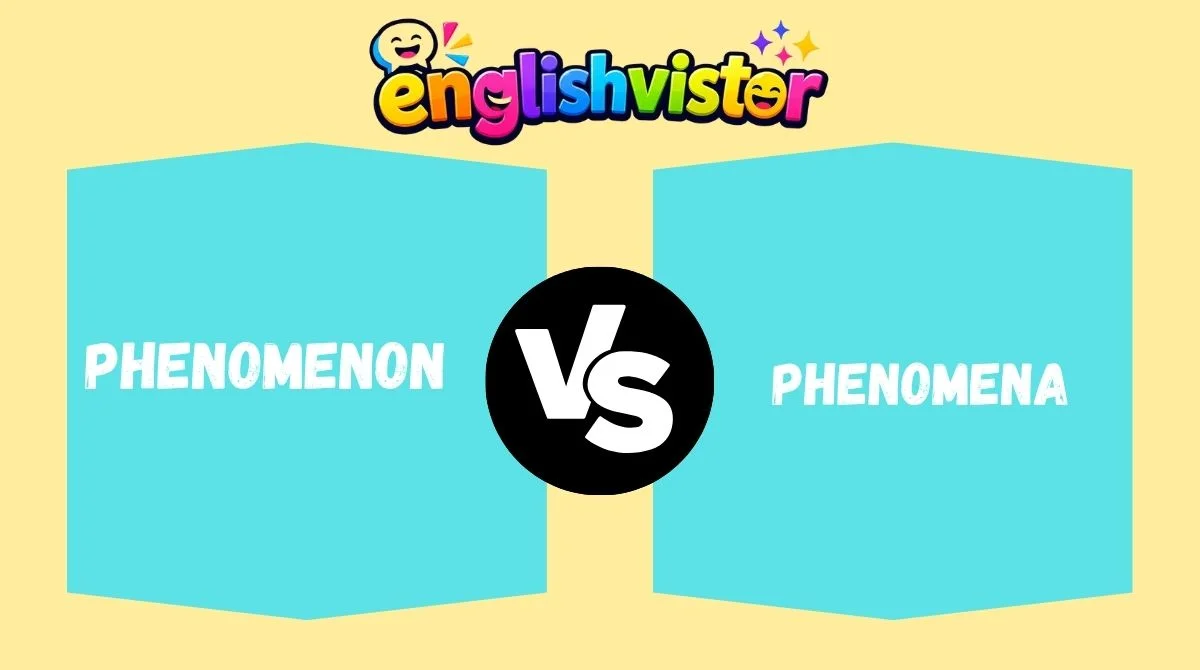
Many English learners feel confused when they see the words phenomenon and phenomena. They look almost the same, and both are connected to the same idea. The main difference is not meaning but grammar. One word is singular, and the other is plural Phenomenon vs Phenomena.
This small difference can create big mistakes in writing and speaking. Many students say “a phenomena” or use “phenomenon” when they are talking about more than one thing. These errors are common because these words come from Greek, not from regular English word patterns.Phenomenon vs Phenomena.
Understanding this pair is useful because these words appear often in news, science, education, business, and everyday conversations. You may hear people talking about a natural phenomenon, social phenomena, or unusual events happening around the world.
The good news is that the rule is simple once you understand it. Phenomenon means one unusual event or thing. Phenomena means more than one unusual event or thing.Phenomenon vs Phenomena.
After learning this difference, you will know how to choose the correct word, build correct sentences, avoid common grammar mistakes, and use these words confidently in both speaking and writing.Phenomenon vs Phenomena.
What Does “Phenomenon” Mean?
Phenomenon is a singular noun. It means an unusual, interesting, or noticeable event, situation, or fact that can be observed or studied.
When you talk about only one event or one thing, use phenomenon.Phenomenon vs Phenomena.
The word is often used in science, but it is also common in everyday English. It can describe something natural, social, cultural, or unusual.
For example, a rainbow is a natural phenomenon because it is a single natural event that people can observe. A sudden change in human behavior can also be called a phenomenon.Phenomenon vs Phenomena.
Grammar Rule for Phenomenon
Because phenomenon is singular, it usually works with:Phenomenon vs Phenomena.
- a
- an
- one
- this
- that
Examples:
- This phenomenon is difficult to explain.
- A strange phenomenon appeared in the sky.
- That phenomenon surprised scientists.
- One phenomenon changed the way people studied nature.
You should not use phenomenon with plural words like “many” or “several.”
Incorrect:
- Many phenomenon are happening today.
Correct:
- Many phenomena are happening today.
Examples of Phenomenon in Sentences
- The Northern Lights are a beautiful natural phenomenon.
- Scientists are studying this weather phenomenon.
- The growth of online learning is an interesting social phenomenon.
- A rare medical phenomenon attracted researchers.Phenomenon vs Phenomena.
- This phenomenon happens only in certain conditions.
- The teacher explained the phenomenon with a simple example.
- The sudden popularity of the app became a cultural phenomenon.
- Nobody could explain the unusual phenomenon.
Common Learner Confusion
Many learners think phenomenon means “many things” because they hear it used in discussions about large topics.
For example:
“Climate change is a global phenomenon.”
Some students think “global” means many, so they use “phenomena.” However, the sentence talks about one large event or situation. Therefore, phenomenon is correct.
Remember:
One event = phenomenon
What Does “Phenomena” Mean?
Phenomena is the plural form of phenomenon. It means two or more unusual events, situations, or things that can be observed or studied.
Use phenomena when you are talking about multiple examples.Phenomenon vs Phenomena.
The word follows an irregular plural pattern because it comes from Greek. It does not become plural by simply adding “s.”
Regular English examples:Phenomenon vs Phenomena.
- book → books
- idea → ideas
- problem → problems
But:
- phenomenon → phenomena
Grammar Rule for Phenomena
Because phenomena is plural, it works with:Phenomenon vs Phenomena.
- many
- several
- these
- those
- different
- various
Examples:
- These phenomena are difficult to understand.
- Many phenomena occur in nature.
- Scientists study different phenomena.
Do not use “a” before phenomena because “a” is only used with singular nouns.
Incorrect:
- A phenomena was discovered.
Correct:
- A phenomenon was discovered.
Correct:
- Several phenomena were discovered.
Examples of Phenomena in Sentences
- Scientists observe many natural phenomena every year.Phenomenon vs Phenomena.
- These phenomena affect people in different ways.
- The book explains unusual phenomena from around the world.
- Several social phenomena have changed modern society.
- Researchers are studying these phenomena carefully.
- Many strange phenomena remain unexplained.
- The internet has created new cultural phenomena.
- Different weather phenomena can be seen during storms.
Common Learner Confusion
The biggest mistake is treating phenomena like a singular word.
Incorrect:Phenomenon vs Phenomena.
- This phenomena is interesting.
Correct:
- This phenomenon is interesting.
Incorrect:
- Phenomena is difficult to explain.
Correct:
- Phenomena are difficult to explain.
The reason is simple:
Phenomena = more than one, so use plural grammar.Phenomenon vs Phenomena.
Difference Between Phenomenon and Phenomena
The main difference is the number of things being discussed.
Phenomenon talks about one unusual event.Phenomenon vs Phenomena.
Phenomena talks about two or more unusual events.
| Feature | Phenomenon | Phenomena |
|---|---|---|
| Number | Singular | Plural |
| Meaning | One unusual event or fact | Multiple unusual events or facts |
| Origin | Greek | Greek plural form |
| Uses | One thing | More than one thing |
| Example | A natural phenomenon | Natural phenomena |
| Common helpers | a, this, that, one | many, these, several, variousPhenomenon vs Phenomena. |
Usage Difference
Compare these sentences:
The eclipse is a natural phenomenon.
This means one event: the eclipse.
Solar eclipses are natural phenomena.
This means many events: different eclipses.
Another example:
The popularity of video games is a social phenomenon.
The sentence describes one broad situation.
The popularity of different online trends are social phenomena.
The sentence describes multiple trends.
Grammar Logic
English normally changes singular nouns into plural nouns by adding “s” or “es.”
Examples:
- car → cars
- class → classes
However, some words keep their original foreign forms.Phenomenon vs Phenomena.
Phenomenon belongs to this group:
- singular: phenomenon
- plural: phenomena
Similar examples:
- criterion → criteria
- analysis → analyses
- basis → bases
Learning these patterns helps you understand academic English better.Phenomenon vs Phenomena.
Sentence Structure Difference
Singular structure:
A/This/That + phenomenon + singular verb
Examples:
- This phenomenon is amazing.
- A phenomenon was discovered.
Plural structure:
These/Many/Several + phenomena + plural verb
Examples:
- These phenomena are amazing.
- Many phenomena were discovered.Phenomenon vs Phenomena.
Grammar Rules You Must Remember
Rule 1: Use Phenomenon for One Thing
When you mention only one event, use phenomenon.
Example:
- The invention of smartphones is a modern phenomenon.
The sentence describes one major development.
Rule 2: Use Phenomena for More Than One Thing
When you discuss several events or situations, use phenomena.Phenomenon vs Phenomena.
Example:
- Scientists study different natural phenomena.Phenomenon vs Phenomena.
The sentence refers to many types of events.
Rule 3: Match the Verb Correctly
A singular noun needs a singular verb.
Example:
- This phenomenon is rare.
A plural noun needs a plural verb.
Example:
- These phenomena are rare.
Rule 4: Do Not Add “s” to Make the Plural
The plural is already built into the word.
Incorrect:
- phenomenons
Correct:
- phenomena
Example:
- Researchers discovered several phenomena.
Common Mistakes Students Make
Mistake 1: Using Phenomena for One Thing
Incorrect:
- This phenomena is amazing.
Why is it wrong?
Because “this” usually points to one thing, but phenomena is plural.
Correct:
- This phenomenon is amazing.
Mistake 2: Using Phenomenon for Many Things
Incorrect:
- Many phenomenon happen in nature.
Why is it wrong?
Because “many” requires a plural noun.
Correct:
- Many phenomena happen in nature.
Mistake 3: Adding “s” to Phenomenon
Incorrect:
- Scientists study many phenomenons.
Correct:
- Scientists study many phenomena.
The plural form is already different.
Mistake 4: Forgetting Verb Agreement
Incorrect:
- These phenomena is unusual.
Correct:
- These phenomena are unusual.
A plural noun needs a plural verb.
Easy Correction Tips
Ask yourself one question:
Am I talking about one thing or more than one thing?
One:
- phenomenon
More than one:
- phenomena
Look at the words around it.
Words like:
- a
- this
- that
- one
usually show singular.
Words like:
- many
- these
- several
- different
usually show plural.
Easy Trick to Remember the Difference
Use this simple memory trick:
“Phenomenon has an ‘on’ ending for ONE.”
Think:
- Phenomenon = one phenomenon
“Phenomena has an ‘a’ ending for ALL or many.”
Think:
- Phenomena = many examples
Another easy method is to remember the pattern:
One → phenomenon
Two or more → phenomena
Just like:
One person → people
One child → children
One phenomenon → phenomena
The spelling changes because the word comes from another language.
Daily Life Examples

Here are simple examples you may hear in real conversations:
- “The sudden popularity of that song became a cultural phenomenon.”
- “The scientist explained a strange natural phenomenon.”
- “Many people are interested in weather phenomena.”
- “The teacher showed us different scientific phenomena.”
- “Online shopping is a modern phenomenon.”
- “Scientists are studying several environmental phenomena.”
- “This phenomenon happens only during certain seasons.”
- “These phenomena can affect human behavior.”
- “The growth of artificial intelligence is an important social phenomenon.”
- “Researchers are trying to understand new technological phenomena.”
Practice Section
Choose the correct word: phenomenon or phenomena.
- The strange lights were a rare ______.
- Scientists study many natural ______.
- This ______ is still not fully understood.
- Different cultural ______ exist around the world.
- The popularity of this website is a modern ______.
Answers
- phenomenon
- phenomena
- phenomenon
- phenomena
- phenomenon
FAQs
What is the difference between phenomenon and phenomena?
Phenomenon is the singular form, meaning one unusual event or situation. Phenomena is the plural form, meaning two or more unusual events or situations.
Can we use phenomenon in questions?
Yes. You can use phenomenon in questions when asking about one event.
Example:
“Is this phenomenon common?”
For multiple events, use phenomena:
“Why do these phenomena happen?”
Is phenomenon formal or informal?
Phenomenon is used in both formal and everyday English. It is common in science, education, news, and normal conversations.
Can we say “a phenomena”?
No. “A” is used with singular nouns, but phenomena is plural.
Correct:
- A phenomenon
Correct:
- Several phenomena
Why does phenomenon become phenomena?
The word comes from Greek. English has borrowed many words from other languages and sometimes keeps their original plural forms.
Is “phenomenons” correct?
No. The correct plural form is phenomena. Adding “s” creates an incorrect form.
Conclusion
Understanding the difference between phenomenon and phenomena becomes easy when you focus on one simple idea: number.
Use phenomenon when you are talking about one unusual event, fact, or situation. Use phenomena when you are talking about several unusual events, facts, or situations.
The most important thing is to check whether your sentence is singular or plural. Words like “a,” “this,” and “that” usually need phenomenon. Words like “many,” “these,” and “several” usually need phenomena.
These words may look difficult at first, but with regular practice, they become natural. Try using them in your own sentences, read examples, and pay attention when you see them in books or news stories.
Good grammar is built step by step. Learning small differences like this helps you become a clearer and more confident English speaker.

Hi, I’m Isabella Foster, an English language writer passionate about making grammar, vocabulary, and communication skills easy to understand. At EnglishVistor, I create clear, practical, and engaging learning resources to help learners improve their English with confidence.