Many English learners feel confused when they use words like everyone, someone, anyone, and nobody. The confusion usually comes from one simple question: should we use “is” or “are” after these words?
A common mistake is saying “everyone are” because the word “everyone” sounds like it talks about many people. After all, it includes many individuals. However, English grammar does not always follow everyday thinking. The word everyone has a special rule Everyone Is vs Everyone.
Knowing the difference between everyone is vs everyone are is important because these words appear often in daily conversations, emails, school writing, and professional communication.Everyone Is vs Everyone.
The good news is that the rule is quite simple. After reading this guide, you will understand why “everyone is” is usually correct, why “everyone are” is incorrect in standard English, and how to use similar words correctly.
You will also learn easy examples, common mistakes, memory tricks, and real-life sentences that will help you speak English with more confidence.
What Does “Everyone” Mean?
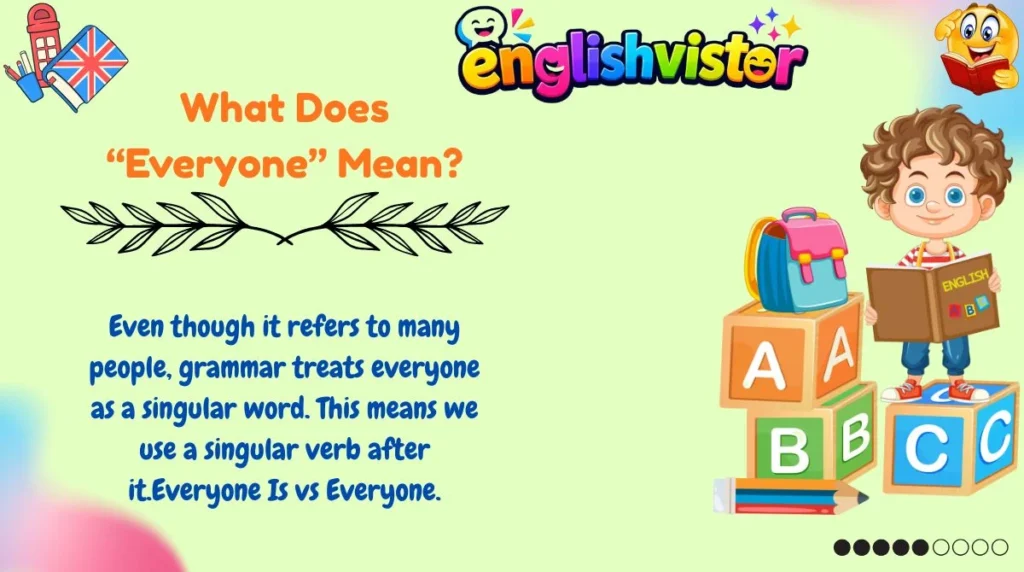
Everyone is an indefinite pronoun that means all people or every person in a group.Everyone Is vs Everyone.
Even though it refers to many people, grammar treats everyone as a singular word. This means we use a singular verb after it.Everyone Is vs Everyone.
The correct structure is:
Everyone + singular verb
Examples:
- Everyone is ready.
- Everyone likes this movie.
- Everyone has a chance.
- Everyone wants to learn English.
The word “everyone” talks about people as a complete group, but grammar looks at it as one unit.
Think about it this way:
“Everyone” means “every single person.” When we focus on each person one by one, English uses a singular form.Everyone Is vs Everyone.
For example:
- Everyone is happy.
This means:
- Every person is happy.
- Each person is happy.
The verb is matches the singular idea.
When Should We Use “Everyone”?
We use everyone when we mean all people in a group.Everyone Is vs Everyone.
It is common in:
- Daily conversations
- Announcements
- Instructions
- Formal writing
- Questions
Examples:
- Everyone is invited to the party.
This means all people can come.
- Everyone knows the answer.Everyone Is vs Everyone.
This means all people know it.
- Everyone has a different opinion.
This means each person has an opinion.
- Everyone was excited about the trip.
This means all people felt excited.
- Everyone wants success.
This means all people want success.Everyone Is vs Everyone.
- Everyone needs help sometimes.
This means every person needs help at some time.
- Everyone enjoys holidays.
This means all people enjoy holidays.
- Everyone is working hard today.
This means all people are working hard.Everyone Is vs Everyone.
Common Learner Confusion About “Everyone”
Many students think:
“Everyone means many people, so I should use are.”
This seems logical, but English grammar works differently.
Compare:
- Everyone is here. ✅
- They are here. ✅
Why?
Because everyone is singular, but they is plural.
Remember:
- Everyone = singular
- They = plural
This small difference helps avoid many grammar mistakes.Everyone Is vs Everyone.
What Does “Are” Mean?
Are is a form of the verb “to be.” It is used with plural subjects and with you.
We use are when we talk about more than one person, more than one thing, or when we use the pronoun “you.”
The basic structure is:
Plural subject + are
Examples:
- They are students.
- The children are playing.
- My friends are happy.
- You are welcome.
When Should We Use “Are”?
Use are with:
- We
- You
- They
- Plural nouns
Examples:
- They are my classmates.
“They” means more than one person.
- The books are on the table.
“Books” is plural.
- You are very kind.
“You” always uses are.
- We are ready for the test.
“We” refers to more than one person.
- The students are studying.
“Students” is plural.
- My parents are at home.
“Parents” means two or more people.
- The dogs are playing outside.
“Dogs” is plural.
- These flowers are beautiful.
“Flowers” means more than one.
Common Learner Confusion About “Are”
The biggest confusion happens because learners focus on meaning instead of grammar form.Everyone Is vs Everyone.
They think:
“Everyone means many people, so everyone are must be correct.”
But English does not choose verbs only by meaning. It also follows grammar rules.Everyone Is vs Everyone.
The correct sentence is:
- Everyone is coming. ✅
Not:
- Everyone are coming. ❌
Difference Between Everyone Is and Everyone Are
The main difference is that “everyone is” is grammatically correct, while “everyone are” is generally incorrect in standard English.Everyone Is vs Everyone.
The reason is simple:
Everyone is a singular indefinite pronoun, so it needs a singular verb.
| Point | Everyone Is | Everyone Are |
|---|---|---|
| Grammar status | Correct | Incorrect in standard English |
| Verb type | Singular verb | Plural verb |
| Meaning | Every person in a group | Attempts to mean all people |
| Usage | Used in speaking and writing | Avoided by English speakers |
| Example | Everyone is happy. | Everyone are happy. ❌ |
Usage Difference
Look at these examples:
Correct:
- Everyone is waiting outside.
- Everyone is invited.
- Everyone is enjoying the event.
Incorrect:
- Everyone are waiting outside.
- Everyone are invited.
- Everyone are enjoying the event.
The second group sounds unnatural because the verb does not match the subject.Everyone Is vs Everyone.
Grammar Logic Behind the Rule
Some words look plural but are actually singular.
Examples:
- Everyone
- Everybody
- Someone
- Somebody
- Anyone
- Nobody
These words always use singular verbs.
Examples:
- Everybody is welcome.
- Someone has called you.
- Nobody knows the answer.
- Anyone can join.
Although these words refer to people, grammar treats them as one complete idea.Everyone Is vs Everyone.
Sentence Structure Difference
Correct structure:
Everyone + singular verb + rest of sentence
Examples:
- Everyone is ready.
- Everyone likes music.
- Everyone wants peace.
Incorrect structure:
Everyone + plural verb
Examples:
- Everyone are ready. ❌
- Everyone like music. ❌
- Everyone want peace. ❌
Grammar Rules You Must Remember
Rule 1: Everyone Always Takes a Singular Verb
The word everyone works like a singular subject.Everyone Is vs Everyone.
Examples:
- Everyone is excited.
- Everyone has a responsibility.
- Everyone needs support.
Do not use:
- Everyone are excited. ❌
- Everyone have a responsibility. ❌
Rule 2: Words Ending With “-one” and “-body” Are Usually Singular
Many indefinite pronouns follow the same pattern.Everyone Is vs Everyone.
Examples:
- Everyone is here.
- Somebody is calling.
- Anyone can answer.
- Nobody wants trouble.
These words need singular verbs.
Rule 3: Do Not Choose the Verb Based on the Nearby Noun
Sometimes another noun appears after everyone, but it does not change the verb.
Example:
- Everyone in the classes is ready. ✅
Not:
- Everyone in the classes are ready. ❌
The main subject is everyone, not “classes.”
Rule 4: Use “They Are” When the Subject Is Actually Plural
If the subject is a real plural noun, use are.
Examples:
- The students are ready.
- My friends are coming.
- The teachers are busy.
But:
- Everyone is ready.
- Everyone is coming.
- Everyone is busy.
Common Mistakes Students Make
Mistake 1: Thinking Everyone Means Plural
Wrong:
- Everyone are happy. ❌
Correct:
- Everyone is happy. ✅
Why?
Because everyone means each person separately.
Easy correction:
Replace everyone with “each person.”
“Each person is happy.”
So:
“Everyone is happy.”
Mistake 2: Using “Have” Instead of “Has”
Wrong:
- Everyone have a phone. ❌
Correct:
- Everyone has a phone. ✅
The same singular rule applies.
Mistake 3: Copying Other Plural Sentences
Students often learn:
“They are good.”
Then they create:
“Everyone are good.”
But these subjects are different.
They = plural
Everyone = singular
Mistake 4: Confusing Everyone With Every One
These two look similar but have different meanings.
Everyone means all people.
Example:
- Everyone enjoyed the show.
Every one means each individual item or person.
Example:
- Every one of the books is new.
Both usually take singular verbs.
Easy Trick to Remember the Difference
Use this simple memory trick:
Everyone = Every single person = IS
When you see “everyone,” imagine a group of people standing together, but you are pointing at each person individually.
Example:
Everyone is ready.
Meaning:
Each person is ready.
Another trick:
Words ending in:
- one
- body
usually take singular verbs.
Examples:
- Everyone is
- Somebody is
- Anybody is
- Nobody is
Remember this pattern and many grammar problems become easier.
Daily Life Examples
Here are common spoken English examples:
- Everyone is waiting for the teacher.
Meaning: All people are waiting.
- Everyone is welcome at my house.
Meaning: All people can come.
- Everyone knows your name.
Meaning: All people know it.
- Everyone is talking about the new movie.
Meaning: Many people are discussing it.
- Everyone has a different talent.
Meaning: Each person has a talent.
- Everyone wants to be successful.
Meaning: All people want success.
- Everyone is ready for the meeting.
Meaning: All people are prepared.
- Everyone likes good food.
Meaning: All people enjoy it.
- Everyone was happy after the result.
Meaning: All people felt happy.
- Everyone needs a little help sometimes.
Meaning: Every person needs help.
Practice Section
Choose the correct option:
- Everyone ___ excited about the holiday.
a) are
b) is
- Everyone ___ a chance to improve.
a) has
b) have
- Everyone ___ waiting outside.
a) is
b) are
- Everyone ___ their own opinion.
a) has
b) have
- Everyone ___ ready for the exam.
a) is
b) are
Answers:
- is
- has
- is
- has
- is
FAQs
What is the difference between everyone is and everyone are?
The difference is grammar. Everyone is is correct because “everyone” is a singular pronoun. Everyone are is incorrect in standard English because “are” is a plural verb.
Can we use everyone in questions?
Yes, we can use everyone in questions.
Examples:
- Is everyone ready?
- Is everyone here?
- Does everyone understand?
Notice that we still use singular forms.
Is everyone is formal or informal?
“Everyone is” works in both formal and informal English. You can use it in conversations, emails, school writing, and professional communication.
Why do people say everyone are sometimes?
Some learners use “everyone are” because they think everyone means many people. This mistake happens because the meaning feels plural, but the grammar is singular.
Can everyone be replaced with they?
Sometimes yes. In modern English, “they” can refer to a person when gender is unknown.
Example:
- Everyone brought their book.
However, the verb after everyone remains singular.
Do everybody and everyone follow the same rule?
Yes. Everybody and everyone have the same grammar rule.
Examples:
- Everybody is happy.
- Everyone is happy.
Both need singular verbs.
Conclusion
Understanding everyone is vs everyone are becomes easy when you remember one important rule: everyone is always treated as singular in English grammar.
Although everyone talks about many people, it means “every single person,” so it takes singular verbs like is, has, and does.
The correct forms are:
- Everyone is ready.
- Everyone has a question.
- Everyone wants to learn.
Avoid sentences like:
- Everyone are ready.
- Everyone have a question.
These mistakes are common, but they can be fixed with regular practice. Pay attention to the subject before choosing your verb. Do not only think about the meaning; think about the grammar pattern too.
With a little practice, using everyone correctly will become natural. Keep noticing these small grammar details in everyday English, and your speaking and writing skills will improve step by step.

Hi, I’m Isabella Foster, an English language writer passionate about making grammar, vocabulary, and communication skills easy to understand. At EnglishVistor, I create clear, practical, and engaging learning resources to help learners improve their English with confidence.