Many English learners feel confused when they see the words avenge and revenge because both words are connected with the idea of responding to something bad that happened.
They often look like they have the same meaning, and in some situations, native speakers may use them in similar ways. However, there is an important difference between them.
Understanding the difference between avenge vs revenge can help you speak and write English more naturally. These words are common in movies, books, news stories, and everyday conversations. Using the wrong word may make your sentence sound unnatural or change the meaning completely.
The main difference is about who receives the action and why it happens. The word “avenge” is usually connected with getting justice for someone who was harmed. The word “revenge” is more personal and focuses on hurting or punishing someone because of anger or a desire to get even.
After learning this topic, you will understand the meaning of both words, their grammar rules, common mistakes, and how native English speakers use them in real situations.
With a few simple rules and examples, these two confusing words become much easier to remember.
What Does “Avenge” Mean?
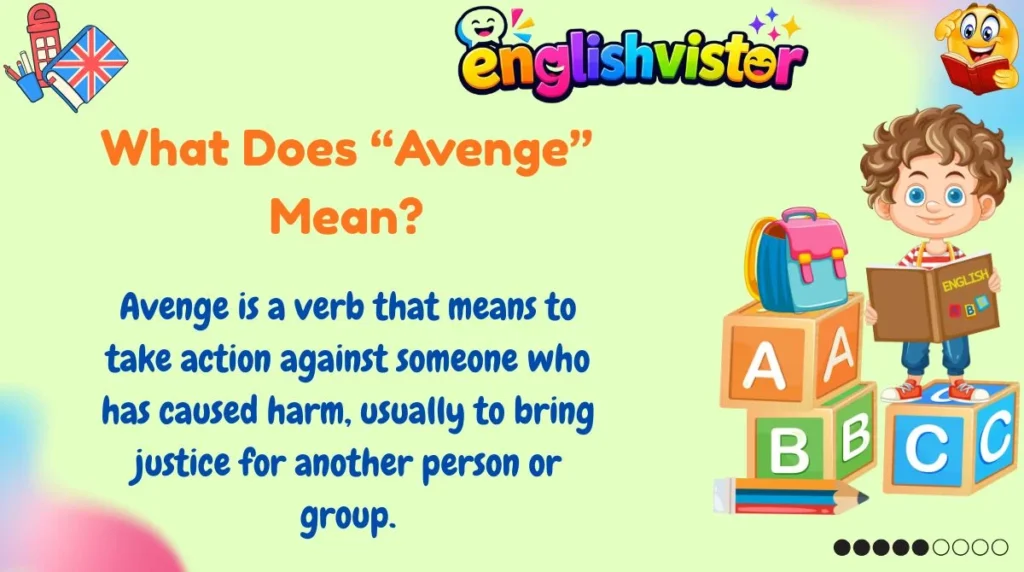
Avenge is a verb that means to take action against someone who has caused harm, usually to bring justice for another person or group.
The focus of “avenge” is often not personal anger. Instead, it is about correcting a wrong action or standing up for someone who cannot do it themselves.
For example, if a person hurts someone’s family member, another person may try to punish the wrongdoer because they want justice for the victim. This action is called avenging.
When to Use “Avenge”
Use avenge when:
- Someone wants justice for another person.
- Someone is protecting the honor or memory of someone.
- The action is connected with correcting a wrong.
The person who acts is usually not the original victim.
Grammar Rule of “Avenge”
Avenge + person/thing that suffered harm
Examples:
- She wanted to avenge her brother’s death.
- The hero returned to avenge his fallen friends.
Notice that the object after “avenge” is usually the person or group that was harmed, not the person who caused the problem.
Example Sentences with “Avenge”
- The warrior promised to avenge his village after the attack.
- She fought to avenge her father’s honor.
- The team wanted to avenge their previous defeat.
- The character in the story tried to avenge his family.
- He returned home to avenge the people who suffered.
- The soldiers believed they were fighting to avenge their country.
- The hero decided to avenge his friend’s betrayal.
- They hoped to avenge the loss of their teammates.
Common Learner Confusion About “Avenge”
Many students think avenge means taking revenge, but the feeling behind the word is different.
“Avenge” usually has a connection with justice or fairness. It is often used in serious situations, stories, or formal writing.
For example:
- The king wanted to avenge his people.
This means the king wanted justice for his people.
It does not simply mean the king was angry and wanted to hurt someone.
What Does “Revenge” Mean?
Revenge means doing something harmful or unpleasant to someone because they harmed you or someone close to you.
The main idea behind revenge is a personal desire to get even. A person usually feels angry, hurt, or upset and wants the other person to suffer in return.
Unlike “avenge,” revenge is usually connected with the person who was directly affected.
When to Use “Revenge”
Use revenge when:
- Someone wants to punish another person personally.
- Someone wants to “get even.”
- The motivation comes from anger, hurt, or personal feelings.
Grammar Rule of “Revenge”
“Revenge” can be used as both a noun and a verb.
As a noun:
take revenge on someone
Example:
- He wanted to take revenge on his enemy.
As a verb:
revenge yourself on someone
Example:
- She planned to revenge herself on the person who betrayed her.
However, the verb form is less common in everyday English. Native speakers usually use phrases like take revenge or get revenge.
Example Sentences with “Revenge”
- He wanted revenge after being treated unfairly.
- She took revenge on the person who lied to her.
- The movie is about a man seeking revenge.
- He believed revenge would solve his problem.
- The character planned to get revenge for the insult.
- She decided not to take revenge and moved forward.
- The story follows a hero who searches for revenge.
- They were driven by feelings of anger and revenge.
Common Learner Confusion About “Revenge”
Many learners use “revenge” when they actually mean “justice.”
For example:
- Incorrect: The firefighter wanted revenge for the people he saved.
- Better: The firefighter wanted to avenge the people he saved.
Why?
Because the firefighter is acting for others, not because he personally suffered.
“Revenge” is more about personal feelings.
Difference Between Avenge and Revenge
Although avenge and revenge are related, they are not always interchangeable.
The easiest way to understand the difference is to look at the reason behind the action.
| Feature | Avenge | Revenge |
|---|---|---|
| Part of speech | Verb | Noun and verb |
| Main meaning | To seek justice for someone harmed | To hurt someone in return |
| Main focus | Justice | Personal anger |
| Usually done for | Another person, group, or cause | Yourself |
| Feeling involved | Honor, duty, justice | Anger, frustration, hurt |
| Common use | Stories, history, formal situations | Everyday speech, emotions, personal conflicts |
Usage Difference
The word avenge often sounds more noble or serious.
Example:
- The hero wanted to avenge his family.
This suggests the hero is fighting for justice.
The word revenge often sounds more emotional.
Example:
- He wanted revenge after his friend betrayed him.
This suggests personal anger.
Grammar Logic Difference
The grammar pattern also helps you remember the difference.
Avenge:
Avenge someone/something
Examples:
- She avenged her brother.
- They avenged their country.
The person receiving justice is the focus.Avenge vs Revenge.
Revenge:
Take revenge on someone
Examples:
- He took revenge on his enemy.
- She wanted revenge on the person who hurt her.Avenge vs Revenge.
The person being punished is the focus.
Meaning Comparison
Compare these sentences:
1. The soldier wanted to avenge his fallen friends.Avenge vs Revenge.
Meaning:
The soldier wanted to honor his friends and seek justice.
2. The soldier wanted revenge on his enemy.
Meaning:
The soldier personally wanted to punish the enemy.
Both sentences involve a conflict, but the reason is different.
Grammar Rules You Must Remember
Learning a few simple rules can make the difference between using avenge and revenge correctly. These words are connected, but their grammar patterns and meanings are different.Avenge vs Revenge.
Rule 1: Use “Avenge” When Someone Seeks Justice for Another Person
The word avenge usually focuses on helping someone who was harmed or protecting the memory of someone.
The person taking action is often not the victim.
Structure:
Avenge + person, group, or thing that suffered
Examples:
- The knight wanted to avenge his king.Avenge vs Revenge.
- She worked hard to avenge her family.
- The soldiers promised to avenge their fallen teammates.
Here, the focus is not only on punishment. The focus is on justice, honor, or defending someone.
A simple question can help:
“Am I doing this for someone else?”
If the answer is yes, “avenge” may be the correct choice.
Rule 2: Use “Revenge” for Personal Anger or Getting Even
The word revenge is connected with personal feelings. Someone feels hurt, angry, or disappointed and wants to make the other person suffer in return.Avenge vs Revenge.
Common structures:
- Take revenge on someone
- Get revenge on someone
- Seek revenge against someone
Examples:
- He wanted to take revenge on his rival.
- She got revenge on the person who cheated her.
- The character was seeking revenge against his enemy.Avenge vs Revenge.
A simple question can help:
“Am I doing this because I personally feel hurt?”
If yes, “revenge” is usually the better word.
Rule 3: “Revenge” Is More Common as a Noun
Although “revenge” can be used as a verb, modern English speakers usually use it as a noun.
Common expressions include:
- Take revenge
- Get revenge
- Seek revenge
- Plan revenge
Examples:
- He wanted revenge after the argument.Avenge vs Revenge.
- She decided not to take revenge.
- The movie tells a story about revenge.
The verb form “revenge yourself” is grammatically correct but sounds old-fashioned or formal.
Example:
- He revenged himself on his enemy.Avenge vs Revenge.
Most native speakers would say:
- He took revenge on his enemy.
Rule 4: Do Not Confuse Justice with Personal Punishment
The biggest difference between these words is the reason behind the action.
Justice:
- A person tries to correct something wrong.
Revenge:
- A person wants to hurt someone because they were hurt.
Examples:
- The lawyer wanted justice for the victim.
- The angry man wanted revenge after being insulted.
The first sentence focuses on fairness. The second focuses on personal emotion.Avenge vs Revenge.
Common Mistakes Students Make
Many English learners use avenge and revenge incorrectly because they translate these words directly from their own language. In many languages, one word may cover both meanings.
English separates these ideas more clearly.
Understanding the situation behind the action is the easiest way to choose the correct word.
Mistake 1: Using “Revenge” When Helping Someone Else
❌ Incorrect:
- The hero wanted revenge for his village.
✅ Correct:
- The hero wanted to avenge his village.
Why?
The hero is acting for the village, not only for himself.Avenge vs Revenge.
A better way to remember:
Avenge = justice for others
Mistake 2: Using “Avenge” for Personal Anger
❌ Incorrect:
- I will avenge my classmate because he insulted me.
✅ Correct:
- I will take revenge on my classmate because he insulted me.
Why?
The person speaking is personally affected.
The situation is about personal anger, so “revenge” fits better.
Mistake 3: Saying “Do Revenge”
Many learners create sentences like this:
❌ Incorrect:
- He will do revenge.
This expression is not natural in English.
Use:
✅ Correct:
- He will take revenge.
- He will get revenge.
English uses specific phrases with “revenge.”Avenge vs Revenge.
Mistake 4: Forgetting the Preposition with Revenge
Students often say:
❌ Incorrect:
- She took revenge him.
The correct structure is:
✅ Correct:
- She took revenge on him.Avenge vs Revenge.
Remember:
Take revenge on someone
Easy Correction Tips
Here are simple questions to check your sentence:
Question 1:
“Is the person acting for someone else?”
Yes → Use avenge
Example:
- He avenged his brother.
Question 2:
“Is the person angry and trying to get even?”
Yes → Use revenge
Example:
- He wanted revenge on his enemy.
Easy Trick to Remember the Difference
A simple memory trick can help you remember these words forever.Avenge vs Revenge.
Avenge = A for Another Person
Think:
Avenge starts with A → Another person
When you avenge someone, you usually act for another person.
Examples:
- A brother avenges his sister.
- A hero avenges a group of people.
- A leader avenges his nation.
The action is connected with helping others or restoring justice.Avenge vs Revenge.
Revenge = Return the Pain
Think:
Revenge means returning something bad that happened to you.
Someone hurts you, and you want to hurt them back.Avenge vs Revenge.
Example:
Your friend breaks your phone on purpose. You feel angry and want to damage their phone too.
That feeling is revenge.
Real-Life Logic
Imagine two situations:
Situation 1:
A firefighter dies while saving people. His team works to stop the person responsible.
This is closer to avenging because they are seeking justice for someone else.
Situation 2:
Someone insults you, and you want to insult them back.Avenge vs Revenge.
This is revenge because it is personal.
The key difference:
Avenge looks outward toward justice.
Revenge looks inward toward personal feelings.
Daily Life Examples of Avenge vs Revenge
These examples show how native English speakers use these words naturally.
Example 1
Sentence:
The hero returned to avenge his fallen friends.Avenge vs Revenge.
Meaning:
The hero wanted justice for his friends.
Example 2
Sentence:
She wanted revenge after her coworker embarrassed her.
Meaning:
She felt personally hurt and wanted to get even.
Example 3
Sentence:
The king promised to avenge his people.
Meaning:
The king wanted justice for his people.
Example 4
Sentence:
He took revenge on the person who betrayed him.
Meaning:
He personally wanted punishment.
Example 5
Sentence:
The movie is about a man seeking revenge.
Meaning:
The story focuses on his personal desire to punish someone.
Example 6
Sentence:
The family wanted to avenge their lost son.
Meaning:
They wanted justice for their son.Avenge vs Revenge.
Example 7
Sentence:
She chose forgiveness instead of revenge.
Meaning:
She decided not to punish someone because of anger.Avenge vs Revenge.
Example 8
Sentence:
The team wanted to avenge their previous loss.
Meaning:
They wanted to win again after being defeated before.
Example 9
Sentence:
The character’s search for revenge changed his life.Avenge vs Revenge.
Meaning:
His personal anger became the main part of the story.
Example 10
Sentence:
The community united to avenge the victims.
Meaning:
They wanted justice for the victims.
Practice Section
Choose the correct word: avenge or revenge.
1. The warrior wanted to ______ his fallen soldiers.
Answer: __________
2. She planned to take ______ on the person who hurt her.
Answer: __________
3. The movie tells the story of a man seeking ______.
Answer: __________
4. The leader promised to ______ his people.
Answer: __________
5. He wanted to get ______ after being treated unfairly.
Answer: __________
Answers:
- avenge
- revenge
- revenge
- avenge
- revenge
FAQs
1. What is the difference between avenge and revenge?
Avenge means seeking justice for someone who was harmed. Revenge means personally trying to punish someone because they hurt you. Avenge focuses on justice, while revenge focuses on personal feelings.
2. Can we use avenge in everyday conversations?
Yes, but it is less common in casual speech. It often appears in stories, movies, books, or serious situations. In daily conversation, people usually use words like “get justice” instead.
3. Is revenge a noun or a verb?
“Revenge” can be both a noun and a verb, but the noun form is much more common. People usually say “take revenge” or “get revenge” instead of using “revenge” as a verb.
4. Is avenge a formal word?
Avenge is not always formal, but it often sounds serious. It is commonly used in literature, history, and dramatic stories.
5. Can avenge and revenge mean the same thing?
Sometimes they may appear similar because both involve responding to harm. However, their meanings are different. Avenge focuses on justice, while revenge focuses on personal punishment.
6. Which word should I use when I am angry?
If you are talking about personal anger and wanting to hurt someone back, revenge is usually the correct word. If you are talking about protecting someone or seeking justice, use avenge.
Conclusion
Understanding the difference between avenge vs revenge becomes easier when you focus on the reason behind the action.
Avenge is about seeking justice for someone else. It is often connected with honor, protection, and correcting a wrong. Revenge is about personal feelings and the desire to punish someone who caused harm.Avenge vs Revenge.
Remember the simple trick:
Avenge = Another person
Revenge = Return the hurt
When you understand this small difference, you can choose the right word in conversations, writing, and exams. Many English words look similar, but learning their real meaning helps you communicate more clearly.
Keep practicing with examples, and these confusing words will soon feel natural. Good English comes from understanding the ideas behind words, not only memorizing definitions.Avenge vs Revenge.

Hi, I’m Isabella Foster, an English language writer passionate about making grammar, vocabulary, and communication skills easy to understand. At EnglishVistor, I create clear, practical, and engaging learning resources to help learners improve their English with confidence.