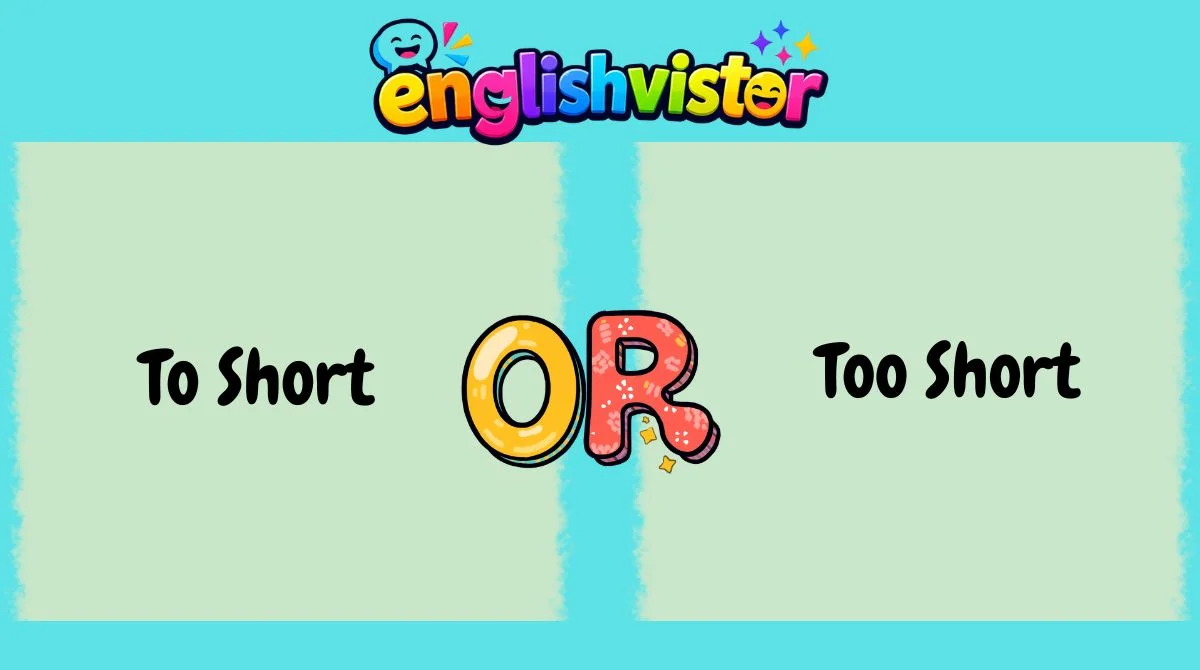
Many English learners get confused when they hear “to short or too short.” The confusion is easy to understand because to and too sound almost the same when we speak. However, they have completely different jobs in a sentence.
If you are learning English, you may have seen sentences such as “This shirt is too short” or “I want to cut it to short.” One sentence can be correct, while another may sound wrong because the wrong word has been chosen.
The good news is that the difference is actually quite simple. Too often means “more than needed” or “more than wanted,” while to usually shows direction, purpose, or a connection between words. There is also a common grammar problem: short can be an adjective, but it can also appear in other structures.
Understanding to short or too short is useful because these words appear in everyday English. You may use them when talking about clothes, hair, height, distance, time, objects, school work, and many other things.
After learning the rules below, you will know which word to choose, why it is correct, and how native speakers normally use it. You will also see simple examples that you can use in real conversations.
What Does “To Short” Mean?
The first important point is that “to short” is usually not the correct phrase when you want to say that something has less length than necessary.
For example:
- “This dress is to short.” ❌
- “This dress is too short.” ✅
The word to has several important uses in English. It can show movement toward a place, introduce an infinitive verb, or show a relationship between two things.
For example:
- I am going to school.
- She went to the market.
- I want to learn English.
- To Short or Too Short
- Give the book to Ali.
Notice that to is not being used to mean “more than necessary.”
The problem happens because to and too have almost the same pronunciation in normal speech. When learners hear them, they may not notice the extra sound in spelling. This often leads to writing mistakes.
When short describes something that does not have enough length, height, or duration, we normally use too short.
For example:
- This skirt is too short.
- To Short or Too Short
- The table is too short for this room.
- The meeting was too short.
- These trousers are too short for me.
- The video is too short to explain everything.
- His speech was too short.
- The rope is too short to reach the tree.
So, when students search for to short or too short, they are often asking whether to or too should come before the adjective short.
In this structure, too is the correct choice.
A useful grammar pattern is:
too + adjective
Examples:
- too big
- too small
- too expensive
- To Short or Too Short
- too long
- too short
Therefore:
too + short = too short
A common learner confusion is thinking that to and too are interchangeable because they sound alike. They are not. Their spelling and grammar functions are different.
What Does “Too Short” Mean?
Too short is the normal expression when something has less length, height, or duration than is needed or wanted.
The word too means more than is suitable, necessary, or wanted. With the adjective short, it means that something is not long enough.
For example:
This dress is too short for me.
The sentence means the dress does not have enough length for the speaker.
Here are more examples:
- My hair is too short now.
- This pencil is too short to use comfortably.
- The ladder is too short to reach the roof.
- The sleeves are too short for my arms.
- The movie was too short.
- Your answer is too short for this question.
- To Short or Too Short
- The rope is too short to reach the other side.
There are several common patterns with too short.
Too short + for
Use too short for + person/thing when something does not have enough length or height for a particular purpose.
Examples:
- This chair is too short for me.
- These jeans are too short for him.
- The shelf is too short for these books.
- This dress is too short for school.
Too short + to + verb
Use this structure when something lacks enough length, height, time, or duration to complete an action.
Examples:
- The ladder is too short to reach the window.
- The rope is too short to tie around the box.
- The lesson was too short to cover the whole topic.
- To Short or Too Short
This structure is especially useful in everyday English.
Another important point is that too short does not always refer to physical length.
It can also refer to time:
The break was too short.
It can refer to written content:
Your answer is too short.
It can refer to a speech or explanation:
His explanation was too short.
So, the meaning depends on the noun or situation.
When learners compare to short or too short, the easiest answer in sentences such as “The dress is ___” is too short.
Difference Between To Short and Too Short
The main difference is grammatical.
To is normally a preposition or part of an infinitive. Too is commonly an adverb meaning “more than necessary” or “also.”
The phrase too short is a standard English combination because too modifies the adjective short.
| Word | Main function | Example | Meaning |
|---|---|---|---|
| to | Preposition/infinitive marker | I went to school. | Direction or infinitive |
| too | Adverb | The dress is too short. | More than suitable/necessary |
| short | Adjective | The dress is short. | Not long |
| too short | Adverb + adjective | The dress is too short. | Not long enough |
This makes the question of to short or too short much easier.
Compare these sentences:
I went to the shop.
Here, to shows movement toward the shop.To Short or Too Short
The road is too short.
Here, too tells us that the road does not have enough length for the situation.
Now compare:
She wants to cut her hair.
Here, to comes before the verb cut. It is part of the infinitive to cut.
But:
Her hair is too short.
Here, too modifies the adjective short.
To Short or Too Short
Structure 1: to + noun
to + place/person/thing
- go to school
- talk to my teacher
- give it to John
- travel to London
Structure 2: to + verb
to + base verb
- to eat
- to study
- to sleep
- To Short or Too Short
Structure 3: too + adjective
too + adjective
- too short
- too tall
- too difficult
- too expensive
That is why you should not simply choose a word because it sounds right.
Grammar Rules You Must Remember
1. Use “too” before an adjective when something is more than suitable
The basic pattern is:
too + adjective
Examples:
- To Short or Too Short
- too long
- too big
- too small
- too hot
- too cold
So we say:
The skirt is too short.
Not:
The skirt is to short. ❌
This is the most important rule to remember when dealing with to short or too short.
2. Use “to” before a base verb
When to is part of an infinitive, it comes before the base form of a verb.
Examples:
- I want to study.
- She needs to sleep.
- He likes to read.
- To Short or Too Short
Do not confuse this structure with too short.
For example:
I want to shorten the dress.
Here, to is correct because shorten is a verb.
But:
To Short or Too Short
Here, too is correct because short is an adjective.
This distinction is extremely useful.
3. “Too short” can describe length, height, or time
The word short has several meanings.
It can describe physical length:
The rope is too short.To Short or Too Short
It can describe height:
The wall is too short.
It can describe duration:
The meeting was too short.
It can describe written content:
Your answer is too short.To Short or Too Short
So too short is not limited to clothes or objects.
4. “Too short to” is a useful sentence pattern
The structure is:
too + adjective + to + verb
Examples:
The ladder is too short to reach the roof.To Short or Too Short
The table is too short to use comfortably.
The explanation is too short to understand the whole idea.
Here, notice that both words can appear in the same sentence, but they have different jobs.
This is one reason to short or too short can seem confusing.To Short or Too Short
Common Mistakes Students Make
Why do these mistakes happen?
The biggest reason is pronunciation. To and too often sound almost identical in everyday speech.
A learner may hear:
“The dress is too short.”
Then, when writing the sentence, the learner may choose to because the words sound similar.To Short or Too Short
Another reason is that students often memorize words separately instead of learning common sentence patterns.
Learning too + adjective is much more useful than memorizing too by itself.
Mistake 1: Using “to” before “short”
Wrong:
My pants are to short. ❌
Correct:
My pants are too short. ✅
The adjective short needs too when you mean “not long enough.”
Mistake 2: Writing “to short” in a description
Wrong:
This haircut is to short. ❌
Correct:
This haircut is too short. ✅
The speaker means the haircut has less length than desired.To Short or Too Short
Mistake 3: Confusing “too short” with “short”
These sentences have different meanings:
The dress is short.
This simply describes the dress.
The dress is too short.
This says the dress is shorter than is acceptable or wanted.
The word too adds the idea of a problem or unwanted amount.
Mistake 4: Confusing “too” with “very”
Very short and too short are not exactly the same.
The boy is very short.
This describes his height strongly.
The boy is too short to reach the shelf.
This means his height is not enough for the purpose.
A simple correction tip is to ask:
“Am I saying something is more than needed or acceptable?”
If the answer is yes, too is often the right choice.
Easy Trick to Remember the Difference
Here is a simple trick for remembering to short or too short.
Think about the extra o in too.
You can imagine that the extra o means “extra.”
Too = extra
For example:
The dress is too short.
It has a problem because its length is not enough.
The bag is too heavy.
Its weight is more than you want.
The room is too small.
Its size is less than you need.
This memory trick works because too often shows an amount that goes beyond what is suitable.
Now remember:
To is commonly used for movement or before a verb.
Examples:
I went to school.
I want to learn.
She came to help me.
So when you see short as an adjective, think:
too short
When you see a base verb after the word, think:
to + verb
For example:
I want to shorten my hair.
Here, shorten is a verb.
But:
My hair is too short.
Here, short is an adjective.
This little difference can help you avoid many spelling and grammar mistakes.
Daily Life Examples
Examples in Real Conversations
The phrase too short appears in many normal conversations. You may hear it when people talk about clothes, hair, furniture, school work, videos, meetings, and time.
1. Talking about clothes
A: How do these trousers look?
B: They look nice, but they are too short.
Here, the trousers do not have enough length.
2. Talking about a dress
A: Do you like this dress?
B: Yes, but I think it is too short for me.
The speaker likes the dress but does not think its length is suitable.
3. Talking about hair
A: Did you cut your hair?
B: Yes. I think I cut it too short.
The speaker means the hair was cut more than desired.
4. Talking about a ladder
A: Can we use this ladder?
B: No. It is too short to reach the window.
The ladder does not have enough height.
5. Talking about a meeting
A: How was the meeting?
B: It was useful, but too short.
The meeting did not last as long as needed.
6. Talking about an answer
Teacher: Why is your answer only one sentence?
Student: Sorry. I thought it was enough.
Teacher: It is too short. Please explain your answer.
Here, too short refers to the amount of written information.
7. Talking about a video
A: Did you watch the new lesson?
B: Yes, but the video was too short to explain everything.
The video did not have enough time.
8. Talking about a rope
A: Can you tie the box?
B: I can’t. The rope is too short.
The rope does not have enough length.
9. Talking about a chair
A: Is this chair comfortable?
B: Not really. It is too short for me.
The chair is not high enough for the speaker.
10. Talking about time
A: Did you finish the test?
B: No. The time was too short.
The speaker means there was not enough time.
These examples show why understanding to short or too short is useful outside grammar exercises. You can use this structure in many everyday situations.
Practice Section
Choose the Correct Option
Choose to or too in each sentence.
- This shirt is ___ short for me.
- I want ___ buy a new shirt.
- The rope is ___ short to reach the tree.
- She went ___ the store.
- His answer is ___ short.
- We need ___ leave now.
- These trousers are ___ short.
- I talked ___ my teacher.
Answers
- too — This shirt is too short for me.
- to — I want to buy a new shirt.
- too — The rope is too short to reach the tree.
- to — She went to the store.
- too — His answer is too short.
- to — We need to leave now.
- too — These trousers are too short.
- to — I talked to my teacher.
Notice how the grammar changes depending on what comes after the word.
Before a base verb, to is common:
to buy
to leave
to study
Before the adjective short, when you mean “more/less than suitable,” use:
too short
FAQs
What is the difference between “to short” and “too short”?
Too short is the normal correct expression when you mean that something does not have enough length, height, or duration. To has other jobs, such as showing direction or forming an infinitive.
Is “to short” grammatically correct?
It can appear as part of a larger grammatical structure, but “to short” is not normally correct when you mean “not long enough.” For that meaning, use too short.
Can we use “too short” in questions?
Yes. Too short can easily be used in questions.
For example:
Is this dress too short?
Is the rope too short?
Was the meeting too short?
These are natural questions in everyday English.
Is “too short” formal or informal?
Too short is neutral English. It is suitable for casual conversations, school writing, emails, and many formal situations. The exact level of formality depends on the whole sentence.
Why do people confuse “to” and “too”?
The two words often sound very similar when spoken quickly. This makes spelling difficult for English learners. Learning their grammar roles is more reliable than trying to hear the difference.
How can I remember “too short”?
Remember this simple pattern:
too + adjective
You can say too short, too long, too big, too small, too expensive, and too difficult. When short is an adjective and you mean “not enough length,” choose too.
Conclusion
The difference between to short or too short becomes much easier when you focus on grammar instead of pronunciation.
Use too short when you mean that something does not have enough length, height, time, or duration for a particular purpose. For example, you can say, “This dress is too short,” “The rope is too short,” or “The meeting was too short.”
Use to for its normal grammatical jobs, such as showing direction or introducing an infinitive verb. Examples include “I went to school” and “I want to study.”
The most useful pattern to remember is:
too + adjective
So:
too short ✅
If you practice these patterns in real sentences, the difference will soon become automatic. Pay attention when you read, listen, and write English. Whenever you mean more than suitable or not enough for a purpose, check whether too is the word you need.

Hi, I’m Isabella Foster, an English language writer passionate about making grammar, vocabulary, and communication skills easy to understand. At EnglishVistor, I create clear, practical, and engaging learning resources to help learners improve their English with confidence.