English has many words that look almost the same but are not always used in the same way. Deactivate or inactivate is one such confusing pair. Both words can describe something that is made inactive, but native speakers do not always use them in exactly the same situations.
You may see these words when talking about phones, accounts, machines, systems, services, features, chemicals, or biological processes. For example, a website may ask you to deactivate your account, while a scientific text may say that a substance was inactivated.
This can make learners wonder: Are both words correct? Can you replace one with the other? Is one more formal than the other? These are common questions, especially for students who are learning English for school, work, or everyday communication.
The good news is that the basic difference is quite easy to understand. Deactivate usually means to switch something off, stop its activity, or make it no longer active. Inactivate also means to make something inactive, but it is more common in technical, scientific, medical, or formal contexts.
Once you understand this small difference, choosing the right word becomes much easier. You will also learn how these verbs work in sentences, which situations favor each word, and which common mistakes you should avoid Deactivate or Inactivate.
What Does “Deactivate” Mean?
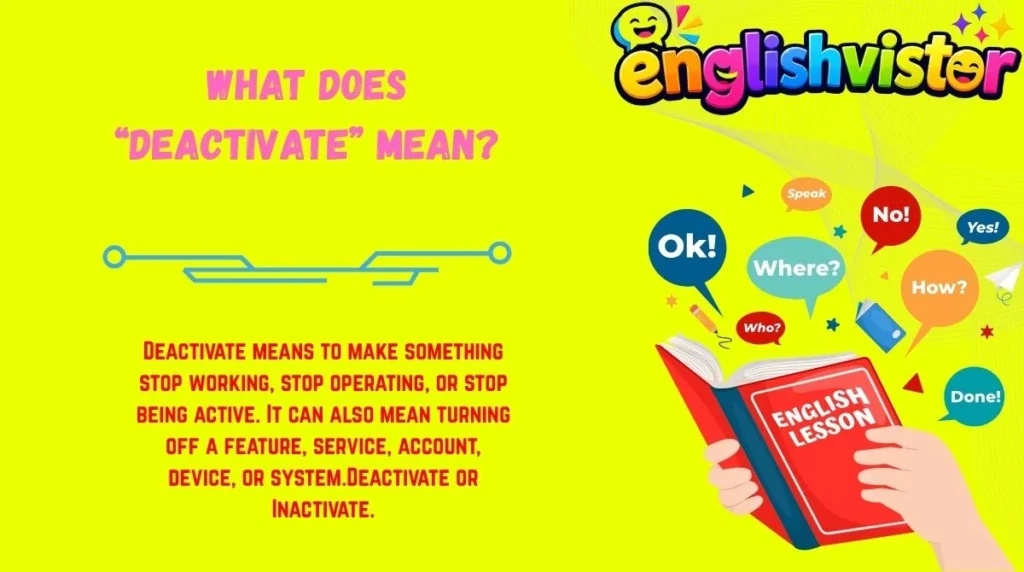
Deactivate means to make something stop working, stop operating, or stop being active. It can also mean turning off a feature, service, account, device, or system.Deactivate or Inactivate.
The word is formed from de-, meaning to remove, reverse, or undo an action, and activate, meaning to make something active.
In everyday English, deactivate is usually the more natural choice when you are talking about technology or something that a person can deliberately switch off.
For example, you can deactivate an account, deactivate a phone, or deactivate a security system.
When should you use “deactivate”?
Use deactivate when something is intentionally stopped or switched from an active state to an inactive state.Deactivate or Inactivate.
It is especially common with:
- User accounts
- Social media accounts
- Security systems
- Electronic devices
- Software features
- Online services
- Alarms
- Cards and memberships
The normal grammar pattern is:
Subject + deactivate + object
Examples:
- I need to deactivate my old account.
- Please deactivate the alarm before entering the room.
- She deactivated her social media account last month.
- The technician deactivated the security system.
- You can deactivate this feature in the settings.
- He decided to deactivate his membership.Deactivate or Inactivate.
- The bank may deactivate your card if it is reported lost.
- We should deactivate the device before repairing it.
Notice that the verb normally has an object. You deactivate something.
You can also use its passive form:
- The account was deactivated.
- The card has been deactivated.
- The alarm was deactivated by the technician.
A common learner confusion
Some learners think deactivate means completely destroy something. Usually, it does not.
If you deactivate an account, the account may still exist. You have simply stopped it from being active.
That is why deactivate is often a useful word when something can later be activated again.Deactivate or Inactivate.
For example:
I deactivated my Instagram account for a month.
This does not necessarily mean that the account was permanently deleted. It simply means that the account was made inactive.
What Does “Inactivate” Mean?
Inactivate also means to make something inactive or to cause it to lose its activity.Deactivate or Inactivate.
However, it is used less often in ordinary conversation than deactivate. It appears more frequently in scientific, medical, biological, technical, and formal writing.
For example, scientists may talk about inactivating a virus, enzyme, protein, or biological substance. A technical document may also use the word when describing a process that removes or reduces activity.
The basic grammar pattern is:
Subject + inactivate + object
Examples:
- Heat can inactivate certain enzymes.
- The treatment inactivated the virus.
- Researchers used chemicals to inactivate the bacteria.
- The process can inactivate harmful proteins.
- The vaccine contains an inactivated virus.Deactivate or Inactivate.
- The chemical was used to inactivate the enzyme.
- The laboratory method inactivates the biological agent.
- High temperatures may inactivate some microorganisms.
Here, inactivate focuses strongly on the loss or removal of activity.
When should you use “inactivate”?
Use inactivate when the context is more technical or scientific, especially when something has a natural or biological activity that needs to be stopped.
Common combinations include:
- Inactivate a virus
- Inactivate an enzyme
- Inactivate a protein
- Inactivate a toxin
- Inactivate bacteria
- Inactivate a biological agent
- Inactivate a chemical reaction
You may also see the adjective inactive and the past participle inactivated.
For example:
The researchers used an inactivated virus.
This means the virus has been treated so that it is no longer active in the relevant way.
A common learner confusion
The main problem is that learners sometimes use inactivate for everyday technology when deactivate sounds much more natural.
For example, this sentence is understandable:
I inactivated my Facebook account.Deactivate or Inactivate.
However, in normal everyday English, most people would more naturally say:
I deactivated my Facebook account.
So the difference is not simply about grammar. Context and natural usage matter.
Difference Between Deactivate and Inactivate (Detailed)
The main difference between these two verbs is where and how they are commonly used.Deactivate or Inactivate.
Both can mean “make inactive,” so there is some overlap. However, deactivate is much more common in everyday English, especially when a person intentionally turns something off.
Inactivate is more strongly associated with scientific, technical, medical, and biological contexts.
| Point | Deactivate | Inactivate |
|---|---|---|
| Basic meaning | Make something inactive | Make something inactive |
| Everyday use | Very common | Less common |
| Technology | Very common | Less natural in many cases |
| Accounts | Very common | Uncommon |
| Devices | Very common | Uncommon |
| Scientific writing | Possible | Very common |
| Biological subjects | Possible but less typical | Very common |
| Tone | General and everyday | Technical or formal |
| Example | Deactivate an account | Inactivate a virus |
Think about the situation.
If you are talking to a friend about a social media account, deactivate is the natural choice:
I want to deactivate my account.
If you are writing a science report, inactivate may be the better choice:
The treatment was designed to inactivate the virus.
Usage difference
Deactivate often suggests a deliberate action that changes something from active to inactive.Deactivate or Inactivate.
For example:
The user deactivated the account.
The user made the decision and took an action.
Inactivate can describe a process that causes something to lose its activity.
For example:
Heat inactivated the enzyme.
The focus is on the effect of heat on the enzyme.
Grammar logic
Both words are transitive verbs when used in these examples. That means they normally take an object.Deactivate or Inactivate.
You deactivate something.
You inactivate something.
For example:
She deactivated the alarm.
The heat inactivated the enzyme.
Both sentences follow the same basic grammatical structure.Deactivate or Inactivate.
The major difference is meaning in context and normal word choice, not the basic sentence structure.
Sentence structure difference
The structures can look almost identical:
Deactivate:
Subject + deactivate + object
The administrator deactivated the account.Deactivate or Inactivate.
Inactivate:
Subject + inactivate + object
The treatment inactivated the virus.
So, grammar alone will not tell you which word to choose. You need to look at what is being made inactive and the type of English being used.Deactivate or Inactivate.
Grammar Rules You Must Remember
1. Use “deactivate” for everyday systems and accounts
When you are talking about something a person can turn off or stop using, deactivate is usually the safest choice.
Please deactivate my account.
I deactivated the notification feature.
The employee deactivated the security system.
These sentences sound natural in ordinary English.Deactivate or Inactivate.
2. Use “inactivate” more often in scientific contexts
When the object is a virus, enzyme, protein, toxin, or other biological or scientific substance, inactivate is often the more suitable word.
The process inactivates the virus.
The chemical can inactivate the enzyme.
This does not mean that deactivate is impossible in every technical situation. It means that inactivate is strongly established in many scientific contexts.Deactivate or Inactivate.
3. Both verbs can take an object
Do not forget that these verbs usually act directly on something.
Correct:
She deactivated the account.
The treatment inactivated the virus.
A common mistake is to leave the object out when the intended meaning requires one.Deactivate or Inactivate.
4. “Deactivated” and “inactivated” are common forms
Both verbs can be used in the past tense and passive voice.
Examples:
The account was deactivated.
The machine was deactivated.
The virus was inactivated.
The enzyme was inactivated during the experiment.
The choice still depends on the context.
Common Mistakes Students Make
Why do these mistakes happen?
These words confuse learners because their basic meanings are extremely close. Both contain the idea of removing activity.
The problem becomes clearer when learners try to translate directly from their first language. A word that means “make inactive” in one language may be translated into English as either deactivate or inactivate.Deactivate or Inactivate.
English does not always work that way. Native usage and context help determine the natural choice.
Mistake 1: Using “inactivate” for every device
Learners sometimes write:
I inactivated my phone.
The meaning can be understood, but deactivated is usually more natural if the intended meaning is to turn off or disable a phone, service, or feature.Deactivate or Inactivate.
Better:
I deactivated my phone service.
Mistake 2: Assuming “deactivate” is always wrong in science
The opposite mistake is also possible. Some learners think scientific contexts must always use inactivate.
That is too strict.
The words overlap, and deactivate can appear in technical contexts, depending on the thing being discussed. The important point is that inactivate is especially common when the subject involves biological or chemical activity.Deactivate or Inactivate.
Mistake 3: Thinking “deactivate” means delete
Consider:
I deactivated my account.
This does not automatically mean:
I deleted my account permanently.
Deactivation usually means the account has been made inactive. Deletion is a different idea.Deactivate or Inactivate.
Mistake 4: Confusing “inactive” with “inactivate”
Inactive is an adjective.
My account is inactive.
Inactivate is a verb.
The system will inactivate the process.
Similarly:
Deactivated is commonly used as an adjective or past participle.
My account is deactivated.
Remember:
inactive = state
inactivate = action
deactivate = action
Easy Trick to Remember the Difference
Think “switch off” versus “scientific activity”
Here is a simple memory trick.
When you imagine a button, account, alarm, card, app, or feature, think:
Deactivate = switch it off.
When you imagine a virus, enzyme, protein, toxin, or biological process, think:
Inactivate = remove its activity.
This is not an absolute rule, but it is a very useful guide for learners.
Imagine your phone.
You might say:
I deactivated the notification.
Now imagine a science laboratory.
You might read:
The researchers inactivated the virus.
The first sentence sounds like ordinary daily English. The second sounds like scientific English.
Another easy way to remember it is this:
Deactivation is often about a function or service.
Inactivation is often about activity inside a scientific or technical system.
If you keep this idea in mind, you will make the right choice most of the time.
Daily Life Examples (Very Important)
10 Easy Spoken English Examples
Here are natural examples that show how deactivate is commonly used in daily life and how inactivate appears in more technical situations.
- “Can you deactivate the alarm?”
Someone asks another person to turn off an alarm. - “I deactivated my old email account.”
The speaker stopped using the account without necessarily deleting it. - “You should deactivate Bluetooth when you are not using it.”
The feature is being turned off. - “The bank deactivated my card after I reported it missing.”
The card was made unusable. - “She deactivated her social media account for a few weeks.”
She temporarily stopped the account from being active. - “Please deactivate this setting before you leave.”
The speaker wants a setting switched off. - “The treatment can inactivate the virus.”
This is a scientific use. - “High temperatures may inactivate some enzymes.”
The sentence describes a scientific process. - “The researchers found a way to inactivate the protein.”
The object is a biological substance. - “The technician deactivated the security system.”
A person deliberately stopped the system from operating.
These examples show why deactivate or inactivate cannot always be treated as completely interchangeable words.
In everyday conversation, deactivate will often sound more natural. In scientific writing, inactivate can be the better choice.
Practice Section
Choose the Correct Option
Choose deactivate or inactivate in each sentence.
- Please ______ your account before you stop using the service.
- The scientist used heat to ______ the enzyme.
- The technician had to ______ the alarm.
- The treatment may ______ the virus.
- I want to ______ the notification feature on my phone.
Answers
- deactivate — An account is commonly deactivated.
- inactivate — An enzyme is a scientific subject, so inactivate is natural.
- deactivate — An alarm is normally deactivated.
- inactivate — A virus is commonly described as being inactivated.
- deactivate — A phone feature is normally deactivated.
The easiest thing to notice is the type of object. Accounts, alarms, features, and services usually point toward deactivate. Biological substances often point toward inactivate.
FAQs
What is the difference between deactivate and inactivate?
Both verbs mean to make something inactive. Deactivate is much more common in everyday English and is often used for accounts, devices, features, alarms, and services. Inactivate is more common in scientific, medical, biological, and technical contexts.
Can we use deactivate in questions?
Yes. Deactivate can easily be used in questions.
For example:
Can I deactivate my account?
How do I deactivate this feature?
These are very natural questions in everyday English.
Is deactivate formal or informal?
Deactivate is neither strongly formal nor strongly informal. It is a normal English verb used in everyday conversation, business communication, websites, instructions, and technical contexts.
Is inactivate grammatically correct?
Yes. Inactivate is a correct English verb. However, it is less common in ordinary conversation. It is especially useful when discussing scientific or biological activity.
Can deactivate and inactivate be used interchangeably?
Sometimes they can overlap in meaning, but they are not equally natural in every context. A sentence about an online account normally favors deactivate, while a sentence about an enzyme or virus often favors inactivate.
Is deactivation the same as deletion?
No. Deactivation normally means making something inactive or unavailable. Deletion means removing it. An account can be deactivated without being permanently deleted, depending on the service.
Conclusion
Understanding deactivate or inactivate becomes much easier when you stop looking only at their dictionary meanings and start thinking about context.
Both words describe the idea of making something inactive. However, deactivate is the more common choice for everyday things such as accounts, alarms, cards, devices, services, and software features.
Inactivate is especially common in scientific, medical, biological, and technical writing. You are more likely to see it with words such as virus, enzyme, protein, toxin, or biological agent.
A simple rule can help you remember the difference: deactivate often means switching something off, while inactivate often means causing scientific or biological activity to stop.
Do not worry if the distinction feels confusing at first. Native English usage has some overlap between these verbs. The more examples you read and use, the more natural the difference will become.
Try making your own sentences with both words. Practice with everyday technology first, then move to scientific examples. With a little practice, choosing the right word will become much easier.

Hi, I’m Isabella Foster, an English language writer passionate about making grammar, vocabulary, and communication skills easy to understand. At EnglishVistor, I create clear, practical, and engaging learning resources to help learners improve their English with confidence.