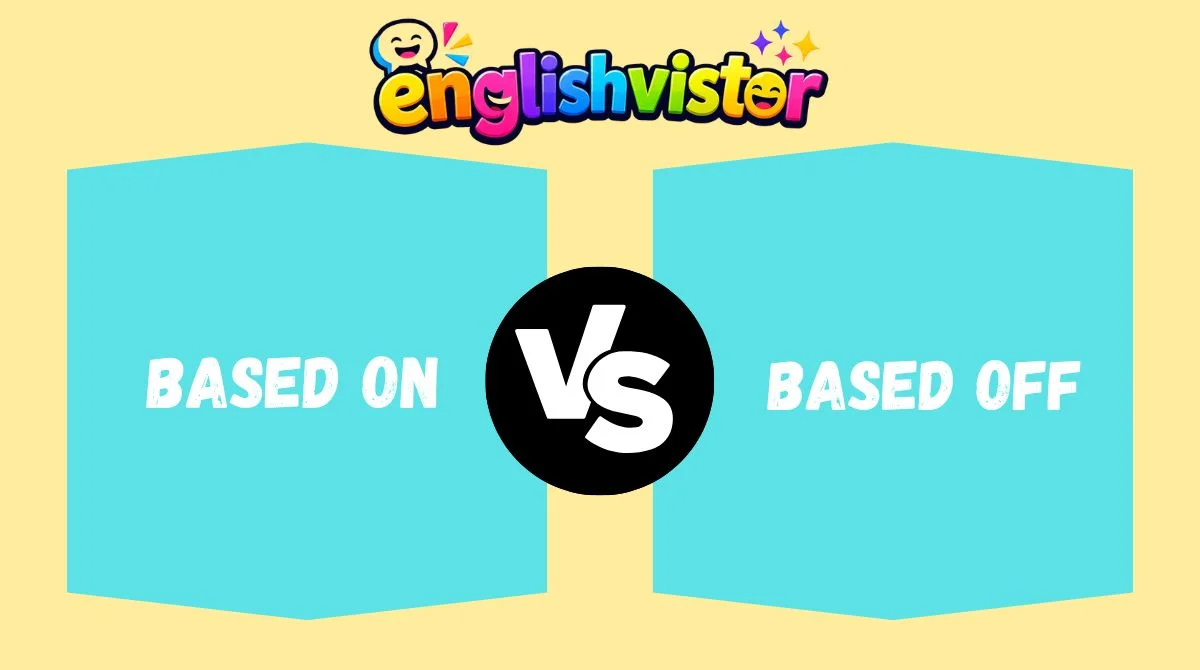
Many English learners feel confused when they hear phrases like “based on” and “based off of.” Both expressions are common in everyday English, and native speakers often use them in similar situations.Based On vs Based Off.
This makes it difficult for students to know which one is correct and which one they should choose.Based On vs Based .
The confusion usually happens because both phrases talk about the same basic idea: something comes from another source, idea, or information.
For example, a movie can come from a book, a decision can come from facts, or a plan can come from someone’s suggestion.
However, there is a small difference in style and acceptance. “Based on” is the standard and widely accepted phrase, especially in formal writing, academic English, and professional communication.Based On vs Based .
“Based off of” is more common in casual spoken English, but some teachers and editors consider it less correct.
Understanding this difference helps you write better emails, essays, reports, and articles. It also helps you sound more natural when speaking English.Based On vs Based .
After reading this guide, you will understand what these phrases mean, when to use them, how they are different, and how to avoid common mistakes. You will also learn simple tricks and real-life examples that make the difference easy to remember.
What Does “Based On” Mean?
Based on means something is created, decided, or developed using a particular source, idea, fact, or information.
It shows that one thing depends on another thing.
The word based comes from the idea of having a foundation. Just like a building needs a strong foundation, an idea or creation can have a foundation too.
For example:
- A movie can be based on a true story.
- A teacher’s lesson can be based on research.Based On vs Based Off.
- A decision can be based on facts.
When to Use “Based On”
“Based on” is used in many situations:
1. When something comes from a book, story, or real event
Example:
- The movie is based on a famous novel.
This means the movie was created using the novel as its source.
2. When making decisions
Example:
- We chose the winner based on performance.
The decision was made using performance as the reason.Based On vs Based Off.
3. When explaining opinions or ideas
Example:
- My opinion is based on my personal experience.
The experience is the foundation of the opinion.
Grammar Rule for “Based On”
The usual structure is:
Subject + be + based on + noun/noun phrase
Examples:
- This film is based on a true story.
- Her answer is based on careful research.
- The report was based on customer feedback.
Another common structure is:
Subject + base something on something
Examples:
- The writer based the story on his childhood.
- The company based its decision on market data.Based On vs Based Off.
Example Sentences With “Based On”
- The book is based on historical events.
- Our project is based on new technology.
- The teacher created the test based on the lessons we studied.
- His opinion is based on facts, not guesses.
- The movie was based on a real person’s life.
- The company changed its plan based on customer reviews.
- Her research is based on many years of study.
- The article is based on expert information.
Common Learner Confusion
Many students think “based on” means only “copied from.” That is not true.Based On vs Based Off.
Something can be based on another thing without being exactly the same.
For example:
- The movie is based on a book.
This does not mean the movie is exactly the same as the book. It means the book provided the main idea or source.Based On vs Based Off.
What Does “Based Off Of” Mean?
Based off of has almost the same meaning as based on. It means something is created or developed from another source, idea, or example.
It is often heard in everyday conversations, especially in American English.Based On vs Based Off.
Examples:
- The character is based off of a real person.
- This design is based off of an old model.
The meaning is clear, but the phrase is more informal.Based On vs Based Off.
When to Use “Based Off Of”
“Based off of” is usually used in casual speaking.
You may hear it in:
- Conversations
- Interviews
- Videos
- Social media posts
- Informal messages
Example:
- “The game is based off of a popular cartoon.”
This sounds natural in casual speech.Based On vs Based Off.
However, for formal writing, many writers prefer:
- “The game is based on a popular cartoon.”
Grammar Rule for “Based Off Of”
The structure is:
Subject + be + based off of + noun/noun phrase
Examples:
- The character is based off of a real person.
- The design is based off of nature.
- The story was based off of an old legend.Based On vs Based Off.
Although this structure is commonly used, many grammar experts prefer avoiding it in formal English because “based on” already expresses the idea clearly.
Example Sentences With “Based Off Of”
- This movie is based off of a popular video game.
- The drawing is based off of a photograph.
- The character was based off of the writer’s friend.
- The new product is based off of customer ideas.
- The story is based off of an old family tradition.
- The building design was based off of modern architecture.
- The song was based off of a personal experience.Based On vs Based Off.
- The show is based off of a famous comic series.
Common Learner Confusion
Students often believe that “based off of” is always wrong. That is not exactly true.Based On vs Based Off.
It is widely used by native speakers, and people understand it easily. The main issue is formality.
For school assignments, business writing, exams, and professional documents, “based on” is usually the safer choice.
Difference Between Based On and Based Off Of
Both phrases communicate a similar meaning, but their usage and style are different.
| Feature | Based On | Based Off Of |
|---|---|---|
| Meaning | Comes from a source or idea | Comes from a source or idea |
| Formality | Formal and informal | Mostly informal |
| Acceptance | Standard English | Common but sometimes debated |
| Best for writing | Yes | Usually avoid |
| Common in speech | Yes | Very common |
| Example | The film is based on a true story. | The film is based off of a true story. |
Usage Difference
The biggest difference is not meaning. The difference is mainly about style.Based On vs Based Off.
Compare:
Formal:
- The report is based on scientific research.
Casual:
- The character is based off of my friend.
Both sentences can be understood, but the first one sounds more professional.Based On vs Based Off.
Grammar Logic
The word based already means “built from” or “created from.” The preposition on naturally connects the foundation with the idea.
That is why “based on” has been the traditional form.Based On vs Based Off.
“Based off of” developed in everyday speech because speakers connected the idea with “off,” meaning something comes away from a source.
For example:
- A copy is made off a model.Based On vs Based Off.
- A design is created off an idea.
Over time, “based off of” became popular.
Sentence Structure Difference
Both structures follow a similar pattern:
Something is based on something.Based On vs Based Off.
Example:
- The movie is based on a book.
Something is based off of something.
Example:
- The movie is based off of a book.Based On vs Based Off.
The grammar structure is almost identical. The difference is the level of formality.
Meaning Comparison
Sentence 1:
- The article is based on research.
Meaning:
The research is the foundation of the article.Based On vs Based Off.
Sentence 2:
- The article is based off of research.
Meaning:
The same idea, but the phrase sounds more conversational.Based On vs Based Off.
Grammar Rules You Must Remember
1: Use “Based On” for Formal Writing
When writing essays, reports, applications, or professional documents, choose “based on.”
Example:
- The conclusion is based on the available evidence.
Avoid informal choices when accuracy and professionalism matter.Based On vs Based Off.
2: “Based On” Can Introduce Facts or Sources
Use it when something depends on information.
Example:
- The decision was based on customer feedback.
The feedback created the foundation for the decision.Based On vs Based Off.
3: “Based Off Of” Is Mainly for Casual Speech
You can use it in friendly conversations.Based On vs Based Off.
Example:
- The cartoon character is based off of a real person.
It sounds natural in everyday speaking.
4: Do Not Confuse “Based On” With “Because Of”
They are related but different.
Example:
- The decision was based on research.Based On vs Based Off.
The research was the source.
- The game was canceled because of rain.
The rain was the reason.
Common Mistakes Students Make
1: Using “Based Off Of” Everywhere
Some learners use it in every situation because they hear native speakers say it.Based On vs Based.
Wrong:
- My essay is based off of academic studies.
Better:
- My essay is based on academic studies.
Correction tip: Use “based on” whenever you are writing something important.
2: Thinking Both Phrases Have Different Meanings
Many students search for a meaning difference, but the main difference is style.
Wrong idea:
“Based on” means one thing and “based off of” means another.
Correct idea:
Both usually mean “created from a source,” but “based on” is more standard.
3: Forgetting the Object After the Phrase
Wrong:
- The movie is based.
Correct:
- The movie is based on a true story.
The phrase usually needs information after it.
4: Using Extra Words
Some learners write:
- Based on from the information…
This is incorrect.
Correct:
- Based on the information…
Easy Trick to Remember the Difference
Remember this simple rule:
“Based ON = safe everywhere.”
Think of “on” as something standing on a foundation.
Example:
A house stands on a foundation.
An idea is based on information.
“Based off of” is like a casual shortcut. It is common in conversation, but it is not always the best choice for formal English.
A student writing an exam, essay, or business email should choose:
Based on
A friend talking about a movie or character can naturally say:
Based off of
Daily Life Examples
Here are common spoken English examples:
- A: Why did you choose this restaurant?
B: I chose it based on online reviews. - This movie is based on a true story.
- The teacher created the quiz based on yesterday’s lesson.
- My decision was based on what my parents advised.
- The new app is based on user feedback.
- The character is based off of someone the writer knew.
- This painting is based on a beautiful memory.
- The design was based off of an old building style.
- We selected the hotel based on its location.
- The game idea was based on a popular story.
Practice Section
Choose the correct option:
1. The movie is ______ a famous novel.
a) based on
b) based off of
2. My opinion is ______ personal experience.
a) based on
b) based off of
3. The character was ______ a real person.
a) based on
b) based off of
4. The report was ______ scientific research.
a) based on
b) based off of
5. The design was ______ an old building.
a) based on
b) based off of
Answers:
- based on
- based on
- based off of
- based on
- based on or based off of (depending on formality)
FAQs
What is the difference between based on and based off of?
Both phrases mean that something comes from another source, idea, or example. The main difference is that “based on” is standard English, while “based off of” is more informal.
Can we use based off of in formal writing?
It is better to avoid “based off of” in formal writing. Use “based on” for essays, reports, academic work, and professional communication.
Is based off of grammatically wrong?
Many people use “based off of,” and it is understood by native speakers. However, some grammar experts consider it less preferred than “based on.”
Which phrase should English learners use?
English learners should choose “based on” in most situations. It is accepted everywhere and works in both formal and informal English.
Can we use based on in questions?
Yes. Example:
“What is this movie based on?”
The phrase works naturally in questions.
Why do people say based off of?
People often use “based off of” because it sounds natural in conversation. Language changes over time, and common speech can create new expressions.
Final Conclusion
Understanding the difference between based on and based off of is simple once you focus on usage instead of meaning.
Both phrases usually express the same idea: something is created from a source, idea, fact, or example. The main difference is the level of formality.
Based on is the safest choice. It works in conversations, school writing, professional documents, and formal communication.
Based off of is common in everyday speech, especially when people are talking casually about movies, characters, designs, and ideas.
If you are unsure which one to use, choose based on. It is clear, correct, and accepted by all English speakers.
The best way to master these expressions is through practice. Notice how native speakers use them, read English regularly, and try making your own sentences. With time, choosing the right phrase will become natural.

Hi, I’m Isabella Foster, an English language writer passionate about making grammar, vocabulary, and communication skills easy to understand. At EnglishVistor, I create clear, practical, and engaging learning resources to help learners improve their English with confidence.