Many English learners feel confused when they see phrases like “you all” and “all of you.” Both expressions talk about a group of people, and both can sometimes have the same meaning.
Because of this, students often wonder: “Are they the same?” or “Which one should I use?”
The answer is simple: they are very similar, but there are small differences in style, grammar, and usage. Knowing these differences can help you sound more natural when speaking and writing English.
In everyday conversations, native speakers use both expressions. You may hear someone say, “You all did a great job,” or “All of you did a great job.” The meaning is almost the same, but the feeling of the sentence can be slightly different.
Understanding this topic is useful because English does not always follow direct translation rules. A phrase that sounds correct in one situation may feel unusual in another.
After learning the difference, you will understand:
- when to use you all
- when to use all of you
- which phrase sounds more natural in different situations
- common mistakes learners make
- how native speakers use these expressions in daily English
Let’s look at these two phrases carefully and make the difference easy to remember.
What Does “You All” Mean?
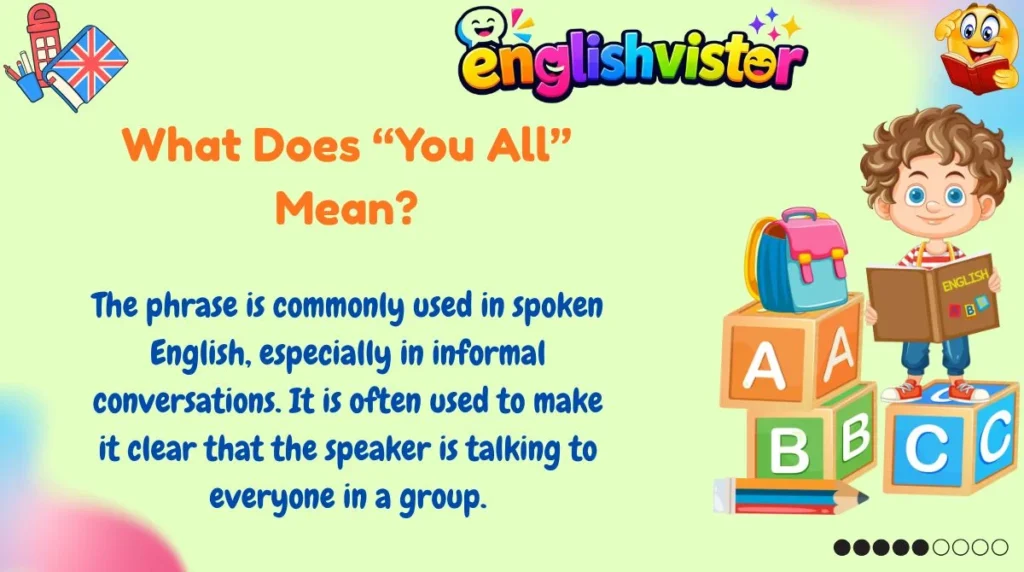
“You all” means all the people you are speaking to. It refers to a group of listeners, not just one person.
The phrase is commonly used in spoken English, especially in informal conversations. It is often used to make it clear that the speaker is talking to everyone in a group.
For example:
“You all need to finish your homework.”
This means every person in the group needs to finish their homework.
The word “you” can mean one person or many people in modern English. Because of this, adding “all” helps show that the speaker means more than one person.
Grammar Rule
The basic structure is:
You all + verb + rest of sentence
Examples:
- You all look happy today.
- You all need to listen carefully.
- You all have done very well.
- You all should be proud of yourselves.
Here, “you all” acts as the subject of the sentence.
Examples of “You All”
- You all are invited to my birthday party.
Meaning: Everyone in this group is invited.
- You all worked hard this week.
Meaning: Every person in the group worked hard.
- You all need to be ready by 8 o’clock.You All vs All of You.
Meaning: Everyone should be ready.
- I hope you all enjoy the trip.
Meaning: The speaker hopes every person enjoys it.
- You all made the right decision.
Meaning: The whole group made the correct choice.
- You all look different after so many years.
Meaning: Every person in the group looks different.
- You all helped me when I needed support.
Meaning: Each person in the group helped.
- Are you all coming to the meeting?
Meaning: Is everyone in the group coming?
Common Learner Confusion
Many learners think “you all” is incorrect because they learn that “you” already includes plural meaning. Grammatically, “you” can already refer to many people.
However, English speakers sometimes add “all” for clarity and emphasis.
Compare:
You are invited.
This could mean one person or many people.
You all are invited.
This clearly means a group of people.
What Does “All of You” Mean?
“All of you” also means every person in a group. It focuses on the complete group and includes every individual person.
This phrase is slightly stronger because it emphasizes that nobody is left out.You All vs All of You.
For example:
“All of you must complete this project.”
The speaker means every single person must complete it.
Grammar Rule
The structure is:
All of + object pronoun
Examples:
- all of you
- all of us
- all of them
We use “of” because “you” is an object pronoun in this structure.You All vs All of You.
Examples:
- All of you are welcome.
- I want to thank all of you.
- All of you have improved.
- The teacher spoke to all of you.
Examples of “All of You”
- All of you did an excellent job.
Meaning: Every person performed well.
- I want to thank all of you for your help.
Meaning: The speaker thanks every person.
- All of you can join the competition.
Meaning: Everyone in the group can join.
- The teacher asked all of you to sit down.
Meaning: The teacher asked every student.
- I am proud of all of you.
Meaning: The speaker feels proud of every person.
- All of you need to complete this form.
Meaning: Every person must complete it.
- She invited all of you to her wedding.
Meaning: Everyone in the group was invited.You All vs All of You.
- I have spoken to all of you before.
Meaning: The speaker has talked with every person.
Common Learner Confusion
Some students use “all you” instead of “all of you.”
Incorrect:
I appreciate all you.
Correct:
I appreciate all of you.
The word “of” is required before the pronoun.
However, remember that “all” can be used without “of” before nouns.You All vs All of You.
Example:
All students passed the exam.
But:
All of you passed the exam.
Difference Between You All and All of You
Both phrases usually mean the same thing: every person in a group.
The main difference is the way they are used and the feeling they create.
| Point | You All | All of You |
|---|---|---|
| Meaning | Every person in a group | Every person in a group |
| Common use | More common in speaking | Common in speaking and writing |
| Style | More casual | Slightly more formal or serious |
| Focus | The group as a whole | Each individual person |
| Grammar position | Usually before a verb | Can be subject or object |
| Example | You all look great. | All of you look great. |
Usage Difference
You all often sounds friendly and conversational.
Example:
“Are you all ready?”
This sounds natural when a teacher talks to students or a friend talks to a group.You All vs All of You.
All of you can sound more direct or stronger.
Example:
“All of you must follow these rules.”
This gives more attention to every person.
Grammar Logic
The phrase “you all” keeps “you” as the main subject and adds “all” for extra information.
Example:
You all understand the lesson.
Subject: You all
The phrase “all of you” treats the whole group as a complete set.You All vs All of You.
Example:
All of you understand the lesson.
Subject: All of you
The meaning is almost identical.
Sentence Structure Difference
You all:
You all + verb
- You all deserve a chance.
- You all know the answer.
All of you:
All of you + verb
- All of you deserve a chance.
- All of you know the answer.You All vs All of You.
Both structures are correct.
However, all of you can also come after a verb.
Examples:
- I called all of you.
- She invited all of you.
- We missed all of you.
“You all” usually does not work in these positions.
Incorrect:
I called you all. (This can actually be correct, especially in speech.)
Correct:
I called all of you.
Both can be correct, but “all of you” is often clearer when it is the object.You All vs All of You.
Grammar Rules You Must Remember
: Use “you all” mainly as a subject
When you want to talk directly to a group, “you all” works well.
Example:
You all need to study harder.
The group is receiving the action.
2: Use “all of you” when you want to emphasize every person
This phrase highlights each individual.
Example:
All of you are responsible for your own work.
The message applies to every person separately.You All vs All of You.
3: Do not forget “of” before pronouns
Before pronouns like you, us, and them, use “of.”
Correct:
- all of you
- all of us
- all of them
Incorrect:
- all you
- all us
- all them
4: Both phrases need plural verbs
Because they refer to multiple people, use plural verbs.You All vs All of You.
Correct:
You all are welcome.
Correct:
All of you are welcome.
Incorrect:
You all is welcome.
Incorrect:
All of you is welcome.
Common Mistakes Students Make
1: Thinking “you all” is always wrong
Some learners believe “you” cannot be followed by “all.”
Example:
Incorrect idea:
“You all is wrong.”
Correct:
“You all are wrong.”
The problem is not the phrase. The problem is the verb agreement.You All vs All of You.
2: Removing “of” from “all of you”
Incorrect:
I want to thank all you.You All vs All of You.
Correct:
I want to thank all of you.
A simple way to remember this is:
Before a pronoun, use of.You All vs All of You.
3: Using “you all” in very formal writing
“You all” is common and natural, but in formal documents, “all of you” or another expression may sound better.
Example:
Casual:
You all did great today.You All vs All of You.
More formal:
All of you performed very well.
4: Confusing “you all” with “y’all”
“Y’all” is a shortened form of “you all.” It is strongly connected with some regional varieties of English, especially in the southern United States.
Example:
Y’all are welcome here.
It is common in conversation but usually avoided in formal writing.You All vs All of You.
Easy Trick to Remember the Difference

Here is a simple memory trick:
“You all” = talking to the group.
“All of you” = thinking about every person.
Imagine a teacher standing in front of a classroom.
The teacher says:
“You all need to open your books.”
The teacher is speaking to the class.You All vs All of You.
Now imagine the teacher checking each student’s work.
The teacher says:
“All of you need to improve your writing.”
The focus is on every individual student.
A simple rule:
- Talking to everyone together → you all
- Highlighting every single person → all of you
Remember, both are correct. The difference is mostly about emphasis and style.You All vs All of You.
Daily Life Examples
These phrases appear often in real conversations.
1. At School
Teacher:
“You all need to submit your assignments tomorrow.”
Meaning: Every student must submit.
2. Talking With Friends
“Are you all ready to go?”
Meaning: Is everyone ready?
3. At Work
Manager:
“All of you have done a wonderful job on this project.”
Meaning: Every worker is appreciated.You All vs All of You.
4. At a Party
Host:
“I hope you all enjoy the food.”
Meaning: Everyone should enjoy it.
5. Giving Instructions
“All of you must wear your ID cards.”
Meaning: Every person must wear one.
6. Thanking People
“Thank you all for coming.”
Meaning: Thanks to everyone.
7. Family Conversation
“I miss you all.”
Meaning: I miss every person in the family.
8. Online Meetings
“Can you all see my screen?”
Meaning: Can everyone see it?
9. Encouraging Students
“I believe in all of you.”
Meaning: The speaker believes in every student.
10. Group Activities
“You all worked together very well.”
Meaning: The whole group worked well.
Practice Section
Choose the correct option:
1. ______ need to bring your books tomorrow.
a) You all
b) All you
Answer: You all
2. I want to thank ______ for your support.
a) all of you
b) all you
Answer: all of you
3. Are ______ ready for the test?
a) you all
b) all you
Answer: you all
4. The coach is proud of ______.
a) all of you
b) all you
Answer: all of you
5. ______ have worked very hard this year.
a) You all
b) All you
Answer: You all
FAQs
What is the difference between you all and all of you?
Both expressions mean every person in a group. “You all” is often more casual and common in conversation, while “all of you” can give stronger emphasis to each person.
Can we use you all in questions?
Yes. “You all” is very common in questions.
Example:
Are you all coming to the party?
It means: Is everyone coming?
Is you all formal or informal?
“You all” is mostly used in informal spoken English. It is natural in conversations but may not be the best choice for very formal writing.
Is all of you grammatically correct?
Yes. “All of you” is completely correct. It is used before verbs and after verbs as an object.
Examples:
All of you are invited.
I appreciate all of you.
Can you all and all of you be used in the same sentence?
Sometimes, yes. They can have the same meaning.
Example:
You all did well.
All of you did well.
Both sentences are correct.
Why do English speakers say you all?
English uses “you” for both one person and many people. Adding “all” helps speakers show clearly that they mean a group.
Conclusion
Understanding the difference between you all and all of you can make your English sound clearer and more natural. Both expressions talk about a complete group of people, and in many situations, they can be used in the same way.You All vs All of You.
The main difference is the focus. “You all” is often used when speaking directly to a group in a friendly way. “All of you” often gives more attention to each individual person.
The most important rules are simple:
- Use you all when addressing a group.
- Use all of you when you want to emphasize everyone.You All vs All of You.
- Remember that all of you needs “of” before the pronoun.You All vs All of You.
- Use plural verbs with both expressions.You All vs All of You.
The best way to learn this difference is through practice. Listen to real conversations, notice how native speakers use these phrases, and try making your own sentences.
With regular practice, these small grammar choices will become easy and natural.You All vs All of You.

Hi, I’m Isabella Foster, an English language writer passionate about making grammar, vocabulary, and communication skills easy to understand. At EnglishVistor, I create clear, practical, and engaging learning resources to help learners improve their English with confidence.