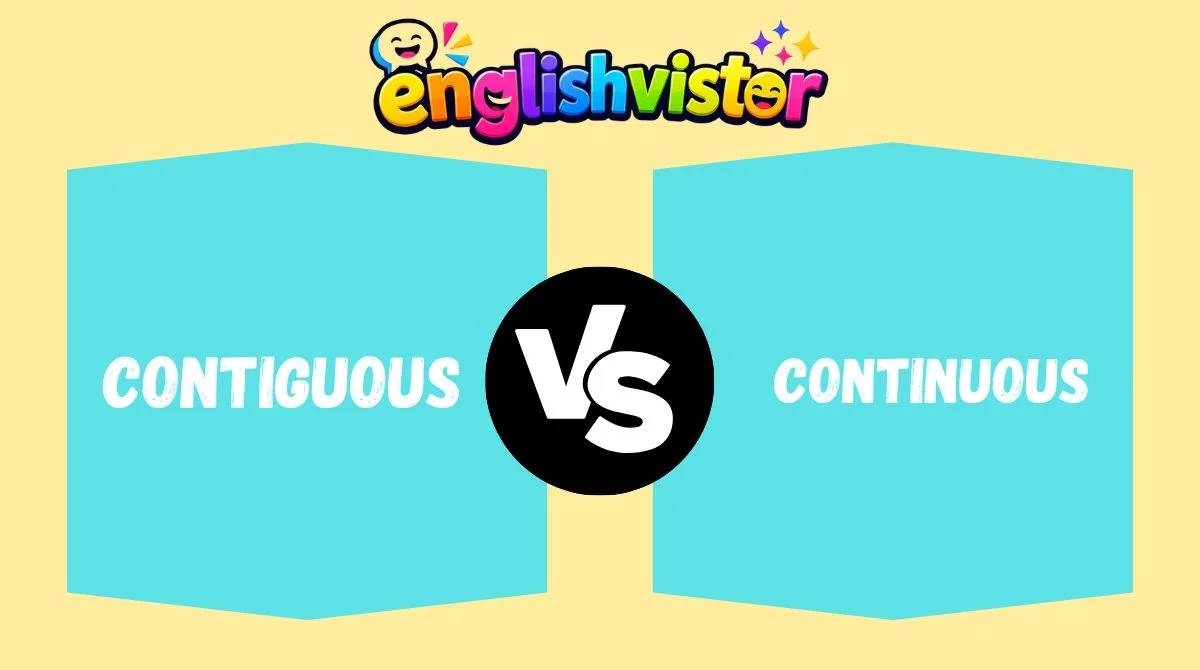

Many English learners feel confused when they see the words contiguous and continuous because both words sound similar and both can describe things that are connected in some way. However, their meanings are different. Using the wrong word can change the meaning of your sentence and make your English sound unclear Contiguous vs Continuous Complete .
These two words often create problems for students, writers, and even fluent speakers because they both come from the idea of connection. Contiguous vs Continuous Complete .One word talks about things being next to each other, while the other talks about something happening without stopping.
Understanding this difference is important because these words appear in daily conversations, academic writing, business communication, and exams. A small mistake can lead to misunderstanding.Contiguous vs Continuous Complete .
After learning this topic, you will clearly know:
- what contiguous means and when to use it,
- what continuous means and when to use it,
- how their grammar patterns are different,
- common mistakes learners make,
- and simple tricks to remember the difference forever.Contiguous vs Continuous Complete .
Learning confusing word pairs is a great way to improve your English because these small details help you communicate more naturally and confidently.Contiguous vs Continuous Complete .
What Does “Contiguous” Mean?
The word contiguous means touching each other, next to each other, or sharing a common border or connection.
It is usually used when we talk about places, areas, objects, or things that are physically connected. The important idea is that there is no gap between them.Contiguous vs Continuous Complete .
For example, two houses standing side by side are contiguous because they touch or are directly next to each other. Two countries that share a border are also contiguous.
The focus of contiguous is not time. It is about location and physical connection.
Grammar Rule for Contiguous
Contiguous is an adjective. It describes a noun.Contiguous vs Continuous Complete .
Common structures:
- contiguous + noun
- noun + be + contiguous
Examples:
- contiguous areas
- contiguous states
- contiguous land
- The two properties are contiguous.
Example Sentences With Contiguous
- The two farms are contiguous, so the owners share a boundary.Contiguous vs Continuous Complete .
- Canada and the United States have contiguous borders in many areas.
- The company purchased several contiguous buildings in the city center.
- The park contains five contiguous sections connected by walking paths.
- The two rooms are contiguous and can be joined together.
- Scientists studied contiguous regions of the forest to understand plant growth.
- The school bought contiguous pieces of land for future expansion.
- These countries are not contiguous because another country separates them.
Common Learner Confusion About Contiguous
Many learners think contiguous means “continuous” because the words look almost the same. This is the biggest mistake.Contiguous vs Continuous Complete .
Remember:
Contiguous = connected by position
It answers the question:
“Are these things next to each other?”
For example:
- Five houses standing in a row → contiguous houses.
- A person working for five hours without a break → not contiguous.Contiguous vs Continuous Complete .
What Does “Continuous” Mean?
The word continuous means happening without stopping or continuing for a period of time.Contiguous vs Continuous Complete .
It is used when something keeps going and does not have breaks or interruptions. The focus is on time, action, or movement.
For example, rain that falls for many hours without stopping is continuous rain. A person talking without pauses is speaking continuously.
The main idea behind continuous is that something continues from one moment to another.Contiguous vs Continuous Complete .
Grammar Rule for Continuous
Continuous is also an adjective. It describes a noun.
Common structures:
- continuous + noun
- noun + be + continuous
Examples:
- continuous improvement
- continuous learning
- continuous noise
- The process is continuous.
Example Sentences With Continuous
- The machine makes a continuous sound during operation.
- She is working on continuous improvement of her English skills.
- Continuous practice helps students become better speakers.
- The river provides a continuous supply of fresh water.
- Contiguous vs Continuous Complete .
- The internet connection was not continuous because it kept disconnecting.
- The company focuses on continuous growth.
- His continuous effort helped him achieve his goal.
Common Learner Confusion About Continuous
Students often use continuous when they want to describe things that are beside each other.
For example:
Incorrect:
- The two countries are continuous.Contiguous vs Continuous Complete .
Correct:
- The two countries are contiguous.
Why?
Because countries sharing a border are connected by location, not by time.
Use continuous when something keeps happening.
Difference Between Contiguous and Continuous (Detailed)
Although these words look similar, their meanings are different.Contiguous vs Continuous Complete .
The easiest way to understand the difference is:
- Contiguous = connected by space
- Continuous = connected by time
Comparison Table
| Feature | Contiguous | Continuous |
|---|---|---|
| Meaning | Things are next to each other | Something continues without stopping |
| Main idea | Physical connection | Time or ongoing action |
| Used for | Places, areas, objects | Actions, events, processes |
| Focus | Where something is | How long something happens |
| Example | Contiguous countries | Continuous rain |
| Opposite idea | Separate or divided | Interrupted or stopped |
Usage Difference
Consider these examples:
Contiguous:
“The three rooms are contiguous.”
This means the rooms are connected or next to each other.
Continuous:
“The meeting lasted for three continuous hours.”
This means the meeting continued for three hours without stopping.Contiguous vs Continuous Complete .
The first sentence talks about space. The second sentence talks about time.
Grammar Logic
Both words are adjectives, but they describe different types of relationships.
Contiguous describes a relationship between objects:
- land
- buildings
- regions
- areas
Continuous describes an ongoing condition:
- activity
- process
- sound
- work
- change
Sentence Structure Difference
Contiguous often appears with nouns related to geography or physical objects:
- contiguous states
- contiguous properties
- contiguous areas
Continuous often appears with nouns related to actions or processes:
- continuous learning
- continuous movement
- continuous improvement
Meaning Comparison
Compare these sentences:
- The two rooms are contiguous.
Meaning:
The rooms are beside each other.
- The noise was continuous.
Meaning:
The noise continued without stopping.
Changing one word changes the entire meaning.
Grammar Rules You Must Remember
Rule 1: Use Contiguous for Physical Connection
When two or more things touch or share a boundary, use contiguous.
Example:
- Contiguous vs Continuous Complete .
The land pieces are connected physically.
Rule 2: Use Continuous for Something That Does Not Stop
When an action or condition continues without interruption, use continuous.
Example:
- Continuous training improves professional skills.
The training continues over time.
Rule 3: Contiguous Usually Describes Location
This word is commonly used with geographical or physical nouns.
Examples:
- contiguous countries
- contiguous territories
- contiguous buildings
Incorrect:
- continuous countries
Correct:
- contiguous countries
Rule 4: Continuous Can Describe Progress and Activities
Use continuous for things that develop or happen repeatedly over time.
Examples:
- Contiguous vs Continuous Complete .
- continuous improvement
- continuous growth
Incorrect:
- contiguous improvement
Correct:
- Contiguous vs Continuous Complete .
Common Mistakes Students Make
Many English learners confuse these words because they have similar spelling and pronunciation.
Mistake 1: Using Continuous for Neighboring Places
Wrong:
- The two states are continuous.
Correct:
- The two states are contiguous.
Why?
States cannot “continue” like an activity. They can only be connected by location.
Mistake 2: Using Contiguous for Long Activities
Wrong:
- She studied contiguous for five hours.
Correct:
- She studied continuously for five hours.
Why?
Studying is an activity that happens over time.
Mistake 3: Thinking Both Words Mean “Connected”
It is true that both words have a connection idea, but the type of connection is different.
Contiguous:
Connection between places or objects.
Continuous:
Connection between moments in time.
Mistake 4: Ignoring Context
Always look at what you are describing.
Ask:
“Is this about a place?”
Use:
contiguous
Ask:
“Is this about time or an ongoing action?”
Use:
continuous
Easy Trick to Remember the Difference
Here is a simple memory trick:
Contiguous contains “touch.”
Think:
Contiguous = Contact
Both start with “C.”
If things are in contact with each other, they are contiguous.
Example:
Two buildings touching each other = contiguous buildings.
Continuous contains “continue.”
Think:
Continuous = Continue
If something continues without stopping, it is continuous.
Example:
Rain that keeps falling = continuous rain.
A simple question can help:
“Are they next to each other?”
Yes → Contiguous
“Does it keep going?”
Yes → Continuous
Daily Life Examples
These examples show how people use these words in real situations.
1. Talking About Land
“The farmer owns two contiguous fields.”
Meaning:
The fields are beside each other.
2. Talking About Work
“She made continuous efforts to improve her skills.”
Meaning:
Her efforts continued over time.
3. Talking About Buildings
“The two offices are contiguous.”
Meaning:
The offices are connected or next to each other.
4. Talking About Learning
“Continuous learning is important in today’s world.”
Meaning:
Learning should continue regularly.
5. Talking About Weather
“We experienced continuous rain yesterday.”
Meaning:
The rain did not stop.
6. Talking About Countries
“The two countries have a contiguous border.”
Meaning:
They share a border.
7. Talking About Technology
“The system requires continuous monitoring.”
Meaning:
The system needs regular checking without stopping.
8. Talking About Property
“They bought three contiguous houses.”
Meaning:
The houses are beside one another.
9. Talking About Improvement
“The company believes in continuous improvement.”
Meaning:
The company keeps improving over time.
10. Talking About Sound
“The machine produced a continuous noise.”
Meaning:
The sound continued without a break.
Practice Section
Choose the correct word: contiguous or continuous.
- The two buildings are ______ and share the same wall.
- The internet service should provide ______ access.
- The countries have a ______ border.
- She showed ______ interest in learning English.
- The three areas form one ______ region.
Answers:
- contiguous
- continuous
- contiguous
- continuous
- contiguous
FAQs
What is the difference between contiguous and continuous?
Contiguous means things are connected because they are next to each other. Continuous means something keeps happening without stopping. Contiguous is about space, while continuous is about time.
Can we use contiguous in questions?
Yes, you can use contiguous in questions when asking about physical connection.
Example:
“Are these two areas contiguous?”
This asks if the areas are next to each other.
Is continuous formal or informal?
Continuous is used in both formal and informal English. You can use it in daily conversation, school writing, and professional communication.
Is contiguous commonly used in everyday English?
Contiguous is less common than continuous. It is often used in geography, law, real estate, and technical writing. However, understanding it helps you read and write accurately.
Can continuous describe people?
Yes, continuous can describe a person’s actions or efforts.
Example:
“She showed continuous dedication to her studies.”
It describes ongoing effort, not the person’s physical position.
Can contiguous and continuous be used interchangeably?
No. They cannot replace each other because they describe different ideas. Contiguous refers to physical connection, while continuous refers to uninterrupted time or action.
Conclusion
The difference between contiguous and continuous becomes easy when you remember one simple idea: contiguous is about space, and continuous is about time.
Use contiguous when things are touching, neighboring, or sharing a boundary. Use continuous when something keeps happening without stopping.
These words look similar, but they describe completely different situations. A contiguous group of houses means the houses are beside each other. A continuous process means the process keeps going.
The best way to remember these words is to notice the situation around you. Are you talking about places and objects? Think of contiguous. Are you talking about actions, events, or time? Think of continuous.
With regular practice and careful attention, confusing word pairs become much easier. Small grammar improvements like this can make your English clearer, more natural, and more confident.