
Many English learners feel confused when they see “thus far” and “so far.” Both expressions talk about something that has happened up to a certain point, and in many sentences they seem to have the same meaning. This makes it difficult for students to know which one sounds natural Thus Far vs So Far.
The good news is that the difference is much easier than it first appears. The two phrases are closely related, but they have different feelings and uses. One is more common in everyday conversations, while the other sounds more formal and is often found in writing, reports, and professional situations.Thus Far vs So Far.
Understanding this small grammar difference can make your English sound more natural. You will be able to choose the right expression when talking about progress, experiences, results, or situations that continue until now.
After learning this topic, you will clearly understand:
- What thus far means and when to use it
- What so far means and why native speakers use it more often
- The grammar rules behind both phrases
- Thus Far vs So Far.
- How to use them correctly in daily English conversations
Small words can create big confusion in English. Once you understand the idea behind these expressions, choosing the correct one becomes simple.Thus Far vs So Far.
What Does “Thus Far” Mean?
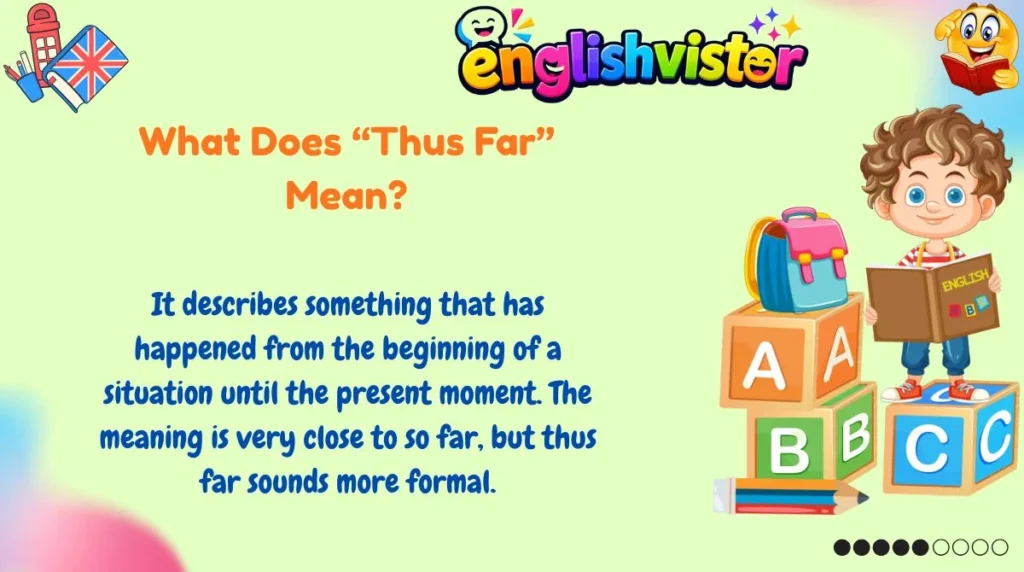
Thus far means “until now,” “up to this point,” or “until this time.”
It describes something that has happened from the beginning of a situation until the present moment. The meaning is very close to so far, but thus far sounds more formal.Thus Far vs So Far.
You will often see thus far in:
- Business writing
- Academic writing
- News reports
- Formal speeches
- Professional discussions
In normal conversation, many native speakers prefer so far because it sounds more relaxed.Thus Far vs So Far.
Grammar Rule of “Thus Far”
“Thus far” is an adverb phrase. It usually comes:
- At the beginning of a sentence
- Before or after the main verb
- At the end of a sentence
It is commonly used with the present perfect tense because it connects the past with the present.
Examples:
- Thus far, we have completed three important projects.Thus Far vs So Far.
Meaning: Until now, three projects are finished.
- The research has been successful thus far.
Meaning: The research has been successful up to this point.
- Thus far, the company has achieved its goals.
Meaning: The company has achieved goals until now.
- The students have performed well thus far.
Meaning: The students have done well until this time.Thus Far vs So Far.
- Thus far, no problems have appeared.
Meaning: Until now, there are no problems.
- The plan has worked well thus far.
Meaning: The plan has worked well up to now.
- Thus far, the team has won every match.
Meaning: The team has won every match until now.
- The results are promising thus far.
Meaning: The results look good at this point.Thus Far vs So Far.
Common Learner Confusion
Many students think thus far and so far have completely different meanings. Actually, their meanings are almost the same.
The main difference is not meaning. The difference is style and tone.Thus Far vs So Far.
For example:
- I have learned a lot so far. (natural conversation)
- I have learned a lot thus far. (more formal)
Both sentences are correct, but the second one sounds more like something written in a report.Thus Far vs So Far.
What Does “So Far” Mean?
So far means “until now,” “up to now,” or “until this moment.”
It is one of the most common expressions used by English speakers. People use it every day when talking about experiences, progress, results, and situations that are still continuing.Thus Far vs So Far.
Examples:
- I have finished five lessons so far.
Meaning: I have finished five lessons until now.
- So far, everything is going well.
Meaning: Everything is good until this moment.
- She has received many messages so far.
Meaning: She has received many messages until now.Thus Far vs So Far.
- We have not had any problems so far.
Meaning: There have been no problems until now.
- The movie is interesting so far.
Meaning: The movie is interesting up to this point.
- I have visited three countries so far.
Meaning: My total number of visited countries is three until now.Thus Far vs So Far.
- He has done a great job so far.
Meaning: His work has been good until now.
- How is your new job going so far?
Meaning: How is your new job going until now?
Grammar Rule of “So Far”
“So far” is also an adverb phrase. It is often used with:
- Present perfect tense
- Present simple tense
- Questions about progress or experiences
Common structures:
Subject + have/has + past participle + so far
Examples:
- Thus Far vs So Far.
- She has completed the course so far.
So far + subject + have/has + past participle
Examples:
- So far, I have enjoyed my new school.
- So far, we have solved the problem.
Common Learner Confusion
Some learners use “so far” only for distance because they know the word “far.”
For example:
- The shop is far away.
Here, “far” talks about distance.
But in:
- I have learned a lot so far.Thus Far vs So Far.
“So far” does not talk about physical distance. It means until now.
Difference Between Thus Far and So Far
The biggest difference between these two expressions is their level of formality.Thus Far vs So Far.
Both mean:
until now / up to this point
However, their usage is different.
| Point | Thus Far | So Far |
|---|---|---|
| Meaning | Until now | Until now |
| Style | Formal | Neutral and common |
| Daily conversation | Less common | Very common |
| Business writing | Common | Also possible |
| Academic writing | Common | Sometimes used |
| Natural speaking | Sounds formal | Sounds natural |
Usage Difference
So Far
“So far” is the best choice for everyday English.Thus Far vs So Far.
Examples:
- I like my new teacher so far.
- How is your trip going so far?
- We have saved enough money so far.
These sentences sound normal in conversation.
Thus Far
“Thus far” is usually chosen when the speaker wants a more serious or formal tone.
Examples:
- Thus far, the investigation has revealed important information.
- The project has shown positive results thus far.
These sentences sound suitable for reports or presentations.Thus Far vs So Far.
Grammar Logic
The grammar behind both expressions is the same. They both describe a period from the beginning of something until the present time.
Compare:
I have completed ten tasks so far.
I have completed ten tasks thus far.
The information is the same. The feeling is different.
The first sentence sounds like normal conversation.
The second sentence sounds more professional.
Sentence Structure Difference
Both phrases can appear in similar positions.
Beginning:
- So far, we have completed the work.
- Thus far, we have completed the work.
Middle:
- We have so far completed the work.
- We have thus far completed the work.
End:
- We have completed the work so far.
- We have completed the work thus far.
However, the ending position is more common with “so far.”
Grammar Rules You Must Remember
Rule 1: Use Both Expressions for “Until Now”
Both phrases show a connection between the past and the present.
Example:
- I have read ten books so far.Thus Far vs So Far.
- I have read ten books thus far.
Both are correct.
Rule 2: “So Far” Is Better for Casual English
When speaking with friends, family, or classmates, “so far” is usually the better choice.
Example:
Natural:
- How is your new course going so far?
More formal:
- How is your new course going thus far?
Rule 3: “Thus Far” Fits Formal Situations
Use “thus far” when writing reports, articles, or professional documents.
Example:
- The experiment has produced successful results thus far.
Rule 4: Both Often Work With Present Perfect Tense
The present perfect tense is commonly used because the action started in the past and continues until now.Thus Far vs So Far.
Example:
- She has improved her English so far.
- She has improved her English thus far.
Common Mistakes Students Make
Mistake 1: Using “Thus Far” Everywhere
Some learners think “thus far” sounds more advanced, so they use it in every situation.
Incorrect idea:
- I enjoyed the party thus far.
This is grammatically possible, but it sounds unnatural in normal conversation.
Better:
- I have enjoyed the party so far.
Mistake 2: Thinking They Have Different Meanings
Students often search for a big meaning difference, but there is not one.
Incorrect:
“Thus far means something different from so far.”
Correct:
Both mean “until now,” but one is more formal.
Mistake 3: Using Past Tense Instead of Present Perfect
Incorrect:
- I finished five books so far.
Better:
- I have finished five books so far.
The present perfect connects past actions with the current situation.
Mistake 4: Confusing “So Far” With Distance
Incorrect understanding:
- So far means very far away.
Correct understanding:
- So far can mean “until now” when used as an expression.
Example:
- The project is going well so far.
Easy Trick to Remember the Difference
Remember this simple rule:
So far = Speaking English
Thus far = Serious English
Think about a normal conversation:
Friend: “How is your new job going?”
You would naturally say:
“Great so far.”
You probably would not say:
“Great thus far.”
Now imagine a company report:
“The company has increased sales thus far.”
Here, the formal expression sounds better.
A simple memory trick:
SO = Simple and Ordinary
THUS = Technical and Formal
This is not a grammar rule, but it helps you choose the natural option quickly.
Daily Life Examples
1. Talking About Learning
A: How is your English practice going?
B: It is going well so far. I have learned many new words.
2. Talking About Work
A: How is your new job?
B: I like it so far. My coworkers are helpful.
3. Talking About a Project
The team has completed half of the project thus far.
4. Talking About Travel
A: How is your vacation going so far?
B: Amazing! The weather is beautiful.
5. Talking About Progress
I have saved enough money so far to buy a new laptop.
6. Talking About Research
The study has produced interesting results thus far.
7. Talking About a Movie
A: Are you enjoying the movie?
B: Yes, it is very exciting so far.
8. Talking About Business
The company has grown significantly thus far.
9. Talking About Health Goals
I have followed my exercise plan well so far.
10. Talking About School
The students have completed all assignments thus far.
Practice Section
Choose the correct option: thus far or so far.
- I have learned many new grammar rules ______.
- The research has shown positive results ______.
- How is your new school going ______?
- The company has achieved several goals ______.
- I have watched three episodes ______.
Answers:
- so far
- thus far
- so far
- thus far
- so far
FAQs
What is the difference between thus far and so far?
Both expressions mean “until now” or “up to this point.” The main difference is style. “So far” is common in everyday speech, while “thus far” sounds more formal.
Can we use thus far in questions?
Yes, but it is uncommon in normal conversation. Most speakers use “so far” in questions.
Example:
Natural: How is your project going so far?
Formal: How has your project progressed thus far?
Is thus far formal or informal?
“Thus far” is formal. It is often used in reports, academic writing, and professional communication.
Is so far correct in formal writing?
Yes. “So far” is acceptable in many types of writing. However, “thus far” may sound more formal in certain professional contexts.
Can thus far and so far be replaced with each other?
Usually yes, because they have the same basic meaning. The choice depends on the tone you want.
Which one should English beginners learn first?
Beginners should learn “so far” first because it is much more common in daily conversations.
Conclusion
Understanding thus far vs so far is a small step that can make your English sound much more natural. Both expressions have almost the same meaning: they describe something that has happened until now or up to this point.
The main difference is the feeling behind them. So far is friendly, common, and perfect for everyday conversations. Thus far is more formal and works well in reports, presentations, and serious writing.
When speaking with friends, classmates, or family, “so far” is usually the safest choice. When writing something professional, “thus far” can add a more formal tone.
The best way to remember the difference is simple: use so far for normal conversations and thus far for formal situations.
Keep noticing these expressions in real English conversations, books, and articles. With regular practice, choosing the correct phrase will become automatic.