Last updated on September 10th, 2026 at 01:23 pm
Many English learners become confused when they see the words bourgeois and bourgeoisie because they look almost the same.
Both words come from French, and both are connected with social class, money, and lifestyle. However, they do not work in the same way in English.
Using the wrong word can change the meaning of your sentence. For example, one word describes a person, idea, or lifestyle, while the other refers to a whole social group.Bourgeois vs Bourgeoisie
This small difference is important for students, writers, and anyone who wants to speak natural English.
These words often appear in books, history lessons, news articles, movies, and discussions about society. Understanding them helps learners read advanced English more easily and express ideas more clearly.
After learning the difference, you will know what bourgeois means, what bourgeoisie means, how they are used in sentences, and the common mistakes that English learners make. You will also learn easy tricks to remember which word to choose.
The good news is that the difference is simple once you understand the basic grammar rule. One word works mainly as an adjective, while the other works as a noun. Let’s make these two confusing words easy to understand.
What Does “Bourgeois” Mean?
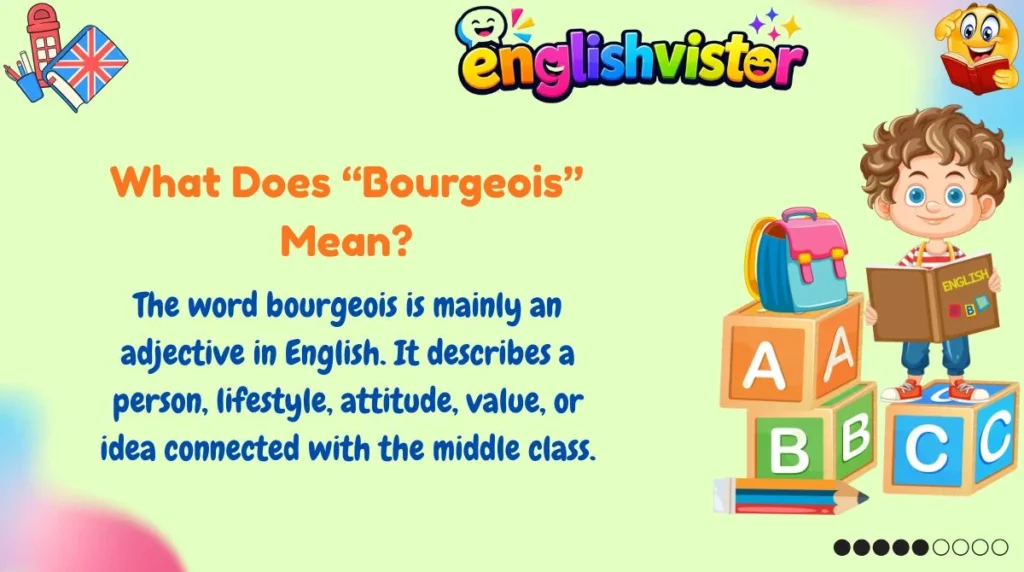
The word bourgeois is mainly an adjective in English. It describes a person, lifestyle, attitude, value, or idea connected with the middle class.
Traditionally, the word referred to people who were neither very poor nor part of the highest social class. Today, it can describe someone who values comfort, stability, money, property, and traditional success.
The pronunciation is usually “boor-ZHWAH” in English.
When to Use Bourgeois
Use bourgeois when you want to describe something.
It answers questions like:
- What kind of lifestyle?
- What type of values?
- What type of person?
- What kind of culture?
Because it describes something, it usually comes before a noun.
Grammar Rule
Bourgeois + noun
Examples:
- bourgeois lifestyle
- bourgeois family
- bourgeois values
- bourgeois culture
Example Sentences
- She enjoys a comfortable bourgeois lifestyle with a nice home and stable career.
- Some writers criticize bourgeois values because they believe society focuses too much on money.
- His parents have a traditional bourgeois attitude toward education and success.
- The novel describes a bourgeois family living in a peaceful neighborhood.
- Many people consider owning a house part of a bourgeois dream.
- The artist rejected bourgeois ideas and wanted a simpler life.
- The film shows the daily habits of a bourgeois community.Bourgeois vs Bourgeoisie.
- He grew up in a bourgeois environment where education was highly valued.
Common Learner Confusion
Many students think bourgeois means “a rich person.” That is not always correct.
A bourgeois person is not necessarily extremely wealthy. The word is more connected with the middle class and certain lifestyle choices.
For example:
- A person with a stable job, home, and comfortable lifestyle may be described as bourgeois.Bourgeois vs Bourgeoisie.
- A billionaire would not usually be called bourgeois because the word traditionally refers to the middle class.
What Does “Bourgeoisie” Mean?
The word bourgeoisie is a noun. It refers to a social class or group of people.
Historically, especially in Marxist theory, the bourgeoisie refers to the class of people who own businesses, property, or capital. They are often compared with the working class.
In modern English, the word can also refer generally to the middle class as a social group.
When to Use Bourgeoisie
Use bourgeoisie when talking about a group of people.
It does not describe something. It names a social group.Bourgeois vs Bourgeoisie.
Grammar Rule
The bourgeoisie + verb
The word usually appears with the because it refers to a specific social group.
Examples:
- The bourgeoisie became powerful during the industrial period.
- The bourgeoisie influenced economic changes.Bourgeois vs Bourgeoisie
Example Sentences
- The bourgeoisie played an important role during the growth of modern industries.
- Many historians study the relationship between the bourgeoisie and the working class.
- The book explains how the bourgeoisie gained political influence.
- The bourgeoisie often supported business development.
- Some social theories focus on conflicts between the bourgeoisie and other classes.
- The rise of the bourgeoisie changed many European societies.
- The writer discusses how the bourgeoisie lived during the nineteenth century.
- The bourgeoisie was an important topic in economic history.
Common Learner Confusion
The biggest mistake is using bourgeoisie to describe one person.
Incorrect:
- He is bourgeoisie.
Correct:
- He belongs to the bourgeoisie.
- He has a bourgeois lifestyle.
Remember that bourgeoisie is a group, not an adjective.
Difference Between Bourgeois and Bourgeoisie
Although these words look similar, their grammar and meaning are different.
| Feature | Bourgeois | Bourgeoisie |
|---|---|---|
| Part of speech | Adjective (sometimes noun) | Noun |
| Meaning | Describes a lifestyle, attitude, or person | A social class or group |
| Refers to | One thing or individual quality | A group of people |
| Common use | Before a noun | Usually with “the” |
| Example | bourgeois culture | the bourgeoisie |
| Main idea | Description | Social group |
Usage Difference
The easiest way to understand the difference is this:
Bourgeois describes. Bourgeoisie names.
Compare:
- She has a bourgeois lifestyle.
- She belongs to the bourgeoisie.
In the first sentence, bourgeois describes the lifestyle.
In the second sentence, bourgeoisie names the social group.Bourgeois vs Bourgeoisie.
Grammar Logic
English often changes words when moving from describing something to naming a group.
Examples:
- wealthy → the wealthy
- poor → the poor
- bourgeois → bourgeoisie
The ending -ie in bourgeoisie creates a noun referring to a group.
Sentence Structure Difference
Bourgeois Structure:
Subject + verb + bourgeois + noun
Example:
- They have bourgeois tastes.
Bourgeoisie Structure:
Subject + verb + the bourgeoisie
Example:
- The bourgeoisie controlled many businesses.
Grammar Rules You Must Remember
Use Bourgeois to Describe Something
When you are describing a lifestyle, belief, or attitude, use bourgeois.
Example:
- They live a bourgeois lifestyle.
Not:
- They live a bourgeoisie lifestyle.
Use Bourgeoisie for a Social Group
When you mean a whole class of people, use bourgeoisie.
Example:
- The bourgeoisie gained economic power.
Not:
- The bourgeois gained economic power.
Bourgeoisie Usually Needs “The”
Because it refers to a specific social group, it often comes with “the.”
Example:
- The bourgeoisie influenced politics.
4: Think About Description vs Group
Ask yourself:
“Am I describing something?”
Use:
- bourgeois
“Am I talking about a group?”
Use:
- bourgeoisie
Example:
- bourgeois fashion (description)
- the bourgeoisie (group)
Common Mistakes Students Make
Mistake 1: Using Bourgeoisie as an Adjective
Wrong:
- She has a bourgeoisie home.
Correct:
- She has a bourgeois home.
Why?
Because the home is being described.
Mistake 2: Using Bourgeois for a Social Class
Wrong:
- The bourgeois created many industries.
Correct:
- The bourgeoisie created many industries.
Why?
Because you are talking about a group.
Mistake 3: Forgetting “The”
Wrong:
- Bourgeoisie was powerful in Europe.
Correct:
- The bourgeoisie was powerful in Europe.
Why?
The word usually refers to a specific social class.
Mistake 4: Thinking Bourgeois Means Only Rich
Wrong idea:
- Every rich person is bourgeois.
Better understanding:
Bourgeois usually connects with middle-class lifestyle, comfort, and traditional values.
Easy Trick to Remember the Difference
Use this simple memory trick:
Bourgeois = describes.
Bourgeoisie = people.
The longer word bourgeoisie ends with “-ie.” Think:
“Group of people = longer word.”
The shorter word bourgeois is used like an adjective:
- Bourgeois vs Bourgeoisie.
- bourgeois lifestyle
- bourgeois ideas
Imagine you are describing a house:
“The house has a bourgeois style.”
Now imagine you are talking about people:
“The bourgeoisie lived in cities.”Bourgeois vs Bourgeoisie.
One describes. One represents a group.
Daily Life Examples
Here are simple examples from real conversations:
- My grandparents have a bourgeois lifestyle. They enjoy comfort and stability.
- The documentary explains how the bourgeoisie changed society.
- She dislikes bourgeois attitudes about success and money.Bourgeois vs Bourgeoisie.
- The history teacher talked about the rise of the bourgeoisie.
- His taste in furniture is Bourgeois vs Bourgeoisiebourgeois.
- The novel focuses on the lives of the bourgeoisie.
- Some people criticize bourgeois values, while others appreciate them.
- The museum has an exhibition about the bourgeoisie in Europe.
- Their home looks modern but slightly bourgeois.Bourgeois vs Bourgeoisie.
- The writer compared the working class with the bourgeoisie.
Practice Section
Choose the correct word: bourgeois or bourgeoisie
1. The ______ played an important role in European history.
2. They have a very ______ lifestyle.
3. The book discusses the power of the ______.
4. She prefers a simple life instead of a ______ lifestyle.
5. Historians often study the relationship between workers and the ______.
Answers:
- bourgeoisie
- Bourgeois vs Bourgeoisie.
- bourgeoisie
- Bourgeois vs Bourgeoisie.
- bourgeoisie
FAQs
1. What is the difference between bourgeois and bourgeoisie?
Bourgeois is mainly an adjective used to describe a lifestyle, attitude, or idea. Bourgeoisie is a noun that refers to a social class or group of people.
2. Can bourgeois be used as a noun?
Yes, sometimes bourgeois can be used as a noun to describe a person from the middle class, but this use is less common than using it as an adjective.Bourgeois vs Bourgeoisie.
3. Is bourgeois formal or informal?
Bourgeois is usually a formal or academic word. It often appears in discussions about society, culture, history, and economics.
4. Is bourgeoisie always about rich people?
No. The word traditionally refers to the middle class, especially people connected with business and property ownership. It does not simply mean “very wealthy.”Bourgeois vs Bourgeoisie
5. Can I say “a bourgeois person”?
Yes. You can say “a bourgeois person” when describing someone with middle-class values or lifestyle.
Example:
- He is a bourgeois person who enjoys comfort and security.
6. Why do people confuse bourgeois and bourgeoisie?
They look almost identical because they come from the same French root. The main difference is grammar: bourgeois describes, while bourgeoisie names a group.
Conclusion
Understanding the difference between bourgeois vs bourgeoisie becomes easy when you remember one simple idea: bourgeois describes, and bourgeoisie refers to a group of people.
Use bourgeois for lifestyles, ideas, attitudes, and things that have certain middle-class qualities. Use the bourgeoisie when you are talking about a social class or historical group.Bourgeois vs Bourgeoisie
These words may seem difficult at first because they come from French and are often used in academic discussions. However, with regular practice and a few examples, they become much easier to use correctly.
Whenever you see these words, ask yourself one question: “Am I describing something, or am I naming a group?” That small question will help you choose the right word every time.
Keep practicing with real sentences, and soon these confusing vocabulary pairs will feel natural in your English conversations and writing.

Hi, I’m Isabella Foster, an English language writer passionate about making grammar, vocabulary, and communication skills easy to understand. At EnglishVistor, I create clear, practical, and engaging learning resources to help learners improve their English with confidence.