English learners often wonder about later or later on because both expressions talk about a time after now or after another event. At first, they may look exactly the same. In many sentences, they can even be used in similar ways. This makes the choice confusing for students who are still learning everyday English.
The good news is that the difference is quite simple. Later is the shorter and more common word. It can mean “at a time after now” or “at a time after another event.” Later on has almost the same basic meaning, but it often gives a stronger feeling of “at some time after this” or “as time passes.”
Knowing when to use each expression can make your English sound more natural. You may hear both expressions in conversations, movies, messages, classrooms, and workplaces Later or Later On.
By the end, you will understand the meaning, grammar, sentence patterns, and common uses of both expressions. You will also see real-life examples that show how native speakers normally use them.
The important point is this: both forms are correct, but they are not always equally natural in every sentence. Learning the small difference will help you choose the better expression.Later or Later On.
What Does “Later” Mean?
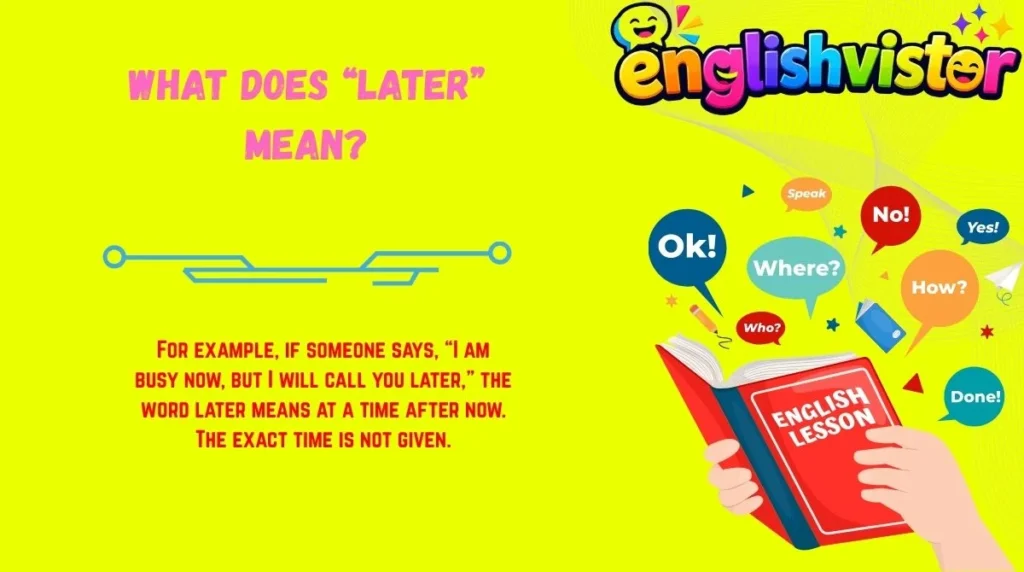
Later means at a time after now or after a time that has already been mentioned. It is one of the most common time words in English.
For example, if someone says, “I am busy now, but I will call you later,” the word later means at a time after now. The exact time is not given.
We also use later when talking about something that happens after another event.Later or Later On.
Consider this sentence:
I went to the bank and later met my friend.
Here, later means after going to the bank. It does not necessarily mean much later. It simply tells us that the second event happened afterward.Later or Later On.
A useful grammar point is that later can work as an adverb. It tells us when an action happens.Later or Later On.
Here are some natural examples:
- I will talk to you later.
- She came home later than usual.
- We can discuss this later.
- He arrived later than his brother.
- I found the answer later.
- They went out later that evening.
- I will finish the work later today.
- She called me later.
You can also use later with words such as today, tonight, this week, or than usual.Later or Later On.
For example:
I will see you later today.
He arrived later than expected.
One common learner mistake is thinking that later always means a long time afterward. It does not. The time can be very short or very long depending on the situation.Later or Later On.
If your friend says, “I will call you later,” they might call in ten minutes, two hours, or even later that day. The exact meaning comes from the situation.
Another useful point is that later can be used by itself:
“When will you do it?”
“Later.”
This is very common in spoken English.
What Does “Later On” Mean?
Later on is also a time expression. It generally means at a later time or after some time has passed.
In many situations, it has almost the same meaning as later.Later or Later On.
For example:
I will call you later on.
This means that the speaker will call at a later time.
You can also say:
We can talk about it later on.
The meaning is still “at a later time.”
The word on does not give a separate time meaning here. Together, later on works as a time expression.Later or Later On.
Here are some examples:
- I will finish it later on.
- We can talk about that later on.
- She became famous later on in life.
- I understood the problem later on.
- They decided to leave later on.
- He learned the truth later on.
- We may need your help later on.
- Things became easier later on.
One important feature of later on is that it can sometimes suggest a period of time passing before something happens.Later or Later On.
For example:
At first, I did not like the job, but later on, I started enjoying it.
The phrase later on fits nicely because the speaker is describing a change that happened after some time.
Similarly:
Later on in the story, the main character meets his brother.
Here, later on means at a point farther along in the story.
This is one reason learners often hear later on in stories, explanations, and conversations about events that develop over time.
However, do not think that later on is always better than later. In many simple sentences, later sounds shorter and more natural.
For example:
I will call you later.
This is extremely natural.
You could say:
I will call you later on.
This is also possible, but the shorter version is often more direct.Later or Later On.
Difference Between “Later” and “Later On” (Detailed)
The basic difference between later or later on is very small. Both expressions can refer to a time after now or after another event.
The main difference is often style, emphasis, and context, rather than a completely different meaning.Later or Later On.
| Point | Later | Later on |
|---|---|---|
| Basic meaning | At a later time | At a later time |
| Grammar | Adverb | Adverbial time expression |
| Common in speech | Very common | Common |
| Short and direct | Yes | Slightly longer |
| Can mean “afterward” | Yes | Yes |
| Can describe development over time | Yes | Often especially natural |
| Formality | Neutral | Neutral |
| Exact time | Usually not stated | Usually not stated |
Usage Difference
Later is usually the simplest choice when you want to say that something will happen after now.Later or Later On.
I will call you later.
This sounds natural, clear, and direct.
Later on can do the same thing:
I will call you later on.
There is no major change in basic meaning. However, later on can sound a little more conversational or can emphasize that something happens after a period of time.Later or Later On.
Compare:
I will explain it later.
I will explain it later on.
Both are correct. The first is shorter and more direct. The second can sound slightly more relaxed.
Grammar Logic
The word later is an adverb. It can modify a verb by showing when something happens.Later or Later On.
She arrived later.
We talked later.
He called later.
Later on works as a combined time expression.Later or Later On.
She arrived later on.
We talked later on.
He called later on.
The meaning remains very close.
Sentence Structure Difference
You can place later in several positions:
I will do it later.
Later, I will explain everything.
She came later than me.
You can also use later on in different positions:
I will do it later on.
Later on, I will explain everything.
Later on in the day, we went home.
The expression is especially useful when you want to connect one part of a story or process with another.Later or Later On.
Meaning Comparison
The safest way to remember the difference is:
Later = at a time after now or another time.
Later on = at a later time, often with a feeling that some time passes first.
But remember that this is not an absolute rule. In many sentences, the two expressions can replace each other without changing the basic meaning.Later or Later On.
Grammar Rules You Must Remember
1. Use “later” for a simple future time
When you simply mean “after now,” later is usually the easiest choice.Later or Later On.
I will call you later.
We can meet later.
She will answer later.
You do not need to add on.
2. “Later” can compare two times
You can use later with than.
He arrived later than me.
She went to bed later than usual.
The train came later than expected.
Here, later clearly compares one time with another.
3. “Later on” can describe something that happens after time passes
When telling a story or explaining a process, later on can sound very natural.Later or Later On.
Later on, we discovered the truth.
Later on in the meeting, everyone agreed.
Later on in life, she became a teacher.
The phrase works especially well when the speaker is moving forward through time.
4. Do not use “on” after every form of “later”
Learners sometimes add on because they think it makes the expression more complete.
That is not necessary.
Correct:
I will see you later.
Also possible:
I will see you later on.
Both are correct.
But if you are simply giving a short answer, later is often more natural:
“See you later!”
This is one of the most common everyday expressions in English.Later or Later On.
Common Mistakes Students Make
Mistake 1: Thinking “later” is wrong without “on”
Some learners believe that the phrase must be later on.
That is incorrect.
❌ I will call you later on because “later” is incomplete.
There is nothing wrong with the sentence:
✅ I will call you later.
Later is a complete and correct adverb.Later or Later On.
Mistake 2: Thinking “later on” has a completely different meaning
The two expressions are not completely different.
I will speak to him later.
I will speak to him later on.
The basic meaning is almost the same.
The choice often depends on context and personal style.Later or Later On.
Mistake 3: Using “later” when a comparison is needed incorrectly
Remember the difference between later and latest.
For example:
She arrived later than I did.
But:
This is the latest train.
Later compares time. Latest means the most recent or the final time in a series.Later or Later On.
Mistake 4: Confusing “later” with “latter”
These words sound similar, but their meanings are different.Later or Later On.
Later relates to time.
I will explain it later.
Latter refers to the second of two things already mentioned.
I like tea and coffee, but I prefer the latter.
Do not use latter when you mean a future time.Later or Later On.
Easy Correction Tips
When you are unsure, ask yourself:
Am I simply talking about a time after now?
If yes, later is usually an excellent choice.
If you are describing a story, process, or change that happens after some time, later on may sound especially natural.
The important thing is not to worry too much. Native speakers use both expressions naturally.
Easy Trick to Remember the Difference
Think “short” and “story”
A simple memory trick is:
Later = short and direct.
Later on = after some time or farther along.
Imagine your friend asks:
“When will you call me?”
You can simply say:
“Later.”
That is short and direct.
Now imagine you are telling a story:
“At first, I was nervous. Later on, I became comfortable.”
Here, you are moving through the story. Later on feels natural because something changed as time passed.
You can also remember this:
Later is like pointing to a future time.
Later on is like moving forward along a timeline.
For example:
Now → Later
But in a story:
Beginning → Events → More time passes → Later on
This does not mean that later on always refers to a long period. It is simply a useful way to think about the common difference in feel.
Daily Life Examples (Very Important)
1. Talking to a friend
“Are you free now?”
“No, I’m busy. I’ll call you later.”
This is a very natural use of later.
2. Making plans
“Can we discuss the project now?”
“I’m in a meeting. Let’s talk later on.”
Here, later on gives the idea that the discussion can happen after the current activity.
3. Talking about the evening
“What are you doing tonight?”
“I’m going to finish my homework first. I’ll watch a movie later.”
The word later is perfect for a simple future time.
4. Telling a story
“At first, he did not understand the lesson. Later on, he realized what the teacher meant.”
The second sentence describes a change after some time.
5. Talking about work
“I cannot check the report right now. I’ll look at it later.”
This sounds natural and professional.
6. Talking about a journey
“We stopped for lunch. Later on, we reached the hotel.”
The phrase helps move the listener forward in the story.
7. Talking about plans
“I need to clean the kitchen first. I’ll rest later.”
This is a simple use of later.
8. Talking about personal development
“I did not like English when I was young, but later on, I started enjoying it.”
Here, later on works well because the speaker is talking about a change over time.
9. Ending a conversation
“I have to go now. See you later!”
This is one of the most common uses of later in everyday English.
10. Explaining a process
“First, add the flour. Later on, add the milk and mix everything.”
The phrase can help show the next stage of a process.
These examples show why context matters. Sometimes later sounds best because the sentence is short and direct. At other times, later on fits better because the speaker is describing a story, process, or change over time.
Practice Section
Choose the Correct Option
Choose later or later on in each sentence. In several cases, both may be possible, but choose the expression that sounds most natural in the context.
- I’m busy right now. I’ll call you ______.
- ______ in the story, the boy finds his lost dog.
- We can discuss the problem ______.
- She became more confident ______ in life.
- “See you ______!”
Answers
- later — “I’ll call you later” is short and natural.
- later on — it moves the reader farther through the story.
- later — this is a simple statement about a future time.
- later on — it describes development over a period of time.
- later — “See you later!” is the normal everyday expression.
The key lesson is that you should not try to force a completely different meaning onto the two expressions. They often overlap.
Instead, look at the context. If the sentence is short and direct, later is often the natural choice. If you are moving through a story or describing something that happens after some time, later on may fit better.
FAQs
What is the difference between later and later on?
Both expressions usually mean “at a time after now” or “at a time after another event.” Later is shorter and very common in everyday speech. Later on can have a slightly stronger feeling of time passing or moving forward in a story.
Can we use later in questions?
Yes. Later can be used naturally in questions.
For example:
“Can we talk later?”
“Will you come later?”
It is also possible to ask:
“Can we talk later on?”
Both can be correct, although the shorter form is often more direct.
Is later formal or informal?
Later is neutral and can be used in both casual and formal English. It is common in conversations, emails, school writing, and workplace communication. The exact sentence and context determine the level of formality.
Is later on grammatically correct?
Yes. Later on is a correct and common English expression. It can mean “at a later time.” It is especially natural when talking about events that happen farther along in a story, process, or period of time.
Can later and later on be used interchangeably?
Often, yes. For example, “I’ll call you later” and “I’ll call you later on” have nearly the same meaning. However, they may not feel exactly the same in every context. Later on can sound more connected to the passage of time.
Which one should English learners use?
If you are unsure, later is usually the safest and simplest choice for everyday English. It is short, natural, and widely used. Learn later on as a useful alternative, especially for stories, explanations, and situations where time seems to move forward.
Conclusion
The difference between later or later on is much smaller than many English learners expect. Both expressions can talk about a time after now or after another event.
Later is the shorter and more direct choice. You can use it when making plans, ending conversations, or saying that something will happen after now. For example, “I’ll call you later” and “See you later” are completely natural.
Later on has a very similar meaning. It can be especially useful when talking about a story, a process, or a change that happens after some time has passed. For example, “Later on, she understood the problem” sounds natural when describing a change in understanding.
You do not need to memorize a difficult grammar rule. Just pay attention to the situation. For simple everyday statements, later is often enough. When you are moving forward through a story or describing events over time, later on can be a good choice.
The best way to learn the difference is to notice these expressions in real conversations and then use them yourself. With regular practice, choosing between them will become much easier.

Hi, I’m Isabella Foster, an English language writer passionate about making grammar, vocabulary, and communication skills easy to understand. At EnglishVistor, I create clear, practical, and engaging learning resources to help learners improve their English with confidence.