Last updated on October 8th, 2026 at 12:32 pm
English learners often wonder whether they should say “speak to” or “speak with.” Both expressions are correct, and both are very common in everyday English.
The confusing part is that their meanings are so close that, in many situations, either one can sound natural Speak to or Speak With.
For example, you might hear someone say, “I need to speak to my teacher,” while another person says, “I need to speak with my teacher.”
Does one sentence mean something different? Usually, not in any important way.Speak to or Speak With.
The small difference is mainly about tone, focus, and the relationship between the speakers. “Speak to” can sometimes sound a little more direct, especially when one person wants to give information, instructions, or advice.Speak to or Speak With.
“Speak with” can sometimes suggest a more mutual conversation. However, native speakers do not always make this distinction.Speak to or Speak With.
Understanding speak to or speak with is useful because both phrases appear in school, work, family conversations, customer service, emails, and formal situations. Choosing the right expression can also help your English sound more natural.
By the end of this guide, you will understand when to use speak to, when to use speak with, whether one is more formal, and why native speakers often use them interchangeably.Speak to or Speak With.
What Does “Speak To” Mean?
Speak to means to talk to someone or communicate with someone. It is one of the most common ways to describe a conversation in English.Speak to or Speak With.
The person you are talking to comes after to.Speak to or Speak With.
Basic structure:
speak + to + person
For example:
- I need to speak to John.
- She spoke to her manager.
- Can I speak to you for a minute?
- We should speak to the teacher.
- He wants to speak to his parents.
The expression does not always mean that the conversation is serious. It can describe a normal, friendly, short, or formal conversation.Speak to or Speak With.
For example, you could say:
I spoke to Sarah at lunch.
This simply means that you had a conversation with Sarah.
When Should You Use “Speak To”?
Use speak to when you want to say that someone communicated with another person. It is especially common in British English, although American English speakers use it too.
It can also be used when someone has something specific to tell another person.
The manager needs to speak to you.
Depending on the situation and tone, this sentence could sound neutral or slightly serious.Speak to or Speak With.
Another example is:
I need to speak to my doctor about this problem.
Here, speak to simply means communicate with the doctor.
Grammar Rule for “Speak To”
The verb speak can be followed by to when the person receiving the communication is mentioned.Speak to or Speak With.
speak + to + person
Remember that the verb changes according to tense:
- speak to
- spoke to
- spoken to
Examples:
I speak to my brother every day.
I spoke to my brother yesterday.
I have spoken to my brother already.
Notice that “speak” is irregular. The past form is spoke, and the past participle is spoken.
Examples of “Speak To”
- I need to speak to my teacher after class.
- She spoke to her mother last night.
- Can I speak to the manager, please?
- He has already spoken to the customer.
- You should speak to your doctor if you are worried.
- I want to speak to you about your homework.
- We spoke to our neighbors about the noise.
- Did you speak to James yesterday?
A Common Confusion
Some learners think speak to means that only one person is talking and the other person is simply listening. That is not necessarily true.Speak to or Speak With.
A conversation can be two-way even when we use speak to.Speak to or Speak With.
I spoke to Tom for an hour.
This clearly suggests a conversation, not simply one person talking.
So, when comparing speak to or speak with, do not assume that speak to always means “talking at someone.” Context matters.
What Does “Speak With” Mean?
Speak with also means to talk to someone or have a conversation with someone.Speak to or Speak With.
The basic structure is:
speak + with + person
For example:
- I need to speak with Sarah.
- He spoke with his boss.
- Can I speak with you?
- We should speak with the customer.
- She wants to speak with her teacher.
In many situations, speak with and speak to have exactly the same practical meaning.Speak to or Speak With.
For example:
I need to speak to my manager.
and
I need to speak with my manager.
Both can mean that you need to have a conversation with your manager.
When Should You Use “Speak With”?
Speak with can be useful when you want to emphasize a conversation between two people.Speak to or Speak With.
The word with naturally suggests being together or communicating together.
For example:
I spoke with my friend about the problem.
This sounds like a discussion between you and your friend.
It does not mean that speak to would be wrong. You could also say:
I spoke to my friend about the problem.
That is perfectly natural.
Grammar Rule for “Speak With”
The structure is:
speak + with + person
The tense rules are exactly the same as with speak to.
I speak with my parents every weekend.
I spoke with my parents yesterday.
I have spoken with my parents already.
The preposition changes, but the verb does not.
Examples of “Speak With”
- I need to speak with my teacher.
- She spoke with her manager this morning.
- Can I speak with you privately?
- We have spoken with several customers.
- He wants to speak with his lawyer.
- I spoke with Anna about the project.
- Did you speak with your brother?
- The doctor spoke with the patient before the test.
A Common Confusion
Some learners believe that speak with is always more polite than speak to. This is not a strict grammar rule.Speak to or Speak With.
“Speak with” can sound collaborative, but “speak to” is also polite when used appropriately.
For example:
Could I speak to you for a moment?
This is perfectly polite.
Likewise:
Could I speak with you for a moment?
This is also polite.
Therefore, the choice between speak to or speak with often depends on personal preference, regional English, and the situation.
Difference Between “Speak To” and “Speak With”
The biggest point to remember is simple:
Both are correct.
In most everyday situations, speak to and speak with mean talk to someone or have a conversation with someone.Speak to or Speak With.
There can be a slight difference in emphasis, but it is not a fixed grammar rule.
| Expression | Basic meaning | Common feeling | Example |
|---|---|---|---|
| Speak to | Talk to someone | Direct, neutral, or conversational | I need to speak to John. |
| Speak with | Talk with someone | Mutual or conversational | I need to speak with John. |
1. Usage Difference
Speak to is extremely common and can be used in almost any situation.
I spoke to my sister yesterday.
Speak with is also common and can make the interaction feel slightly more mutual.Speak to or Speak With.
I spoke with my sister yesterday.
There is no major difference in the actual event. In both cases, you talked to your sister.Speak to or Speak With.
2. Grammar Logic
Both prepositions can introduce the person who receives or participates in the communication.Speak to or Speak With.
speak to someone
speak with someone
Both patterns are grammatically correct.
This is why asking which one is “correct” can be misleading. The better question is which one sounds more natural in the situation?
3. Sentence Structure
The sentence structure is almost identical.Speak to or Speak With.
Speak to:
Subject + speak + to + person
Example:
I spoke to my teacher.
Speak with:
Subject + speak + with + person
Example:
I spoke with my teacher.
You can also add the topic of the conversation:
I spoke to my teacher about my grades.
I spoke with my teacher about my grades.
You can see that the rest of the sentence does not need to change.
4. Meaning Comparison
Consider these two sentences:
I need to speak to the manager.
I need to speak with the manager.
Both normally mean that you want to have a conversation with the manager.Speak to or Speak With.
However, depending on context, speak to may sound a little more direct:
The principal wants to speak to you.
This could sound serious, especially if a student has done something wrong.Speak to or Speak With.
But speak with can sound more like a discussion:
The principal would like to speak with you about the new school program.
Here, the context sounds cooperative.
Still, these are possible shades of meaning, not hard rules.
British English and American English
Both expressions appear in different varieties of English.
British speakers commonly use speak to, while speak with is also completely acceptable.
American speakers also use both. In casual American English, talk to and talk with are extremely common.
So, do not worry that one expression is “wrong” because of your variety of English.
Can “Speak to” and “Speak With” Be Used in the Same Sentence?
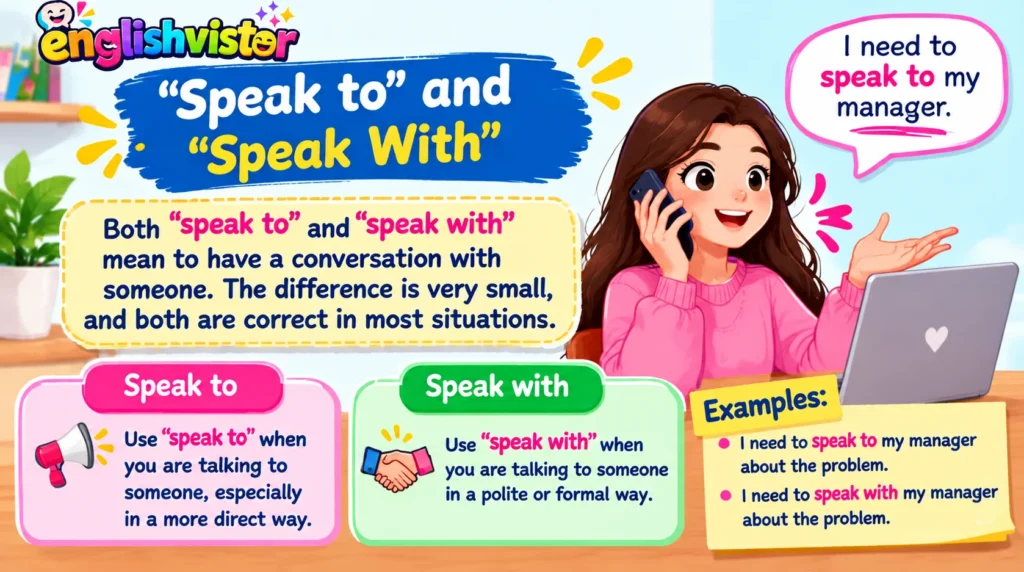
Yes, Speak to or Speak With can often be used in the same sentence without changing the main meaning.
Both expressions can describe communication between two or more people.
The choice usually depends on the speaker’s preferred wording, the situation, and sometimes the style of English being used.
For example, you can say, “I need to speak to my manager about the problem,” or “I need to speak with my manager about the problem.”
In Speak to or Speak With, both versions are grammatically correct and normally tell the reader that you want to have a conversation with your manager.
You may also see both expressions in formal and everyday English.
A receptionist might say, “Would you like to speak to the manager?” while another person might say, “I would like to speak with the manager.” Neither sentence is automatically more correct.
The same applies to past-tense sentences. “I spoke to my teacher yesterday” and “I spoke with my teacher yesterday” can both describe the same conversation.
Therefore, Speak to or Speak With should not be treated as a choice between a correct and incorrect expression.
Couple or Few or Some or Several or Many
Which Expression Sounds More Natural in Everyday English?
When choosing between Speak to or Speak With, the most natural option depends on the speaker, region, and context.
Speak to is extremely common and works well when you simply want to say that you need to communicate with someone. For example, “I need to speak to my brother” sounds completely natural.
Speak with is also natural, especially when the speaker wants to present the interaction as a conversation or discussion.
For example, “I need to speak with my brother about our plans” clearly suggests that the two people will discuss something together.
However, this difference is not a strict rule.
Native speakers can use Speak to or Speak With in many of the same situations without intending a different meaning. A person might say “I spoke to my colleague” one day and “I spoke with my colleague” the next day.
If you are unsure, speak to is a safe and widely understood choice.
But there is no need to avoid speak with. Both expressions are standard English, and both can sound natural in everyday conversations, school, work, and formal communication.
The key lesson for Speak to or Speak With is simple: choose the expression that fits your sentence naturally, and do not assume that one is always more correct than the other.
Grammar Rules You Must Remember
Rule 1: Both “Speak To” and “Speak With” Are Correct
Do not memorize a rule saying that only one is grammatically correct.
I spoke to my teacher.
I spoke with my teacher.
Both sentences are correct.
Rule 2: Use “Spoke” for the Simple Past
The past form of speak is spoke, not “speaked.”
Incorrect:
I speaked to him yesterday.
Correct:
I spoke to him yesterday.
This mistake is more important to fix than choosing between to and with.
Rule 3: Use “Spoken” After Have, Has, or Had
The past participle is spoken.
I have spoken to her.
She has spoken with the manager.
They had spoken to the teacher before the meeting.
Do not say:
I have spoke to him.
Say:
I have spoken to him.
Rule 4: “Speak To” Can Be Used for Direct Communication
When someone wants to communicate with another person, speak to is natural.
I need to speak to my boss.
Please speak to the receptionist.
You should speak to your parents.
It can also be used for formal requests:
May I speak to Mr. Khan, please?
Rule 5: “Speak With” Can Highlight a Two-Way Conversation
When you want to make the conversation feel mutual, speak with can be a good choice.
I spoke with my colleague about the problem.
She spoke with her parents before making a decision.
But remember: speak to can describe the same two-way conversation.
Rule 6: Do Not Think “With” Always Means More Polite
Politeness comes from the whole sentence, not simply from the preposition.
Compare:
Speak to me now.
Could I speak to you for a moment, please?
The second sentence sounds more polite because of could, please, and the softer wording.
Common Mistakes Students Make
Mistake 1: Thinking “Speak With” Is the Only Correct Form
Some learners hear that “with” means two people are talking, so they decide that “speak to” must be incorrect.
That is not true.
Incorrect idea:
“I spoke to him” is grammatically wrong.
Correct understanding:
I spoke to him is completely correct.
Mistake 2: Using “Spoke” After “Did”
After did, use the base form speak, not “spoke.”
Incorrect:
Did you spoke to Sarah?
Correct:
Did you speak to Sarah?
The same rule applies to “speak with”:
Did you speak with Sarah?
Not:
Did you spoke with Sarah?
Mistake 3: Using “Speaked”
Because many English verbs form their past tense with -ed, learners sometimes say “speaked.”
Incorrect:
She speaked with her teacher.
Correct:
She spoke with her teacher.
Mistake 4: Thinking the Choice Changes the Meaning Completely
The difference between speak to or speak with is often much smaller than learners expect.
I spoke to my friend.
I spoke with my friend.
Both normally tell us that you had a conversation with your friend.
The surrounding words and situation give us more information about the conversation.
Mistake 5: Avoiding One Expression Completely
Some students memorize only speak to and never use speak with. Others do the opposite.
There is no need to avoid either expression.
Learn both, notice how native speakers use them, and choose the one that feels natural for the situation.
Easy Trick to Remember the Difference
Here is an easy classroom trick:
TO = talking toward someone.
WITH = talking together.
This is only a memory trick, not a strict grammar rule.
Imagine:
I need to speak to the manager.
Your attention is on the person you want to contact.
Now imagine:
I need to speak with the manager about our plans.
The word with can help you picture two people sitting together and discussing something.
But remember the most important point:
Both expressions can describe the same conversation.
Think of two doors that lead to almost the same room. One door says speak to. The other says speak with. In ordinary English, both doors are open.
For learners, this is the safest rule:
If you are talking to another person, both “speak to” and “speak with” can usually work.
Daily Life Examples
Real-Life Spoken English
Here are some natural examples you might hear at school, at work, at home, or on the phone.
1. At School
Student: I need to speak to my teacher about my grade.
This sounds completely natural. You could also say:
I need to speak with my teacher about my grade.
2. At Work
Employee: Can I speak to you after the meeting?
This is a normal workplace sentence.
You can also say:
Can I speak with you after the meeting?
Both work.
3. On the Phone
Caller: May I speak to Mr. Ahmed, please?
This is a very common telephone expression.
You could also say:
May I speak with Mr. Ahmed, please?
But speak to is especially common in this type of request.
4. Talking About a Problem
I think you should speak to your parents about it.
This means you should have a conversation with your parents.
You could also say:
I think you should speak with your parents about it.
5. At a Doctor’s Office
The doctor wants to speak with you before the appointment.
This sounds natural and professional.
You could use speak to as well:
The doctor wants to speak to you before the appointment.
6. Talking About a Friend
I spoke to Mike yesterday.
This does not tell us that Mike only listened. It normally means you had a conversation.
7. A Business Conversation
Our team needs to speak with the client before making a decision.
Here, speak with sounds natural because the team needs to discuss something with the client.
8. A Serious Situation
The teacher needs to speak to you about your behavior.
The expression can sound serious because of the context.
Changing to to with does not necessarily remove the seriousness:
The teacher needs to speak with you about your behavior.
The context still matters.
9. A Friendly Conversation
I spoke with my cousin for two hours last night.
This sounds like a relaxed conversation.
You could also say:
I spoke to my cousin for two hours last night.
Again, both are natural.
10. Asking for Help
You should speak to someone if you need help.
This is common advice.
You could also say:
You should speak with someone if you need help.
Both are grammatically correct.
Practice Section
Choose the Correct Option
Choose speak to or speak with. Remember that in many sentences, both may be possible.
1. I need to ______ my manager about the new project.
a) speak to
b) speak with
2. Did you ______ Sarah yesterday?
a) speak to
b) spoke to
3. She has ______ her doctor about the problem.
a) spoken to
b) spoke to
4. Can I ______ you for a minute?
a) speak to
b) speak with
5. We ______ our teacher after class.
a) spoke with
b) speaked with
Answers
1. Both “speak to” and “speak with” are correct.
I need to speak to my manager.
I need to speak with my manager.
2. Speak to
Did you speak to Sarah yesterday?
After did, use the base form speak.
3. Spoken to
She has spoken to her doctor about the problem.
After has, use the past participle spoken.
4. Both are correct
Can I speak to you for a minute?
Can I speak with you for a minute?
5. Spoke with
We spoke with our teacher after class.
“Speaked” is incorrect.
FAQs
What is the difference between “speak to” and “speak with”?
Both usually mean to talk to someone or have a conversation with someone. “Speak to” can sometimes sound more direct, while “speak with” can sometimes emphasize a two-way discussion. In everyday English, they are often interchangeable.
Is “speak to” grammatically correct?
Yes. Speak to is completely correct and very common in English. You can use it in casual conversations, workplaces, schools, customer service, and formal situations. For example, “I need to speak to my teacher” is perfectly natural.
Is “speak with” grammatically correct?
Yes. Speak with is also grammatically correct. It is often used when talking about a conversation or discussion between people. For example, “I spoke with my manager yesterday” is a natural English sentence.
Is “speak to” more formal than “talk to”?
Not necessarily. Speak to can sound slightly more formal than talk to, depending on the situation. However, both are common. “Talk to” is especially common in everyday spoken English.
Can I use “speak with” in a formal situation?
Yes. Speak with is perfectly suitable for formal English. You can say, “I would like to speak with the director,” or “The doctor spoke with the patient.” The expression is not limited to casual conversations.
Which is better: “speak to or speak with”?
Neither is always better. Both are correct. Choose speak to when you want the most broadly familiar option, especially in phrases such as “May I speak to Mr. Brown?” Choose speak with when you like the idea of emphasizing a conversation or discussion. Native speakers use both.
Conclusion
The choice between speak to or speak with is much easier once you understand one important fact: both expressions are correct.
Speak to means to communicate or have a conversation with someone. Speak with has the same basic meaning and can sometimes give a stronger feeling of a mutual conversation. However, there is no strict rule saying that one must always be used in a particular situation.
For everyday English, you can safely say:
I spoke to my friend.
or:
I spoke with my friend.
Both sound natural.
Pay more attention to the grammar around the verb. Remember speak, spoke, and spoken. After did, use speak. After have, has, or had, use spoken.
The best way to become comfortable with speak to or speak with is to notice both expressions in real conversations and use them yourself. The more you hear them, the more natural the choice will feel.

Hi, I’m Isabella Foster, an English language writer passionate about making grammar, vocabulary, and communication skills easy to understand. At EnglishVistor, I create clear, practical, and engaging learning resources to help learners improve their English with confidence.



2 thoughts on “Speak to or Speak With: Correct Usage Guide (Updated 2026)”