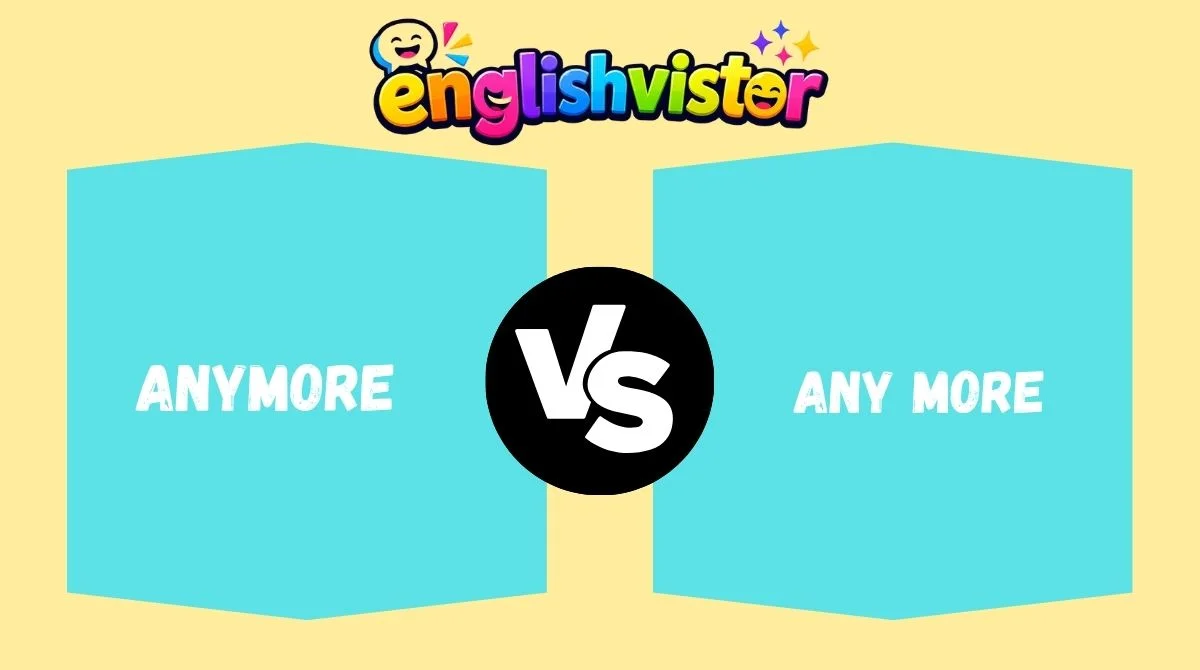
Anymore vs Any More is a small English grammar difference that causes a surprisingly large number of mistakes. The two forms look almost identical, and they are sometimes pronounced in the same way. However, they do not always have the same meaning or grammar role Anymore vs Any More.
For English learners, this can be confusing. You may see a sentence such as “I don’t live there anymore” and another such as “Do you need any more water?” Both contain the word any, but the words work differently. Anymore vs Any More.
The easiest way to understand Anymore vs Any More is to look at what the speaker means. Anymore, written as one word, usually means “now no longer” or “from now on, not.” It is commonly used with negative statements. Anymore vs Any More.
Any more, written as two words, normally means “an additional amount,” “an additional number,” or “something extra.” It can be used with questions, negatives, and other sentence structures. Anymore vs Any More.
Once you understand this simple idea, Anymore vs Any More becomes much easier. You will learn when to write the words together, when to separate them, how American and British English sometimes differ, and how to avoid common mistakes.
What Does “Anymore” Mean?
Anymore is one word. In its most common use, it means “now no longer” or “not any longer.” Anymore vs Any More.
It tells us that something was true in the past but is not true now. Anymore vs Any More.
For example:
I don’t play tennis anymore.
This means:
I used to play tennis, but I don’t play it now.
That is the main idea behind Anymore vs Any More.
When Do We Use “Anymore”?
We usually use anymore in negative sentences, especially in American English. Anymore vs Any More.
A common pattern is:
Subject + negative verb + anymore
Examples:
- I don’t work there anymore.
- She doesn’t call me anymore.
- We don’t watch that show anymore.
- He isn’t angry anymore.
- They don’t visit us anymore.
- My brother doesn’t live here anymore.
- I can’t use that old phone anymore.
- She doesn’t eat meat anymore.
In each sentence, anymore refers to a change from the past to the present. Anymore vs Any More.
Examples of “Anymore”
1. I don’t live in London anymore.
The speaker lived in London before but does not live there now.
2. She doesn’t work at the bank anymore.
She worked there in the past, but that is no longer true.
3. We don’t talk anymore.
The people used to talk, but they have stopped. Anymore vs Any More.
4. He isn’t afraid anymore. Anymore vs Any More.
He was afraid before, but he is not afraid now.
5. My phone doesn’t work anymore.
The phone worked before, but it has stopped working. Anymore vs Any More.
6. They don’t sell that product anymore.
The product was sold in the past, but it is no longer sold.
7. I don’t watch television anymore. Anymore vs Any More.
The speaker watched television before but has stopped doing so.
8. She doesn’t need my help anymore.
She needed help before, but she does not need it now.
These examples show the central meaning clearly. When anymore means “no longer,” it is normally written as one word.
A Simple Test for “Anymore”
If you can replace anymore with “any longer” and the sentence still makes sense, you probably need anymore as one word. Anymore vs Any More.
For example:
I don’t work here anymore. Anymore vs Any More.
Try:
I don’t work here any longer. Anymore vs Any More.
The meaning stays almost the same.
Another example:
She doesn’t call anymore.
Becomes:
She doesn’t call any longer.
Again, the meaning is clear.
This is one of the easiest ways to understand Anymore vs Any More.
A Common Learner Confusion
Many students think that anymore always refers to quantity because it contains the word any. That is not true. Anymore vs Any More.
Compare:
I don’t need this anymore.
Here, anymore means no longer.
But:
Do you need any more water?
Here, any more means additional water.
The spelling changes because the meaning changes.
What Does “Any More” Mean?
Any more consists of two separate words: any + more.
It usually refers to an additional amount or additional number.
For example:
Do you want any more coffee?
The speaker is asking whether the person wants additional coffee.
That is very different from:
I don’t drink coffee anymore.
The first sentence is about extra coffee. The second is about stopping a habit. Anymore vs Any More.
This distinction is at the heart of Anymore vs Any More.
When Do We Use “Any More”?
Use any more when more has its normal meaning of an additional amount or number. Anymore vs Any More.
It can be used with:
- food
- drinks
- money
- time
- work
- questions
- information
- people
- objects
- opportunities
- problems
Examples:
Do you need any more time?
Would you like any more rice?
We don’t have any more chairs.
I can’t answer any more questions.
Is there any more information?
In these sentences, more means additional. Anymore vs Any More.
Examples of “Any More”
1. Do you want any more tea?
The speaker is offering additional tea.
2. Do we need any more chairs?
The question asks whether additional chairs are needed. Anymore vs Any More.
3. I don’t have any more money.
The speaker has no additional money.
4. We don’t need any more food.
The speaker says that additional food is unnecessary.
5. Are there any more questions?
The speaker asks whether there are additional questions. Anymore vs Any More.
6. She doesn’t have any more books.
She has no additional books.
7. Can I have any more time?
The speaker is asking for additional time.
8. There aren’t any more tickets available.
There are no additional tickets available.
The Grammar Behind “Any More”
Here, any works as a determiner, while more tells us about an additional quantity or number.
For example:
Do you need any more water?
“Water” is an uncountable noun. More means an additional amount of water. Anymore vs Any More.
With a countable noun, we can say:
Do you need any more pens?
Here, more means additional pens.
So any more can appear before both uncountable and plural countable nouns.
Any More With Uncountable Nouns
Examples include:
- any more water
- any more milk
- any more time
- any more money
- any more information
- any more advice
- any more work
Example:
I don’t have any more time.
The meaning is I have no additional time.
Any More With Plural Countable Nouns
Examples include:
- any more books
- any more questions
- any more chairs
- any more students
- any more tickets
- any more problems
Example:
Do you have any more questions?
The meaning is Do you have additional questions?
This is another useful clue in understanding Anymore vs Any More.
Anymore vs Any More: The Detailed Difference
The main difference is simple:
Anymore = no longer / any longer
Any more = additional / extra
Here is a quick comparison:
| Form | Number of words | Main meaning | Typical use | Example |
|---|---|---|---|---|
| Anymore | 1 | No longer | Usually negative statements | I don’t work there anymore. |
| Any more | 2 | Additional or extra | Questions, negatives, and other structures | Do you need any more help? |
| Anymore | 1 | No longer | Change from past to present | She doesn’t visit anymore. |
| Any more | 2 | An additional amount/number | Quantity | We don’t need any more chairs. |
The most important question to ask is:
Are you talking about something that has stopped, or are you talking about something extra?
If something has stopped:
I don’t use it anymore.
If you mean something extra:
I don’t need any more books.
Meaning Difference
Consider these two sentences:
I don’t want it anymore.
I don’t want any more.
The first means:
I no longer want it.
The second means:
I don’t want an additional amount of it.
The difference can be small in some situations, but grammatically the two forms have different jobs.
Sentence Structure Difference
With anymore, the common structure is:
Negative verb + anymore
Examples:
I don’t smoke anymore.
She doesn’t live here anymore.
They aren’t friends anymore.
With any more, the common structure is:
any + more + noun
Examples:
Do you need any more water?
We need any more chairs?
The last example is not normally the natural question. A better form is:
Do we need any more chairs?
Another common structure is:
negative verb + any more + noun
Examples:
I don’t have any more money.
She doesn’t have any more questions.
We don’t need any more food.
A Useful Comparison
Look at these pairs:
I don’t eat there anymore.
Meaning: I no longer eat there.
I don’t want any more food.
Meaning: I don’t want additional food.
Another pair:
She doesn’t call me anymore.
Meaning: She no longer calls me.
She doesn’t have any more phone numbers.
Meaning: She has no additional phone numbers.
This is the easiest way to see the difference between Anymore vs Any More in real English.
Grammar Rules You Must Remember
Rule 1: Use “Anymore” for “No Longer”
When you mean not now, although it was true before, use anymore.
I don’t play football anymore.
The speaker played football before but does not play now.
He doesn’t live here anymore.
He lived here in the past but has moved away.
This is the most important rule for Anymore vs Any More.
Rule 2: Use “Any More” for Additional Quantity
When more means additional, keep any and more separate.
Do you need any more water?
The person is asking about extra water.
Would you like any more cake?
The person is offering additional cake.
We don’t have any more seats.
There are no additional seats.
Rule 3: “Anymore” Usually Appears in Negative Sentences
In standard modern American English, anymore commonly follows a negative verb.
I don’t use that computer anymore.
She doesn’t visit us anymore.
We can’t stay here anymore.
He isn’t working there anymore.
The negative meaning comes from don’t, doesn’t, can’t, isn’t, or another negative expression.
Rule 4: “Any More” Can Be Used in Questions
When asking about an additional amount or number, use any more.
Do you need any more help?
Are there any more questions?
Would you like any more coffee?
Is there any more bread?
These questions are about extra or additional things.
Rule 5: “Any More” Can Come Before a Noun
This is a very useful clue.
any more time
any more money
any more questions
any more books
any more work
When more directly describes an additional quantity or number, the two words are normally separate.
Rule 6: “Anymore” Can Stand at the End of a Sentence
This is extremely common.
I don’t use it anymore.
She doesn’t live here anymore.
We don’t talk anymore.
They aren’t together anymore.
This ending position is one of the clearest patterns for anymore.
Common Mistakes Students Make
Mistake 1: Writing “Any More” When You Mean “No Longer”
Incorrect:
I don’t work here any more.
In many varieties of English, especially British English, any more may be accepted in this sense. However, in standard American English, anymore is normally preferred when the meaning is “no longer.”
For clear modern American English:
I don’t work here anymore.
The important point is not simply spelling. It is understanding the intended meaning.
Mistake 2: Writing “Anymore” for Extra Quantity
Incorrect:
Do you need anymore water?
When you mean additional water, use two words:
Do you need any more water?
The word more is describing extra water, so it remains separate.
Mistake 3: Confusing “No Longer” With “No Additional Amount”
Compare:
I don’t eat meat anymore.
This means the person has stopped eating meat.
Now compare:
I don’t want any more meat.
This means the person does not want additional meat at the moment.
The first sentence describes a change in habit.
The second describes quantity.
Mistake 4: Thinking “Any More” Is Always Wrong
Some learners are taught that anymore is always one word. That is too simple.
Both forms are correct, but they have different common uses.
I don’t want it anymore.
Here, one word means no longer.
I don’t want any more food.
Here, two words mean additional food.
The spelling depends on meaning.
Mistake 5: Forgetting Regional Differences
American and British English can differ in how anymore is used.
In American English:
I don’t see him anymore.
is very common.
In British English, speakers often prefer:
I don’t see him any more.
or:
I don’t see him any longer.
The quantity meaning remains separate:
Do you need any more milk?
This regional difference is worth knowing, especially if you are writing for an international audience.
Easy Trick to Remember the Difference
Here is a simple memory trick:
One Word = No Longer
Think:
ANYMORE = NOT NOW
I don’t live there anymore.
Ask yourself:
“Did this stop being true?”
If yes, anymore is likely correct.
Two Words = Something Extra
Think:
ANY MORE = EXTRA
Do you want any more coffee?
Ask yourself:
“Do I mean additional or extra?”
If yes, use any more.
The “Extra” Test
Try replacing the phrase with “additional.”
Do you need any more help?
Becomes:
Do you need additional help?
The meaning works, so any more is correct.
Now try:
I don’t work there anymore.
Replace it with “additional”:
I don’t work there additional.
That makes no sense.
Instead, replace it with “any longer.”
I don’t work there any longer.
That works.
So:
anymore → any longer
any more → additional
This trick makes Anymore vs Any More much easier to remember.
Daily Life Examples
Example 1: Talking About a Job
Sarah: Does Tom still work at the restaurant?
Mike: No, he doesn’t work there anymore.
Here, Tom worked there before but does not work there now.
Example 2: Asking for More Food
Mom: Would you like any more rice?
Son: No, thanks. I’m full.
Here, “any more” means additional rice.
Example 3: Talking About a Habit
I don’t drink soda anymore.
The person used to drink soda but has stopped.
Example 4: Asking for Extra Time
Do you need any more time to finish your homework?
The speaker asks whether additional time is needed.
Example 5: Talking About a Friendship
We don’t talk anymore.
The people used to talk, but they no longer do.
Example 6: Talking About Money
I don’t have any more money.
This means the speaker has no additional money.
Example 7: Talking About a Store
That store doesn’t sell DVDs anymore.
The store sold DVDs in the past but has stopped selling them.
Example 8: Asking About Questions
Does anyone have any more questions?
The speaker is asking about additional questions.
Example 9: Talking About a Phone
My old phone doesn’t work anymore.
It worked in the past, but it does not work now.
Example 10: Talking About Food
I can’t eat any more cake.
This means the speaker cannot eat additional cake.
Notice how the meaning changes depending on the sentence:
I don’t eat cake anymore.
= I no longer eat cake.
I can’t eat any more cake.
= I cannot eat additional cake.
This pair is an excellent example of Anymore vs Any More.
More Examples for English Learners
Understanding examples is often easier than memorizing rules. Read these sentences slowly and notice the meaning.
Anymore Examples
- I don’t use that app anymore.
- She doesn’t live with her parents anymore.
- We don’t go to that restaurant anymore.
- He doesn’t play basketball anymore.
- My sister doesn’t need help anymore.
- They don’t visit us anymore.
- I can’t wear these shoes anymore.
- The machine doesn’t work anymore.
- She isn’t nervous anymore.
- We aren’t classmates anymore.
Every example refers to something that is no longer true.
Any More Examples
- Do you need any more information?
- Would you like any more coffee?
- Are there any more tickets?
- I don’t have any more questions.
- We don’t need any more chairs.
- Do you want any more cake?
- Is there any more milk?
- She doesn’t have any more work today.
- Can you give me any more details?
- We don’t have any more time.
Here, more refers to an additional amount or number.
Anymore vs Any More in Questions
One common question from learners is whether anymore can be used in questions.
The answer depends on the meaning and variety of English.
When you mean additional, use any more:
Do you need any more help?
Is there any more food?
Are there any more seats?
When you mean no longer, standard American English can use anymore in a negative-style question or rhetorical structure, but this is less common for beginners.
For example:
Don’t you live there anymore?
This asks whether the person no longer lives there.
A clearer equivalent is:
Don’t you live there any longer?
For learners, the safest rule is:
Use “any more” for additional quantity and “anymore” for “no longer.”
Anymore vs Any More in American English
American English strongly uses anymore as one word when it means “no longer.”
Examples:
I don’t watch that show anymore.
She doesn’t work here anymore.
We don’t use that system anymore.
This usage is very common in everyday American speech and writing.
However, American English still uses any more as two words when the meaning is additional quantity.
Do you want any more coffee?
We don’t have any more tickets.
So American English makes the distinction especially clear in many sentences.
Anymore vs Any More in British English
British English often uses any more as two words where American English uses anymore to mean “no longer.”
For example, a British speaker may write:
I don’t live there any more.
An American speaker would commonly write:
I don’t live there anymore.
Both express the idea of no longer living there.
But this does not mean the two-word form is always interchangeable with the one-word form in every sentence.
When more clearly means additional, use two words:
Do you want any more tea?
That form is natural in both American and British English.
For international learners, recognizing this regional difference is useful. It prevents you from thinking that every example you see follows exactly the same spelling rule.
Is “Anymore” Formal or Informal?
Anymore is a normal English word and is not simply slang.
It is common in everyday American English, including ordinary writing.
For example:
I don’t use that service anymore.
There is nothing grammatically wrong or unusually informal about the sentence.
In more formal writing, you may sometimes choose “no longer” because it sounds more formal or precise.
Compare:
The company doesn’t offer this service anymore.
More formal:
The company no longer offers this service.
Both are correct.
Is “Any More” Formal or Informal?
Any more is also completely normal English.
It appears in casual conversation, school writing, business communication, and formal writing.
Examples:
Do you need any more information?
We cannot provide any more details at this time.
The second example can easily appear in professional writing.
So the difference is not really formal versus informal. The main issue is meaning and grammar.
Anymore vs Any More With Countable and Uncountable Nouns
This is another useful grammar point.
Use any more when talking about an additional amount of an uncountable noun:
Do you need any more water?
Is there any more information?
We don’t have any more time.
Use any more with plural countable nouns:
Do you have any more books?
Are there any more students?
We need any more chairs?
Again, the natural question is:
Do we need any more chairs?
This shows why sentence structure matters.
But anymore as one word does not normally describe a noun directly.
We say:
I don’t read books anymore.
Not:
I don’t anymore books.
The placement is completely different.
Anymore vs Any More in Negative Sentences
Negative sentences can contain either form, which is one reason learners get confused.
Consider:
I don’t smoke anymore.
Here, anymore means no longer.
Now:
I don’t have any more cigarettes.
Here, any more means additional cigarettes.
Both sentences are negative, but their meanings are different.
The first talks about a change in behavior.
The second talks about quantity.
This is a powerful clue when choosing between Anymore vs Any More.
Can “Any More” Mean “No Longer”?
In some varieties of English, particularly British English, any more can be written as two words with the meaning “no longer.”
For example:
I don’t see him any more.
This can mean:
I don’t see him anymore.
American English usually prefers the one-word spelling for this meaning:
I don’t see him anymore.
Therefore, if your website or writing follows American English, use anymore for “no longer.”
If you are writing British English, follow the spelling style used by your chosen variety consistently.
Can “Anymore” Mean “Additional”?
Normally, no.
If you mean additional, write:
any more
For example:
Do you want any more water?
Not:
Do you want anymore water?
The second form is generally considered incorrect in standard American English when more modifies the noun water.
This distinction is especially important in formal writing and English-learning exercises.
Quick Decision Guide
When you are unsure about Anymore vs Any More, ask yourself three questions.
Question 1: Does it mean “no longer”?
If yes:
anymore
Example:
I don’t live there anymore.
Question 2: Does “more” mean “additional”?
If yes:
any more
Example:
Do you need any more time?
Question 3: Is there a noun after “more”?
If more is describing an additional noun, the words will usually be separate.
any more money
any more questions
any more food
any more books
This three-question test works well for beginners.
Practice Section
Choose the Correct Form
Choose anymore or any more in each sentence.
1. I don’t work at that company ________.
2. Do you need ________ paper?
3. She doesn’t call me ________.
4. We don’t have ________ chairs.
5. He doesn’t play tennis ________.
Answers
1. anymore
I don’t work at that company anymore.
The meaning is no longer.
2. any more
Do you need any more paper?
The meaning is additional paper.
3. anymore
She doesn’t call me anymore.
The meaning is no longer.
4. any more
We don’t have any more chairs.
The meaning is additional chairs.
5. anymore
He doesn’t play tennis anymore.
The meaning is no longer.
A Second Practice Set
Try these without looking at the answers.
- Would you like ________ coffee?
- I don’t need that computer ________.
- Are there ________ questions?
- My brother doesn’t live here ________.
- We don’t need ________ information.
Answers
- any more
- anymore
- any more
- anymore
- any more
The key is always the same: no longer = anymore; additional = any more.
FAQs
What is the difference between “anymore” and “any more”?
Anymore usually means “no longer” and is commonly used in negative sentences. Any more means “additional” or “extra.”
For example, “I don’t work there anymore” means I no longer work there. “Do you need any more help?” asks about additional help.
Is “anymore” one word or two words?
When it means “no longer,” American English normally writes anymore as one word.
Example:
I don’t use that website anymore.
When the meaning is additional, write any more as two words.
Can I use “any more” to mean “no longer”?
Yes, this can occur in British English and some other varieties of English.
For example:
I don’t see her any more.
American English usually prefers:
I don’t see her anymore.
Choose the form that matches the variety of English you are using.
Is “anymore” correct in formal writing?
Yes. Anymore is a standard English word, especially common in American English.
However, formal writers may sometimes choose “no longer” because it sounds more formal:
The service is no longer available.
This is a style choice, not a rule that makes anymore incorrect.
Can “any more” be used in questions?
Yes. In fact, it is very common when asking about an additional amount or number.
Examples include:
Do you need any more time?
Would you like any more food?
Are there any more questions?
In these sentences, any more means additional or extra.
What is an easy way to remember the difference?
Remember this simple pair:
Anymore = no longer
Any more = additional
Try replacing anymore with “any longer.” If the sentence still makes sense, you probably need one word.
Try replacing any more with “additional.” If that works, use two words.
Final Comparison: Anymore vs Any More
Before you finish, keep these examples in mind:
I don’t live there anymore.
Meaning: I no longer live there.
I don’t need any more boxes.
Meaning: I don’t need additional boxes.
Another pair:
She doesn’t call anymore.
Meaning: She no longer calls.
She doesn’t have any more phone numbers.
Meaning: She has no additional phone numbers.
And one more:
I don’t eat sweets anymore.
Meaning: I have stopped eating sweets.
I don’t want any more sweets.
Meaning: I don’t want additional sweets right now.
These examples show the real difference better than a complicated grammar definition.
Conclusion
The difference between Anymore vs Any More becomes simple once you focus on meaning instead of spelling.
Use anymore as one word when you mean “no longer” or “not anymore.”
I don’t watch TV anymore.
Use any more as two words when you mean “additional,” “extra,” or “another amount/number.”
Do you need any more help?
The biggest mistake is treating the two forms as interchangeable in every sentence. They are not. The meaning of more is the key. If something has stopped being true, think anymore. If you are talking about something extra, think any more.
Regional English also matters. American English strongly favors anymore for the “no longer” meaning, while British English often uses any more in that meaning.
A good learner does not need to memorize dozens of complicated rules. Just remember the simple test: “no longer” = anymore; “additional” = any more. Practice with everyday sentences, and this small grammar problem will soon feel natural.

Hi, I’m Isabella Foster, an English language writer passionate about making grammar, vocabulary, and communication skills easy to understand. At EnglishVistor, I create clear, practical, and engaging learning resources to help learners improve their English with confidence.