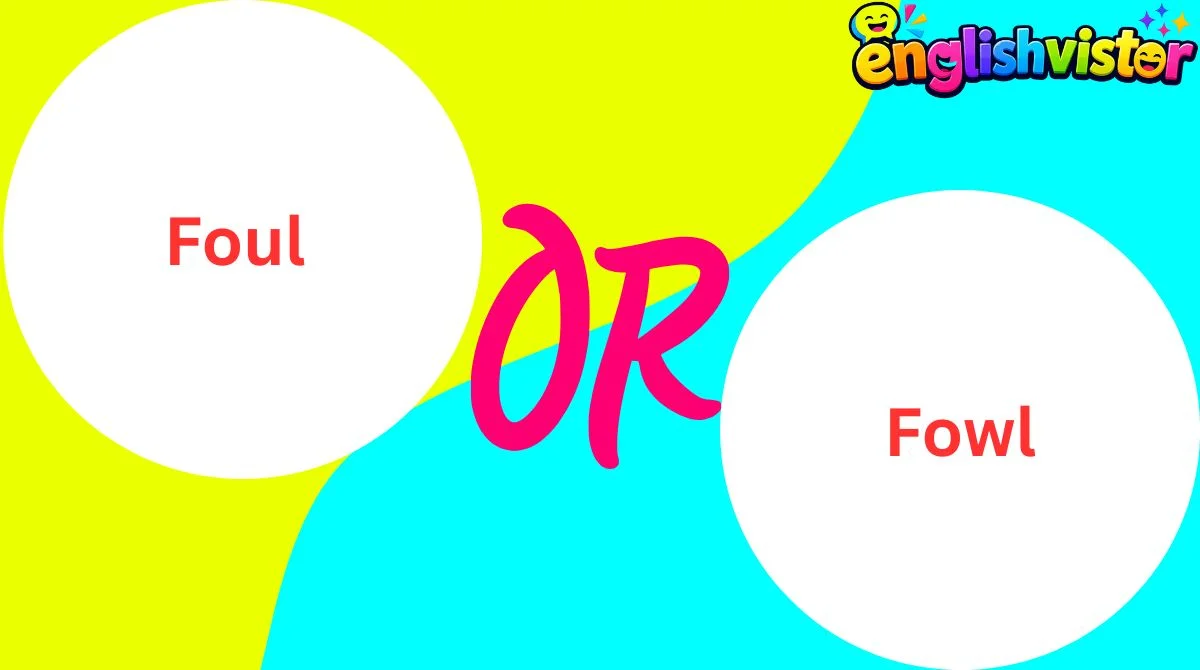
Many English learners stop when they see foul and fowl because the two words sound exactly the same. This is one of those small English problems that can create a big mistake in writing. If you are learning the difference between foul or fowl, you are not alone. Even native speakers sometimes need to think about the spelling before writing.
The key point is simple: foul and fowl have different meanings, even though they are pronounced alike. They are called homophones. Homophones are words that have the same pronunciation but different spellings and meanings Foul or Fowl.
For example, you can say, “The room has a foul smell.” Here, foul means very unpleasant or disgusting. But if you say, “The farmer keeps several fowl,” the word fowl refers to birds, especially domestic birds such as chickens, ducks, or turkeys.Foul or Fowl.
Understanding foul or fowl matters because spelling changes the meaning of your sentence. A spelling mistake can make a sentence confusing or even funny.
The good news is that the difference is easy to remember once you connect each word with its meaning. By the end of this guide, you will know when to use foul, when to use fowl, how they work grammatically, and how to avoid common mistakes.
What Does “Foul” Mean?
Foul is a common English word with several meanings. Its meaning depends on the situation, but it often describes something dirty, unpleasant, offensive, unfair, or against a rule.
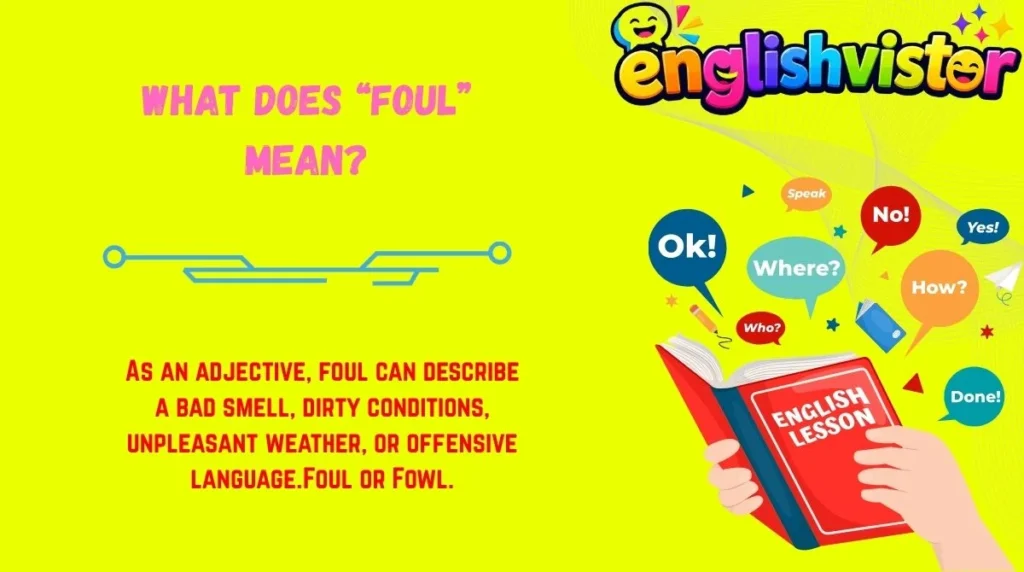
As an adjective, foul can describe a bad smell, dirty conditions, unpleasant weather, or offensive language.Foul or Fowl.
For example:
- The garbage has a foul smell.
- We had to leave because the air was foul.
- He used foul language during the argument.
- The water became foul after the pollution.
- The kitchen was in a foul condition.Foul or Fowl.
- She was in a foul mood after the bad news.
- The players were punished for a foul move.
- The weather turned foul before the storm.
These examples show why foul or fowl can be confusing. The word foul is not connected specifically with birds. It usually carries an idea of something bad, unpleasant, dirty, or improper.
Foul as a Verb
Foul can also be used as a verb. As a verb, it can mean to make something dirty or polluted.
For example:
- The factory fouled the river.
- Oil fouled the engine.
- Do not foul the water with waste.
In sports, foul is also commonly used as a verb.
- The defender fouled the striker.
- The player fouled his opponent.
- She was called for fouling another player.Foul or Fowl.
Foul as a Noun
In sports, foul can be a noun. It means an action that breaks a rule.
- The referee called a foul.
- The player committed a foul.
- That was a serious foul.
So, when thinking about foul or fowl, remember that foul has a wide range of meanings. It can describe something unpleasant, dirty, offensive, or illegal in a game.
Common Learner Confusion
A learner may hear the sentence “There was a foul near the farm” and wonder whether it refers to a bad smell or a bird. The surrounding words usually make the meaning clear.
Also, remember that foul is often used with words such as smell, language, mood, weather, play, and air.Foul or Fowl.
What Does “Fowl” Mean?
Fowl is a noun that refers to a bird, especially a domestic or farm bird. It is commonly used for birds such as chickens, ducks, geese, and turkeys.
For example:
- The farmer raises fowl.
- Several fowl were walking around the yard.
- The barn is full of fowl.
- We saw different kinds of fowl near the lake.
- The farmer feeds the fowl every morning.
- Wild fowl were flying over the wetland.
- The children watched the fowl in the farmyard.
- The old farmer knows how to care for fowl.
The word fowl is especially common when talking about birds kept for food or farming. It can also be used for certain wild birds.
One important point about foul or fowl is that fowl is mainly a noun. You normally use it when you are talking about a bird or birds.Foul or Fowl.
Is “Fowl” Singular or Plural?
This is an interesting grammar point.
Fowl can refer to one bird or more than one bird, depending on context. It can be used as a collective or general noun.
For example:
- The farmer bought a fowl.
- The farmer keeps many fowl.
You may also see fowls when referring to different individual birds or types of birds, especially in certain formal or scientific contexts.Foul or Fowl.
The word is less common in everyday conversation than bird, chicken, or duck. A person usually says “I saw some birds” rather than “I saw some fowl.”
Common Learner Confusion
The biggest problem with foul or fowl is pronunciation. They sound the same in normal English speech.
If someone says, “There are fowl in the yard,” you cannot know the spelling simply by hearing the word. You need to understand the meaning from context.
That is why learning the meaning, not just the pronunciation, is important.
Difference Between Foul and Fowl
The basic difference between foul or fowl is very easy:
Foul usually means something bad, dirty, unpleasant, offensive, or against a rule.
Fowl means a bird, especially a domestic or farm bird.
Both words sound alike, but their spellings and meanings are different.
| Word | Pronunciation | Main Meaning | Common Use | Example |
|---|---|---|---|---|
| foul | /faʊl/ | Bad, dirty, unpleasant, offensive, or a rule-breaking action | Adjective, verb, noun | The room had a foul smell. |
| fowl | /faʊl/ | A bird, especially a domestic or farm bird | Noun | The farmer feeds the fowl. |
Usage Difference
When discussing foul or fowl, ask yourself one simple question:
Am I talking about something unpleasant or a bird?
If you are talking about a bad smell, dirty water, bad language, unfair play, or a sports violation, use foul.
- a foul smell
- foul language
- a foul mood
- a foul ball
- a sports foul
If you are talking about a bird, use fowl.
- farm fowl
- domestic fowl
- wild fowl
- several fowl
Grammar Logic
The grammar of foul or fowl is also different.
Foul can be an adjective, verb, or noun.
- Adjective: It smells foul.
- Verb: The waste fouled the river.
- Noun: The referee called a foul.
Fowl is mainly a noun.
- The fowl are in the yard.
- The farmer feeds the fowl.
This grammatical difference can help you choose the correct word.
Meaning Comparison
Consider these two sentences:
The kitchen has a foul smell.
Here, foul describes the smell.
The farmer keeps fowl in the kitchen yard.
Here, fowl means birds.
The pronunciation is the same, but the meaning is completely different. This is the central lesson when learning foul or fowl.
Grammar Rules You Must Remember
1. Use “foul” for something unpleasant
When something smells bad or seems dirty or offensive, use foul.
- The trash has a foul smell.
- The water smells foul.
- He used foul language.
Think of foul as a word connected with something bad or unpleasant.
2. Use “fowl” for birds
When you mean a bird, especially a farm or domestic bird, use fowl.
- The farmer keeps fowl.
- The fowl are eating grain.
- Wild fowl flew across the field.
If you can replace the word with birds, fowl may be the correct choice.
3. “Foul” is common in sports
In sports, a foul is an action that breaks a rule.
- The referee called a foul.
- The player committed a foul.
- He was punished for a foul.
This is one of the most common uses of foul.
4. “Fowl” is a noun
Use fowl when naming or discussing birds.
- The fowl are outside.
- She feeds the fowl every morning.
- The farmer sells fowl.
This gives you another useful clue when choosing between foul or fowl.
Common Mistakes Students Make
Why Do These Mistakes Happen?
The main reason is simple: foul and fowl are homophones. They sound exactly the same, so listening does not help you decide which spelling to write.
English has many homophones. For example, flower and flour sound alike, but they have different meanings. Foul or fowl works in the same way.
Another reason is that students sometimes remember pronunciation but forget meaning. When writing, they choose the spelling that looks familiar.
Mistake 1: Using “fowl” for a bad smell
Wrong: The garbage has a fowl smell.
Correct: The garbage has a foul smell.
A bad smell is unpleasant, so use foul.
Mistake 2: Using “foul” for birds
Wrong: The farmer keeps several foul.
Correct: The farmer keeps several fowl.
The word refers to birds, so fowl is correct.
Mistake 3: Confusing sports terminology
Wrong: The referee called a fowl.
Correct: The referee called a foul.
A sports violation is a foul, not a bird.
Mistake 4: Thinking “fowl” means “bad”
Because the words sound alike, learners sometimes connect their meanings. They should not.
Fowl = bird.
Foul = unpleasant, dirty, offensive, or a rule-breaking action.
That short contrast solves most problems involving foul or fowl.
Easy Correction Tip
Before writing the word, stop for one second and ask:
“What am I talking about?”
If it is a bird, choose fowl.
If it is something bad, dirty, unpleasant, or a sports violation, choose foul.
Easy Trick to Remember the Difference
Here is a simple memory trick for foul or fowl.
Think:
FOWL has a W for WING.
That is not a spelling rule, but it is an excellent memory aid.
If you are talking about a bird with wings, think of fowl.
Fowl → Wing → Bird
For foul, think about something bad or unpleasant.
Foul → Bad smell → Unpleasant
You can also remember a sports example:
Foul → Football or basketball → Rule violation
Imagine a football referee blowing the whistle. The referee says, “That was a foul!”
Now imagine a farmer feeding chickens. The farmer is feeding the fowl.
This little mental picture makes the difference much easier to remember.
Another useful trick is to replace the word in your sentence.
If you can replace it with bird, use fowl.
If you can replace it with bad, dirty, unpleasant, or illegal in a game, use foul.
For example:
The farmer feeds the ___.
“Birds” works, so fowl is correct.
The room has a ___ smell.
“Bird” does not work. “Bad” works, so foul is correct.
Daily Life Examples
10 Real-Life Spoken English Examples
Real conversations are a good way to understand foul or fowl because context makes the meaning clear.
1. Talking about a bad smell
A: What is that smell?
B: I think something in the fridge has gone bad. It smells foul.
Here, foul describes an unpleasant smell.
2. Talking about a farm
A: What animals does your uncle keep?
B: He keeps chickens, ducks, and other fowl.
Here, fowl means birds.
3. Talking about football
A: Why did the referee stop the game?
B: He saw a foul.
Here, foul means a rule violation.
4. Talking about dirty water
A: Can we drink this water?
B: No. It looks dirty and smells foul.
The word describes something unpleasant.
5. Talking about farm birds
A: Where are the chickens?
B: The fowl are behind the barn.
Here, fowl refers to birds.
6. Talking about someone’s language
A: Why did the teacher speak to Tom?
B: He used foul language in class.
Here, foul means offensive or inappropriate.
7. Talking about sports
A: Why did Sarah get a penalty?
B: She committed a foul.
Again, the word describes a sports violation.
8. Talking about a farm
A: What are those birds doing?
B: The fowl are looking for food.
The context clearly points to birds.
9. Talking about food
A: Why didn’t you eat the meat?
B: It had a foul smell, so I didn’t want to risk it.
The smell is unpleasant, so foul is correct.
10. Talking about wild birds
A: Did you see any birds near the lake?
B: Yes, we saw several wild fowl.
Here, fowl refers to birds.
These examples show why context is so important with foul or fowl. When you know what the speaker means, the correct spelling becomes much easier to choose.
Practice Section
Choose the Correct Word
Test yourself before looking at the answers. Choose foul or fowl for each sentence.
1. The garbage produced a very ___ smell.
2. The farmer feeds the ___ every morning.
3. The referee called a ___ during the match.
4. We saw several wild ___ near the lake.
5. The water became ___ after the chemicals entered the river.
Answers
1. Foul — A bad smell is described as foul.
2. Fowl — The word means birds, especially farm birds.
3. Foul — A rule-breaking action in sports is a foul.
4. Fowl — The sentence is talking about birds.
5. Foul — Polluted or unpleasant water can be described as foul.
If you got all five right, you have understood the basic difference between foul or fowl.
FAQs
What is the difference between foul and fowl?
Foul usually means bad, dirty, unpleasant, offensive, or a violation of a rule in sports. Fowl means a bird, especially a domestic or farm bird. They sound the same but have different spellings and meanings.
Can “foul” be used in questions?
Yes. You can use foul in questions just like other adjectives or nouns.
For example, “Does this milk smell foul?” or “Did the referee call a foul?” The correct choice depends on the meaning of the sentence.
Is “fowl” formal or informal?
Fowl is a normal English word, but it can sound more formal or less common in everyday conversation. People often say bird, chicken, or duck instead. Fowl is common in farming, food, wildlife, and formal descriptions.
Are foul and fowl pronounced the same?
Yes. Foul and fowl are homophones, which means they have the same pronunciation but different spellings and meanings. You normally cannot identify the spelling just by hearing the word.
Is a chicken a fowl?
Yes. A chicken can be called fowl, especially when discussing domestic birds or farm birds. However, in everyday conversation, chicken is much more common.
Is “foul” always a bad word?
Not exactly. Foul often has a negative meaning, but it can have several uses. It can describe a bad smell, dirty conditions, offensive language, bad weather, or a sports violation. The exact meaning depends on the context.
Conclusion
The difference between foul or fowl becomes easy when you focus on meaning instead of pronunciation. Both words sound alike, but they do completely different jobs in English.
Foul is connected with something unpleasant, dirty, offensive, or against the rules. You can talk about a foul smell, foul language, foul weather, or a sports foul.
Fowl, on the other hand, refers to birds, especially domestic or farm birds such as chickens, ducks, geese, and turkeys.
The easiest memory trick is to connect fowl with a bird’s wings. If you are talking about something unpleasant or a sports violation, think foul.
Do not worry if you mix these words up at first. Homophones are tricky because your ears hear the same sound. With a little practice, your brain will start connecting the right spelling with the right meaning. Keep using real sentences, and the difference between foul or fowl will soon feel natural.

Hi, I’m Isabella Foster, an English language writer passionate about making grammar, vocabulary, and communication skills easy to understand. At EnglishVistor, I create clear, practical, and engaging learning resources to help learners improve their English with confidence.