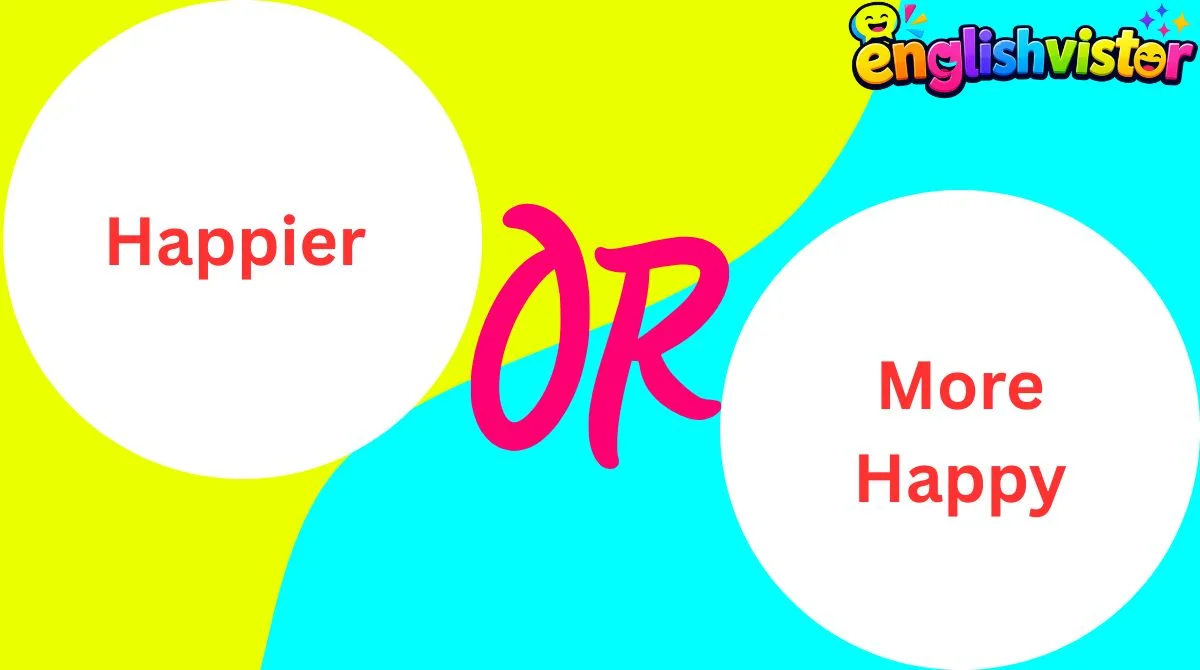
English learners often pause when they want to compare feelings. They may know the adjective happy, but when they want to say that one person has more happiness than another, a question appears: should they say happier or more happy?
This confusion is understandable. English has two common ways to make comparative adjectives. We usually add -er to short adjectives, while longer adjectives often use more. The adjective happy sits in a place where learners may wonder which rule applies Happier or More Happy.
The good news is that the answer is quite simple. Happier is the normal and most natural comparative form of happy. For example, we say, “I feel happier today,” rather than “I feel more happy today” in most ordinary situations.Happier or More Happy.
However, more happy is not completely impossible. It can appear in certain contexts, especially when a speaker wants to emphasize the idea of being happy, make a contrast, or use a particular writing style.Happier or More Happy.
Understanding happier or more happy is useful because happy is one of the most common adjectives in everyday English. You will hear and read it in conversations, stories, emails, social media posts, and school writing.
By the end, you will know when to choose happier, when more happy may be acceptable, and how to avoid common mistakes.
What Does “Happier” Mean?
Happier is the comparative form of the adjective happy. It means more happy than someone or something else, or that a person’s level of happiness has increased.Happier or More Happy.
For example:
I am happier today than I was yesterday.
The speaker is comparing two states: being happy today and being happy yesterday. The speaker feels a greater amount of happiness today.
The word happy ends in -y. When an adjective ends in a consonant followed by y, English normally changes the y to i and adds -er.Happier or More Happy.
So:
happy → happier
This is the standard grammar pattern.Happier or More Happy.
When Do We Use “Happier”?
We use happier when comparing two people, two situations, two times, or two experiences.
Consider these examples:
- Sarah is happier than she was last year.
- I feel happier when I spend time with my family.
- He looks happier after getting the good news.
- My sister is happier in her new job.
- The children seem happier outside.Happier or More Happy.
- I am much happier now.Happier or More Happy.
- Ali became happier after moving to a quieter place.
- She looks happier than her brother.
Notice that happier does not always need an explicit comparison with than. We can simply say:
I feel happier now.
The comparison is understood. The speaker means that their present state is happier than their earlier state.Happier or More Happy.
The Grammar Rule Behind “Happier”
For many short adjectives, English forms the comparative by adding -er.
Examples include:
- tall → taller
- small → smaller
- fast → faster
- kind → kinder
- young → younger
- happy → happier
The special spelling change for happy is important:Happier or More Happy.
happy → happier
Not:
happy → happyer
The final y changes to i before -er.
Why Do Learners Sometimes Say “More Happy”?
Learners may think that happy should follow the same pattern as adjectives such as beautiful or interesting. Those adjectives normally use more:Happier or More Happy.
- beautiful → more beautiful
- interesting → more interesting
But happy is normally treated as a short adjective for comparative formation.Happier or More Happy.
Therefore, happier is the form you should choose in ordinary English.Happier or More Happy.
What Does “More Happy” Mean?
More happy has the basic meaning of having a greater degree of happiness. Grammatically, it uses more + adjective instead of the usual -er form.
At first glance, you might think that more happy is simply another normal comparative form. However, everyday English strongly prefers happier.Happier or More Happy.
For example:
I am happier now.
This sounds natural and normal.
I am more happy now.
This is understandable, but it sounds less natural in ordinary conversation.
That does not mean the second sentence can never occur. English speakers sometimes use more happy for emphasis, contrast, rhythm, or a particular meaning.Happier or More Happy.
When Can “More Happy” Appear?
There are situations where a writer or speaker may deliberately choose more happy.Happier or More Happy.
For example:
I am more happy with the results than with the process.
Here, the speaker is making a contrast between being happy with two different things. The construction can sound acceptable because more is helping emphasize the comparison of two ideas.Happier or More Happy.
Another example is:
She was more happy than worried about the situation.
The sentence contrasts happy and worried. In this kind of structure, more happy can appear naturally enough because the comparison is not simply between two levels of happiness.Happier or More Happy.
Still, if you are a beginner and simply want to compare happiness, use happier.
Examples With “More Happy”
Here are some examples where the phrase may appear:
- I am more happy with the final design than the first one.
- He seemed more happy than nervous before the interview.
- She is more happy to help than to lead.
- The child was more happy than afraid.Happier or More Happy.
- I feel more happy when I am helping other people.
- They appeared more happy than surprised by the news.
These sentences show why context matters. More happy is not usually the first choice for a simple comparative, but it can be used when the writer wants to create a specific contrast or emphasis.Happier or More Happy.
Common Confusion About “More Happy”
A common mistake is believing that more happy and happier are equally common in all situations.Happier or More Happy.
They are not.
If someone asks:
Which is correct: “I am happier now” or “I am more happy now”?
The best everyday choice is:
I am happier now.
If you are writing a school assignment, speaking naturally, or learning standard English, happier should normally be your choice.Happier or More Happy.
Difference Between “Happier” and “More Happy”
The key point is simple:
Happier is the normal comparative form of happy.
More happy can occur in special contexts, but it is much less common for an ordinary comparison.Happier or More Happy.
| Form | Use | Naturalness | Example |
|---|---|---|---|
| happier | Normal comparison | Very natural | I feel happier today. |
| more happy | Special contrast or emphasis | Less common | I am more happy than worried. |
Usage Difference
Suppose your friend asks:
How do you feel after changing jobs?
A natural answer is:
I feel happier.Happier or More Happy.
You would not normally need to say:
I feel more happy.
The first version is shorter, smoother, and more idiomatic.
Now consider this sentence:
I am more happy with the service than with the price.
Here, the speaker is comparing two separate things: the service and the price. The structure gives more happy a special contrastive role.
Grammar Logic
English comparative adjectives generally follow one of two major patterns.
Short adjectives often take -er:
cold → colder
bright → brighter
happy → happier
Longer adjectives usually take more:
expensive → more expensive
comfortable → more comfortable
beautiful → more beautiful
The adjective happy normally belongs to the first group.
Therefore:
happy → happier
is the standard form.
Sentence Structure
The most common structure is:
Subject + linking verb + comparative adjective
For example:
I am happier.
Another common structure is:
Subject + linking verb + comparative adjective + than + comparison
For example:
I am happier than my brother.
We can also use degree words:
I am much happier now.
She is far happier in her new home.
He seems a little happier today.
With more happy, the structure can be different when contrast is intended:
She is more happy than worried.
This is one reason you should not treat the two forms as completely interchangeable.
Meaning Comparison
Both forms relate to a greater degree of happiness, but happier is the normal grammatical choice for a straightforward comparison.
If you simply want to say that someone’s happiness increased, use:
happier
If you are deliberately contrasting happy with another adjective or another idea, more happy may sometimes work.
Grammar Rules You Must Remember
1. Use “Happier” for Normal Comparisons
When you compare two people, times, situations, or emotional states, happier is normally the right choice.
I am happier now than before.
Emma is happier than Mia.
This is the safest rule for learners.
2. Change “Y” to “I” Before “-er”
Because happy ends in consonant + y, change y to i and add -er.
The pattern is:
happy → happier
Do not write:
happyer ❌
Write:
happier ✅
The same pattern appears in:
- easy → easier
- busy → busier
- funny → funnier
- pretty → prettier
- lazy → lazier
3. Use “Than” When You Clearly Name the Comparison
When you compare one person or thing with another, than is commonly used.
I am happier than I was last month.
She is happier than her sister.
They look happier than before.
But than is not required when the comparison is already clear:
I feel happier now.
The listener understands that your current feeling is being compared with an earlier feeling.
4. Use “More” With Longer Adjectives
Do not apply the more + adjective rule to every adjective.
For example:
more beautiful ✅
more expensive ✅
more interesting ✅
But:
happier ✅
This is why knowing the adjective’s comparative form is important.
Common Mistakes Students Make
Why These Mistakes Happen
English learners often try to create comparative forms by using one rule for every adjective. They may learn that more means “a greater amount,” so they naturally produce more happy.
The meaning is understandable, but natural English usually chooses happier.
Another problem comes from spelling. Some learners know that happy needs -er, but they write happyer. The spelling rule changes y to i.
Mistake 1: Using “Happyer”
I feel happyer today. ❌
Correct:
I feel happier today. ✅
Remember: y → i + er.
Mistake 2: Using “More Happy” for Every Comparison
My brother is more happy than me. ❌/unnatural in ordinary English
Better:
My brother is happier than me. ✅
In formal grammar, you may also write:
My brother is happier than I am.
The second version is especially useful in careful writing.
Mistake 3: Thinking “More Happy” Is Always Wrong
It is also not helpful to say that more happy can never appear.
English is flexible, and context matters.
For example:
She was more happy than nervous.
This contrastive construction can work.
So the better lesson is:
Use happier as your normal comparative form. Understand that more happy may occur in special constructions.
Mistake 4: Using “Most Happier”
Never combine most with the comparative -er form.
She is the most happier student. ❌
Use:
She is the happiest student. ✅
Remember:
Comparative: happier
Superlative: happiest
Easy Trick to Remember the Difference
Here is a simple classroom trick:
Think: “Happy Is Short, So Add -ER”
When you see happy, think:
happy → happier
You do not need to stop and ask yourself whether you should use more every time.
Imagine two friends.
Tom is happy.
Ali is even happier.
So:
Tom is happy.
Ali is happier.
That feels natural because happier is the regular comparative form.
A Second Memory Trick
Remember the small family:
happy → happier → happiest
The three forms are:
- happy — basic form
- happier — comparative
- happiest — superlative
For example:
I am happy.
I am happier today.
I am the happiest when I am with my family.
This little chain is useful for students because it shows the complete pattern.
If you are making a simple comparison, reach for happier first.
Daily Life Examples
1. Talking About Your Mood
A: How are you feeling today?
B: I feel happier than yesterday.
This is a very natural use.
2. Talking About a New Job
A: Do you like your new job?
B: Yes. I am much happier here.
The speaker compares the new job with the old one.
3. Talking About Family
My children are happier when we spend time together.
This does not necessarily compare two children. It can compare two situations.
4. Talking About School
I feel happier at my new school.
The implied comparison may be with the student’s previous school.
5. Talking About a Friend
You look happier today!
This is common spoken English.
6. Talking About Exercise
I always feel happier after a walk.
The sentence compares the speaker’s emotional state before and after walking.
7. Talking About Home
She seems happier in her new apartment.
The comparison may be between her old home and her new home.
8. Making a Strong Comparison
He is much happier now.
The word much makes the comparison stronger.
9. Talking About Two Choices
I am happier with the first option.
This means the first option gives the speaker greater satisfaction.
10. Using a Contrastive Construction
She was more happy than worried about the result.
Here, more happy works because the speaker is contrasting two emotional descriptions: happy and worried.
Practice Section
Choose the Correct Option
Try to answer these before looking at the answers.
1. I feel (happier / more happy) today.
2. Sarah is (happier / happyer) than last year.
3. He seems (happier / more happier) now.
4. I am (happier / more happy) with the service than the price.
5. She is the (happiest / most happier) person in the group.
Answers
1. Happier — This is the normal comparative form.
2. Happier — Remember the spelling change: y → i + er.
3. Happier — Never use more with the comparative -er form.
4. More happy — This can work because the sentence makes a specific contrast between being happy with the service and being happy with the price. In ordinary simple comparisons, however, happier is still the usual choice.
5. Happiest — The superlative form is happiest, not most happier.
FAQs
What is the difference between “happier” and “more happy”?
Happier is the standard comparative form of happy and is the normal choice in everyday English. More happy can appear in special contrastive or emphatic constructions, but it is much less common for a simple comparison.
Is “happier” grammatically correct?
Yes. Happier is completely correct and is the normal comparative form of happy. The spelling changes from happy to happier because the final y changes to i before -er.
Is “more happy” wrong?
Not always. More happy can be acceptable in certain contexts, especially when happy is contrasted with another adjective or idea. However, for a simple comparison, happier is the more natural choice.
Can we use “happier” in questions?
Yes. It is very common in questions.
For example:
Are you happier now?
You can also ask:
Do you feel happier in your new job?
These are natural everyday questions.
Is “happier” formal or informal?
Happier is neither unusually formal nor unusually informal. It is a standard English word used in conversations, school writing, business writing, books, and everyday communication.
Should I say “I am happier now” or “I am more happy now”?
Say “I am happier now” in normal English. It is shorter, smoother, and more natural. More happy may be used in special contexts, but beginners should normally choose happier for a simple comparison.
Conclusion
The choice between happier or more happy becomes much easier once you understand the normal comparative rule.
For ordinary comparisons, happier is the form you should use. The adjective happy normally changes from happy → happier → happiest. Remember the spelling change, too: the final y becomes i before -er.
So you can confidently say:
I feel happier today.
She looks happier now.
He is happier than before.
The phrase more happy is not completely impossible. It can appear when a speaker is making a particular contrast, such as being more happy than worried. But this is a special use, not the normal pattern students should use for simple comparisons.
If you are ever unsure, remember the easy classroom rule: happy is a short adjective, so its normal comparative form is happier.
A few simple examples will make the pattern feel natural. Once you start noticing happier in everyday English, the choice will become much easier.

Hi, I’m Isabella Foster, an English language writer passionate about making grammar, vocabulary, and communication skills easy to understand. At EnglishVistor, I create clear, practical, and engaging learning resources to help learners improve their English with confidence.