Many English learners feel confused when they try to make questions with helping verbs. One very common confusion is how i can or how can i. Both phrases look almost the same, but they are not used in the same way.
This small change in word order can completely change the meaning of a sentence. Many students translate directly from their first language, and that is why they often make mistakes while speaking or writing English.
Understanding how i can or how can i is important because we use these question forms in daily conversations. We ask about methods, possibilities, permission, and solutions almost every day.
For example, when you want to ask about a way to learn something, you may say, “How can I improve my English?” When you explain something that someone asked about, you may say, “I know how I can improve my English.”
After understanding this topic, you will clearly know when to use how can I and when to use how I can. You will also learn sentence rules, common mistakes, easy tricks, and real-life examples that will help you speak English more naturally.
Small grammar details create big improvements in communication. Once you understand the logic behind these structures, making correct sentences becomes much easier.
What Does “How Can I” Mean?
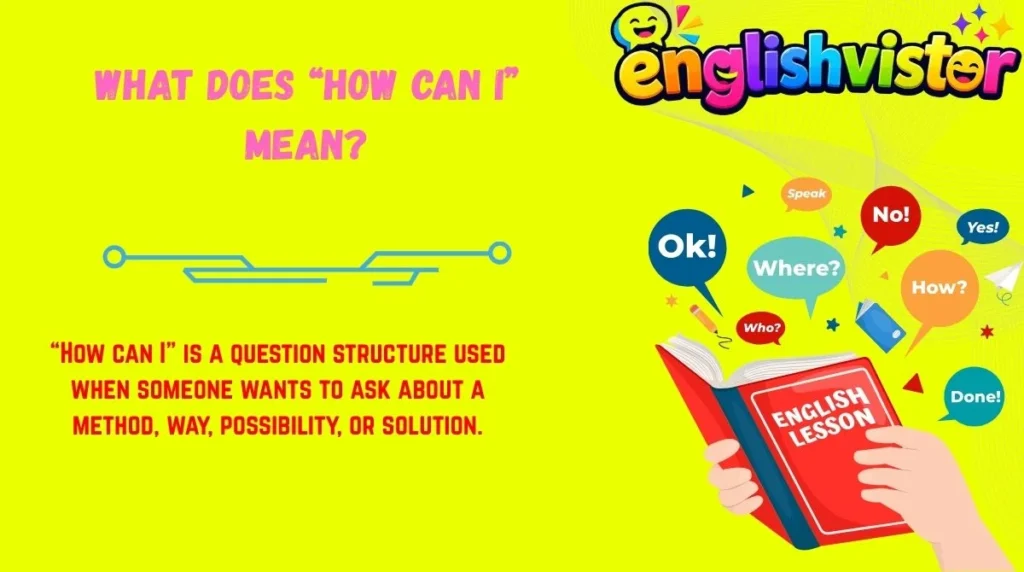
“How can I” is a question structure used when someone wants to ask about a method, way, possibility, or solution.
It is a direct question form. The speaker wants information from another person.
The basic structure is:
How + can + subject + base verb?
Examples:
How can I learn English faster?
How can I open this file?
How can I reach the airport?
How can I solve this problem?
In these sentences, “can” comes before the subject “I” because English question formation usually places the helping verb before the subject.
We use “how can I” when we need an answer or guidance.
Examples:
- How can I improve my pronunciation?
This asks for a method to improve pronunciation.
- How can I contact your company?
This asks for a way to contact someone.
- How can I become a better writer?
This asks about the steps needed.
- How can I remember new vocabulary?
This asks for a learning technique.
- How can I fix my computer problem?
This asks for a possible solution.
- How can I make this recipe?
This asks about the process.
- How can I save more money?
This asks for advice or methods.
- How can I prepare for my exam?
This asks about a preparation method.
Common learner confusion:
Many students think “how I can” is always correct because it sounds natural in their own language. However, when asking a direct question in English, the correct order is usually “how can I.”
Incorrect:
How I can learn English?
Correct:
How can I learn English?
The helping verb “can” moves before “I” because it is a question.
What Does “How I Can” Mean?
“How I can” is used inside a sentence when we are talking about a method, possibility, or information. It is not usually a direct question.
The basic structure is:
Subject + verb + how + subject + can + base verb
We often use “how I can” after words like:
know
understand
show
explain
learn
discover
tell
Examples:
- I know how I can improve my English.
Here, the speaker already has information about the method.
- She explained how I can use this machine.
The sentence talks about an explanation.
- Can you tell me how I can apply for this job?
The complete question starts with “Can you tell me,” but “how I can” is inside the sentence.
- I am learning how I can manage my time better.
The phrase describes the thing being learned.
- He showed me how I can solve this issue.
The speaker received instructions.
- They explained how I can register online.
The phrase gives information about a process.
- I understand how I can improve my skills.
The speaker already understands the method.
- Please tell me how I can reach there.
The main question is “Please tell me,” while “how I can reach there” gives the information needed.
Common learner confusion:
Students often use “how I can” at the beginning of a direct question.
Incorrect:
How I can open this website?
Correct:
How can I open this website?
But “how I can” is correct when it comes after another verb.
Correct:
I know how I can open this website.
The difference is not about the meaning of “how.” The difference is about sentence structure.
Difference Between How Can I and How I Can
| Point | How Can I | How I Can |
|---|---|---|
| Type | Direct question | Part of a sentence |
| Purpose | Asking for information | Giving or discussing information |
| Word order | How + can + I + verb | How + I + can + verb |
| Use | When you need an answer | When you explain a method |
| Example | How can I learn English? | I know how I can learn English. |
Usage Difference
“How can I” is used when you directly ask someone for help or information.
Example:
How can I book a ticket?
You are asking another person for instructions.
“How I can” is used when the phrase is included inside a larger sentence.
Example:
I know how I can book a ticket.
You are not asking a question. You are explaining knowledge.
Grammar Logic
English questions often change the normal sentence order.
Normal sentence:
I can solve the problem.
Question:
Can I solve the problem?
The helping verb moves before the subject.
This is why we say:
How can I solve it?
Not:
How I can solve it?
However, inside a longer sentence, normal word order returns:
I know how I can solve it.
Meaning Comparison
Compare these:
How can I learn English?
Meaning: Tell me the way.
I know how I can learn English.
Meaning: I know the way.
The first sentence requests information. The second sentence contains information.
Grammar Rules You Must Remember
Rule 1: Use “How Can I” for Direct Questions
When your sentence starts with “how” and you are asking someone directly, use “can” before “I.”
Example:
How can I improve my speaking skills?
Not:
How I can improve my speaking skills?
Rule 2: Use “How I Can” Inside a Larger Sentence
When another verb comes before the phrase, use normal sentence order.
Example:
She told me how I can prepare for the interview.
Not:
She told me how can I prepare for the interview.How I Can or How Can I.
Rule 3: Helping Verbs Come Before Subjects in Questions
English questions with helping verbs follow this pattern:
Helping verb + subject + main verb
Example:
Can I join the class?
Can I ask a question?
This rule helps you understand how i can or how can i clearly.
Rule 4: Do Not Translate Word by Word
Different languages create questions differently. English has its own structure.
Example:
Correct:
How can I learn this?
Incorrect:
How I can learn this?
Always think about English sentence patterns, not direct translation.How I Can or How Can I.
Common Mistakes Students Make
Many English learners make mistakes with how i can or how can i because both phrases contain the same words. The only difference is the position of “can” and “I,” but that small change affects the grammar.
The main reason for confusion is that learners often translate sentences from their native language. In many languages, the word order for questions is different from English.
Learning the correct pattern will help you speak more confidently.How I Can or How Can I.
Mistake 1: Using “How I Can” at the Beginning of a Question
Incorrect:
How I can learn English quickly?
Correct:
How can I learn English quickly?
Why?
Because this is a direct question. In English, the helping verb “can” comes before the subject “I.”
Easy correction tip:
When your sentence begins with “How” and you are asking someone something directly, put “can” before “I.”
Mistake 2: Using “How Can I” Inside a Sentence
Incorrect:
I know how can I improve my grammar.How I Can or How Can I.
Correct:
I know how I can improve my grammar.
Why?
The phrase is not a direct question anymore. It is part of a bigger sentence.How I Can or How Can I.
More examples:
Incorrect:
She explained how can I use this app.
Correct:
She explained how I can use this app.
Incorrect:
He showed me how can I fix the problem.How I Can or How Can I.
Correct:
He showed me how I can fix the problem.How I Can or How Can I.
Mistake 3: Forgetting the Difference Between Asking and Explaining
A simple way to understand this difference is:
Question = “How can I?”
Information = “How I can”
Examples:
How can I cook this dish?
(You want someone to tell you the method.)
I learned how I can cook this dish.
(You already know the method.)
Mistake 4: Adding Unnecessary Words
Sometimes learners create long and confusing sentences.How I Can or How Can I.
Incorrect:
Can you explain me that how can I do this?
Correct:
Can you explain how I can do this?
The word “that” is not needed here.
Another example:
Incorrect:
Please tell me that how can I open the account.How I Can or How Can I.
Correct:
Please tell me how I can open the account.
Easy Correction Tips
Remember these simple points:
• Direct question → use how can I
• Part of a sentence → use how I can
• Asking for help → “How can I…?”
• Talking about knowledge → “I know how I can…”
These small rules make a big difference in everyday English.
Easy Trick to Remember the Difference
Remember this simple trick:
Question starts with “Can.”
Information keeps “Can” after “I.”
When you are asking someone directly, “can” moves forward.How I Can or How Can I.
Example:
How can I get there?
You are asking for directions.
When you are talking about a method, “I” stays before “can.”
Example:
I know how I can get there.
You are explaining that you know the way.How I Can or How Can I.
Think of it like a conversation:
Person A asks:
“How can I solve this problem?”
Person B answers:
“I know how I can solve this problem.”
The question and answer use both forms naturally.
Another memory trick:
If you can put a question mark (?) at the end, you probably need:
How can I?
If the phrase is inside a longer sentence, you usually need:
How I can
Examples:
Question:
How can I save time?
Sentence:
I discovered how I can save time.
This simple trick helps beginners avoid many common grammar mistakes.How I Can or How Can I.
Daily Life Examples
The best way to learn how i can or how can i is to see how people use these phrases in real conversations.
Example 1: Asking About Learning
Person A:
How can I improve my English speaking?
Person B:
You can practice speaking every day.
Here, the person is asking for advice.How I Can or How Can I.
Example 2: Talking About Knowledge
I know how I can improve my English speaking.
Here, the speaker already knows the method.
Example 3: Asking for Directions
How can I get to the railway station?
The speaker wants instructions.
Example 4: Explaining Directions
She explained how I can get to the railway station.
The speaker is talking about information received.How I Can or How Can I.
Example 5: Asking About Technology
How can I connect my phone to Wi-Fi?
Someone needs help.
Example 6: Sharing Information
He showed me how I can connect my phone to Wi-Fi.
Someone explained the process.
Example 7: Asking About Work
How can I apply for this position?
The person wants to know the steps.How I Can or How Can I.
Example 8: Talking About a Process
I learned how I can apply for this position online.
The person knows the process.
Example 9: Asking About Health Habits
How can I build a better daily routine?
The speaker wants suggestions.
Example 10: Explaining Personal Learning
I found out how I can manage my time better.How I Can or How Can I.
The speaker shares knowledge.
These examples show that both structures are useful. They are not enemies. They simply have different jobs in English sentences.
Practice Section
Choose the correct option: how can I or how I can
1. ______ improve my English pronunciation?
Answer: How can I improve my English pronunciation?
Explanation:
This is a direct question, so we use “how can I.”
2. I know ______ become a better student.
Answer: I know how I can become a better student.
Explanation:
The phrase is inside a larger sentence.
3. Can you tell me ______ solve this problem?
Answer:
Can you tell me how I can solve this problem?
Explanation:
The main question is “Can you tell me,” so the information part uses “how I can.”How I Can or How Can I.
4. ______ open this document?
Answer:
How can I open this document?
Explanation:
The speaker is asking for help.
5. She explained ______ complete the form.
Answer:
She explained how I can complete the form.
Explanation:
It is an explanation, not a direct question.
FAQs
What is the difference between how i can and how can i?
The difference is sentence structure. “How can I” is used for direct questions, while “how I can” is used inside a larger sentence.
Example:
How can I learn English?
I know how I can learn English.
Can we use how can I in questions?
Yes, “how can I” is the correct structure for direct questions.How I Can or How Can I.
Examples:
How can I contact you?
How can I solve this issue?
It is one of the most common question forms in English.
Is how I can formal or informal?
“How I can” is neither formal nor informal. It is a normal grammar structure used whenever it appears inside a sentence.
Example:
She explained how I can complete the task.
Is how can I always correct?
No. “How can I” is correct mainly for direct questions.How I Can or How Can I.
Incorrect:
I know how can I fix it.
Correct:
I know how I can fix it.
Why do students confuse how i can or how can i?
Students often confuse them because the words are the same. The only difference is word order, and many languages use different question patterns.
Practice helps learners recognize the correct structure.
Can I say “Please tell me how can I do this”?
No, this sentence is incorrect.
The correct sentence is:
Please tell me how I can do this.
After “tell me,” we use normal sentence order.How I Can or How Can I.
Conclusion
Understanding how i can or how can i helps English learners create correct questions and sentences. The main difference is simple: use how can I when you are directly asking someone for information, and use how I can when the phrase is part of a longer sentence.How I Can or How Can I.
For example:
“How can I improve my English?”
This asks for help.
“I know how I can improve my English.”
This shows that you know the method.
Many grammar mistakes happen because learners focus only on individual words. English grammar is not just about words; it is also about word order and sentence patterns.
Keep practicing with real conversations, and these structures will become natural. Read examples, speak daily, and notice how native speakers use questions and explanations.
A small grammar rule can make your English sound much clearer and more confident.

Hi, I’m Isabella Foster, an English language writer passionate about making grammar, vocabulary, and communication skills easy to understand. At EnglishVistor, I create clear, practical, and engaging learning resources to help learners improve their English with confidence.