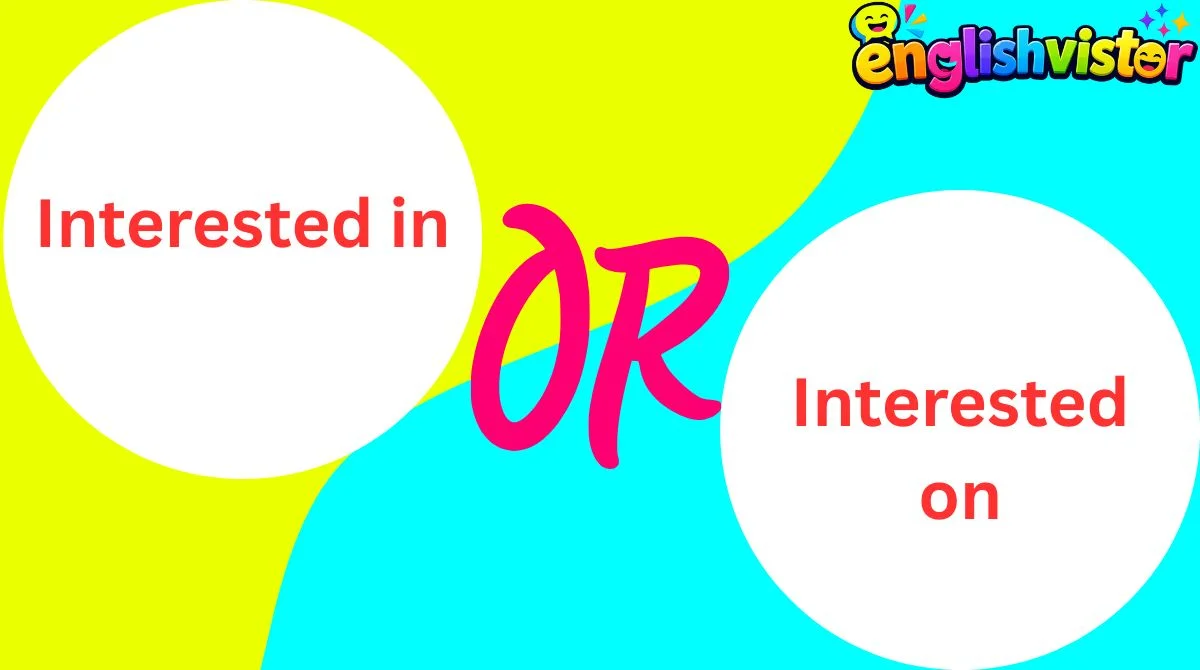
Many English learners feel confused when they want to say that they like something, care about something, or want to know more about something. A common question is whether to say “interested in” or “interested on.” The answer is simple, but it is important to understand the grammar behind it.Interested in or Interested on.
The correct expression in standard English is interested in. We normally do not use “interested on” when we mean that someone likes, wants to learn about, or wants to know more about a subject or activity Interested in or Interested on.
For example, we say, “I am interested in history,” not “I am interested on history.” We also say, “She is interested in learning Spanish.”Interested in or Interested on.
The confusion often happens because English uses different prepositions after different adjectives. A learner may know that on can mean “about” or “related to” in some expressions, so using it after “interested” may seem reasonable. However, English has a fixed and natural combination here.
Understanding this small grammar point can make your everyday English sound much more natural. You will be able to talk about your hobbies, studies, career plans, favorite subjects, and personal interests with confidence.
By the end, you will know which preposition follows “interested,” why it is used, what structures come after it, and how to avoid common mistakes.Interested in or Interested on.
What Does “Interested In” Mean?
Interested in means that you want to know more about something, enjoy something, care about something, or feel attracted to a particular subject or activity.Interested in or Interested on.
The adjective interested describes a person’s feeling or state of mind. The preposition in connects that feeling to the person, thing, subject, activity, or idea that creates the interest.Interested in or Interested on.
The basic structure is:
Subject + be + interested in + noun
For example:
- I am interested in science.
- Tom is interested in football.
- They are interested in art.
- My sister is interested in photography.
You can also put a verb ending in -ing after “interested in.”
The structure becomes:
Subject + be + interested in + verb-ing
For example:
- I am interested in learning French.
- She is interested in becoming a doctor.Interested in or Interested on.
- We are interested in visiting Japan.
- He is interested in playing tennis.
This is an important point for learners. When in works as a preposition, the verb that follows it normally takes the -ing form, not the base form.Interested in or Interested on.
So, we say:
I am interested in learning English.
Not:
I am interested in learn English.
The expression is useful in many parts of everyday English. You can use it when talking about school, work, hobbies, entertainment, sports, travel, technology, relationships, or future plans.Interested in or Interested on.
Here are several examples:
- I am interested in history.
- Maria is interested in painting.
- Are you interested in music?
- My brother is interested in computers.
- We are interested in learning more about the course.
- He became interested in photography last year.
- The students are interested in space science.
- I have always been interested in animals.
A common learner confusion is thinking that “interested” can stand alone with any preposition. English does not work that way. Some adjective-preposition combinations are simply established through normal usage.Interested in or Interested on.
For example, we say good at, afraid of, excited about, and interested in. Changing the preposition can make the sentence unnatural or incorrect.
So, when you want to express someone’s curiosity, attention, or liking toward a subject, remember the natural combination: interested in.
What Does “Interested On” Mean?
Interested on is generally not the correct expression when you want to say that someone has an interest in a subject, activity, person, or idea.
For this meaning, standard English uses interested in.Interested in or Interested on.
For example:
Correct: I am interested in photography.
Incorrect: I am interested on photography.
The problem is not the word on itself. “On” is a very useful English preposition, but it has different jobs. We use it for many meanings, including position, contact, dates, surfaces, and certain topics or activities.Interested in or Interested on.
For example:
- The book is on the table.
- We have a meeting on Monday.
- She is working on a new project.
- I watched a documentary on climate change.
Notice the last sentence. On can sometimes mean “about” when it describes the subject of a book, lecture, report, documentary, or similar thing.Interested in or Interested on.
That does not mean we can put on after every adjective that relates to a topic.
This is why interested on may look logical to some learners but still sound wrong.Interested in or Interested on.
Consider these examples:
- I am interested on science. ❌
- She is interested on cooking. ❌
- Are you interested on this job? ❌
- He is interested on sports. ❌
- We are interested on the new course. ❌
- My children are interested on dinosaurs. ❌
- She became interested on photography. ❌
- I am interested on learning English. ❌
In all these sentences, replace on with in.
The correct versions are:
- I am interested in science.
- She is interested in cooking.
- Are you interested in this job?
- He is interested in sports.
- We are interested in the new course.
- My children are interested in dinosaurs.
- She became interested in photography.
- I am interested in learning English.
So, if your goal is to express personal interest, interested in is the form you should learn and use.Interested in or Interested on.
Difference Between Interested In and Interested On (Detailed)
The main difference is straightforward: interested in is the standard expression for talking about a person’s interest, while interested on is not normally used for this meaning.Interested in or Interested on.
| Expression | Standard English? | Main use | Example |
|---|---|---|---|
| Interested in | Yes | Showing interest in something | I am interested in music. |
| Interested on | No, for this meaning | Not used after “interested” to express personal interest | I am interested on music. ❌ |
The grammar becomes easier when you treat interested in as a fixed adjective-preposition combination.Interested in or Interested on.
The word interested is an adjective. When we connect it to the thing that creates the interest, we use in.
For example:
I am interested in computers.
Here:
- I = subject
- am = form of “be”
- interested = adjective
- in = preposition
- computers = object of the preposition
The same pattern works with other subjects:
She is interested in medicine.
They are interested in football.
We are interested in your idea.
When an activity follows the preposition, use the -ing form:
He is interested in learning coding.
She is interested in becoming a teacher.
I am interested in improving my English.
This is another reason learners sometimes make mistakes. They may change both the preposition and the verb form at the same time.
For example:
I am interested on learn English. ❌
There are two problems. The preposition should be in, and the verb should be learning.
The correct sentence is:
I am interested in learning English.Interested in or Interested on.
The expression can also be used in questions.
For example:
Are you interested in this position?
Is Sarah interested in joining us?
What subjects are you interested in?
You can also use different forms of the verb be:
- I am interested in…
- You are interested in…
- He is interested in…
- She is interested in…
- We are interested in…
- They are interested in…
You can also use past and future forms:
I was interested in astronomy when I was a child.Interested in or Interested on.
She became interested in cooking.
They will be interested in the new program.
The important thing is that the preposition remains in.
Grammar Rules You Must Remember
1. Use “in” after “interested”
The most important rule is simple:
interested + in
Do not replace in with on when expressing personal interest.Interested in or Interested on.
Example:
I am interested in history.
Not:
I am interested on history.
This rule applies whether the sentence is positive, negative, or a question.Interested in or Interested on.
2. Use a noun after “interested in”
A noun can directly follow the preposition.
Examples:
- She is interested in art.
- I am interested in business.
- He is interested in science.
- They are interested in travel.
The noun can refer to a person, subject, activity, object, field, or idea.Interested in or Interested on.
For example:
I am interested in your opinion.
She is interested in that company.
3. Use an -ing verb after “interested in”
When an action follows in, use a gerund, which is the -ing form of a verb.Interested in or Interested on.
Examples:
- I am interested in learning English.
- He is interested in buying a car.
- She is interested in studying medicine.
- They are interested in visiting the museum.
Do not use the base verb directly after the preposition.Interested in or Interested on.
Incorrect:
I am interested in learn English. ❌
Correct:
I am interested in learning English. ✅
4. “Interested” describes a person’s feeling
The adjective interested normally describes how someone feels.
For example:
The students are interested in the lesson.
This means the students find the lesson engaging or want to know more about it.Interested in or Interested on.
Do not confuse interested with interesting.
Compare:
The movie is interesting.
This describes the movie.
I am interested in the movie.
This describes my feeling about the movie.
That small difference is very useful in everyday English.Interested in or Interested on.
Common Mistakes Students Make
Why These Mistakes Happen
Many learners translate directly from their first language. In some languages, the preposition used with the idea of “interest” may be closer to on, “about,” or another word.Interested in or Interested on.
Another reason is that English uses on with many topics:
- a book on history
- a lecture on science
- a report on education
- an article on climate change
Because on can introduce a topic in these expressions, learners may assume it can also follow “interested.”Interested in or Interested on.
But adjective-preposition combinations do not always follow a simple logical pattern. Native speakers learn them as natural combinations.
The most common mistake is:
I am interested on English. ❌
The correction is:
I am interested in English. ✅
Another mistake is:
She is interested in learn Spanish. ❌
The correction is:
She is interested in learning Spanish. ✅
A third common mistake is confusing interested and interesting.
I am interesting in football. ❌
Here, the speaker probably wants to say that football is something they like or care about.
The correct sentence is:
I am interested in football. ✅
But if you say:
Football is interesting.
You mean that football itself is enjoyable, engaging, or worth learning about.Interested in or Interested on.
An easy correction tip is to ask yourself two questions:
Am I describing a person’s feeling?
Use interested.
Am I describing the thing that creates the feeling?
Use interesting.
Then remember the preposition:
interested + in
Easy Trick to Remember the Difference
Use the “Interest Goes In” Trick
A simple memory trick is:
Your interest goes IN something.
Imagine that your attention is moving into a subject.
You become interested in music.
You become interested in sports.
You become interested in computers.
You become interested in learning English.
The word in can help you remember that your attention is directed toward the subject.
You do not need to think about complicated grammar every time you speak. Just remember the common pair:
interested in
Think of it as one unit rather than two separate words.
This is similar to learning expressions such as:
- good at
- afraid of
- proud of
- excited about
- interested in
Trying to translate each preposition from your first language can cause problems. Instead, learn the complete expression and use it naturally.
For example, if someone asks:
What are you interested in?
You can answer:
I am interested in photography.
Or:
I am interested in learning new languages.
Or:
I am interested in technology.
The same pattern will work again and again.
A second memory trick is to remember the question:
What are you interested in?
The final word of the question is in, and your answer normally keeps the same pattern.
What are you interested in?
I am interested in music.
What is she interested in?
She is interested in painting.
This is a very natural way to learn the structure.
Daily Life Examples (Very Important)
Real-Life Spoken English Examples
Here are some simple situations where you can naturally use the correct expression.
1. Talking about hobbies
A: What do you do in your free time?
B: I am interested in photography.
This tells the listener that photography is one of your interests.
2. Talking about school
A: Which subject do you like most?
B: I am interested in science.
The speaker is saying that science catches their attention.
3. Talking about a job
A: Are you interested in this position?
B: Yes, I am very interested in it.
This is common in professional conversations.
4. Talking about learning
A: Why are you studying Spanish?
B: I am interested in learning another language.
Here, the activity follows in, so learning is used.
5. Talking about sports
A: Do you watch sports?
B: Yes. I am especially interested in cricket.
This is a natural way to describe a sports preference.
6. Talking about travel
A: Where would you like to travel?
B: I am interested in visiting Turkey.
The verb visiting follows the preposition.
7. Talking about technology
A: Why did you buy that computer?
B: I am interested in technology and programming.
The expression works with more than one noun.
8. Talking about a course
A: Would you like to join our English course?
B: Yes, I am interested in the course.
This is useful in school, college, and workplace conversations.
9. Talking about future plans
A: What career do you want?
B: I am interested in becoming a software developer.
Again, the verb after in takes the -ing form.
10. Asking someone about their interests
A: What are you interested in?
B: I am interested in books, music, and photography.
This is one of the most useful questions for everyday conversation.
These examples show why learning the whole expression is better than memorizing one isolated rule. Once you become comfortable with the pattern, you can use it with hundreds of different subjects and activities.
Practice Section
Choose the Correct Option
Complete each sentence with the correct choice.
1. I am interested ___ history.
a) in
b) on
2. She is interested in ___ French.
a) learn
b) learning
3. Are you interested ___ this job?
a) in
b) on
4. They are interested in ___ a new business.
a) start
b) starting
5. What are you interested ___?
a) in
b) on
Answers
1. a) in
The correct sentence is: I am interested in history.
2. b) learning
The correct sentence is: She is interested in learning French.
3. a) in
The correct sentence is: Are you interested in this job?
4. b) starting
The correct sentence is: They are interested in starting a new business.
5. a) in
The correct question is: What are you interested in?
If you can answer these correctly, you already understand the main grammar rule. Keep practicing it in your own sentences.
FAQs
What is the difference between “interested in” and “interested on”?
Interested in is the standard English expression used to show that someone has an interest in a subject, activity, person, or idea. Interested on is not normally correct for this meaning. Say, “I am interested in music,” rather than “I am interested on music.”
Can we use “interested in” in questions?
Yes. It is very common in questions. For example, “Are you interested in this course?” and “What are you interested in?” are both natural. The preposition in stays with the adjective even when the sentence becomes a question.
Is “interested in” formal or informal?
Interested in is neither unusually formal nor unusually informal. It is a normal expression used in everyday speech, school writing, business communication, and professional English. You can safely use it in most situations.
Can “interested in” be followed by a verb?
Yes, but the verb normally takes the -ing form because in is a preposition. For example, say “I am interested in learning English” rather than “I am interested in learn English.”
Is “interested on” ever correct?
The combination interested on is not normally used in standard English to express personal interest. You may see on introducing a topic in expressions such as “a lecture on history,” but that is a different grammatical structure from “interested in history.”
What is the difference between “interested” and “interesting”?
Interested describes how a person feels, while interesting describes something that creates interest. For example, “I am interested in science” describes my feeling, while “Science is interesting” describes science.
Conclusion
The main rule is easy to remember: use interested in when you want to talk about someone’s interest in a subject, activity, person, or idea.
For example, say “I am interested in music,” “She is interested in cooking,” and “They are interested in learning English.” Do not normally use interested on for these meanings.
It is also important to remember the verb pattern. When an action comes after the preposition, use the -ing form: interested in reading, interested in studying, or interested in traveling.
Do not worry if this felt confusing at first. Prepositions are often difficult for English learners because they do not always follow simple rules. The best approach is to learn common combinations as complete expressions.
Try making five sentences about your own interests today. Talk about your hobbies, favorite subjects, future plans, or things you want to learn. With a little practice, interested in will start to feel natural.

Hi, I’m Isabella Foster, an English language writer passionate about making grammar, vocabulary, and communication skills easy to understand. At EnglishVistor, I create clear, practical, and engaging learning resources to help learners improve their English with confidence.