Many English learners feel confused when they see the words mom and mum. Both words mean the same thing: a person’s mother. So why are there two different spellings? Which one should you use? Is one correct and the other wrong?
The answer is simple: both words are correct, but they are used in different parts of the English-speaking world.Mom vs Mum
English changes slightly from country to country. Just like people may have different accents, they may also use different words or spellings. The difference between these two words is mainly about regional English, not grammar.Mom vs Mum
Understanding this small difference is useful because you will see both words in books, movies, websites, conversations, and social media. If you are learning English, knowing when to use each word will help you communicate more naturally.Mom vs Mum
After understanding this topic, you will know:
- what each word means,
- where each spelling is commonly used,
- how native speakers use these words,
- which one to choose in different situations,
- and how to avoid common mistakes.
The good news is that you do not need to memorize a difficult grammar rule. You only need to understand where each word belongs and practice using it in real sentences.Mom vs Mum
What Does “Mom” Mean?
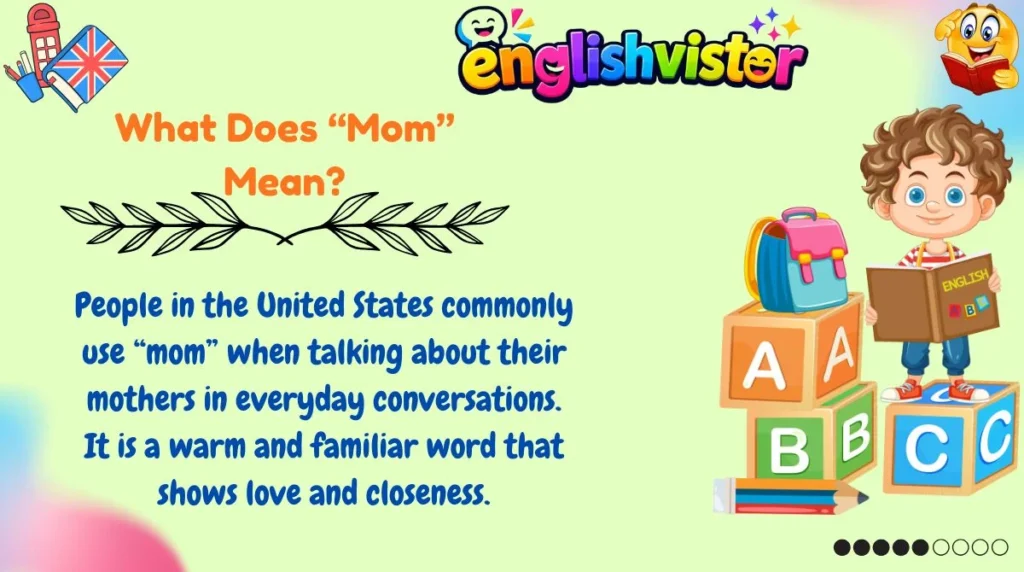
Mom is an informal word for mother. It is mainly used in American English.Mom vs Mum
People in the United States commonly use “mom” when talking about their mothers in everyday conversations. It is a warm and familiar word that shows love and closeness.
The word “mom” is usually used with family members, friends, and in casual situations. It is not normally used in formal writing where the word mother may be more suitable.Mom vs Mum
For example:
- My mom makes the best chocolate cake.
- I called my mom after school.
- My mom works at a hospital.
- I asked my mom for advice.Mom vs Mum
- Her mom is visiting this weekend.
- My mom taught me how to cook.
- I love spending time with my mom.
- His mom picked him up from college.
In American English, children often say:
- “Mom, can you help me?”
- “I miss my mom.”
- “My mom is coming home soon.”
The spelling “mom” is common in the United States and Canada. American movies, TV shows, and online content often use this form.Mom vs Mum
Common learner confusion about “Mom”
Many learners think “mom” is a different word from “mum.” It is not. The meaning is exactly the same. The only major difference is the region where people use it.Mom vs Mum
For example:
American English:
- My mom is a teacher.
British English:
- My mum is a teacher.
Both sentences have the same meaning.Mom vs Mum
What Does “Mum” Mean?
Mum is also an informal word for mother. It is mainly used in British English and many other varieties of English, including Australian English.
People in the United Kingdom usually say “mum” when talking about their mothers in daily life.Mom vs Mum
Examples:
- My mum is making dinner.
- I spoke to my mum yesterday.
- Her mum lives in London.
- My mum gave me a good idea.
- I bought a gift for my mum.
- His mum is very kind.Mom vs Mum
- My mum always supports me.
- I am going shopping with my mum.
Children in the UK often say:
- “Mum, look at this!”
- “Can you help me, Mum?”
- “I love my mum.”
Just like “mom,” the word “mum” is friendly and informal. It is used in normal conversations but may not appear in very formal writing.Mom vs Mum
For example, a person may write:
Formal:
- My mother attended the meeting.
Informal:
- My mum came to the meeting.Mom vs Mum
Common learner confusion about “Mum”
Some learners think “mum” means “silent” because the word “mum” can also be an adjective in phrases like “keep mum,” which means “keep quiet.”Mom vs Mum
However, when talking about a family member, mum means mother.
The meaning depends on the context.Mom vs Mum
Examples:
- My mum called me.
(My mother called me.) - Please keep mum about the surprise.
(Please keep quiet about the surprise.)
These are two different uses of the same spelling.
Difference Between Mom and Mum (Detailed Comparison)
The biggest difference between these two words is not meaning. It is location and style of English.Mom vs Mum
| Point | Mom | Mum |
|---|---|---|
| Meaning | Mother | Mother |
| Main usage | American English | British English |
| Common countries | USA, Canada | UK, Australia, some other regions |
| Style | Informal and friendly | Informal and friendly |
| Formal version | Mother | Mother |
| Example | My mom is here. | My mum is here. |
Usage Difference
The word you choose depends on the type of English you are using.Mom vs Mum
If you are writing for an American audience:
- My mom loves gardening.
If you are writing for a British audience:
- My mum loves gardening.
Both sentences are correct.
The important thing is consistency. If you are writing an article, story, or school assignment, try not to mix both forms unless you are discussing the difference.Mom vs Mum
Grammar Logic
From a grammar point of view, there is no difference.Mom vs Mum
Both words are:
- nouns,
- informal terms,
- used for a female parent.
They can both be used as:
A subject:
- My mom is cooking.
- My mum is cooking.
An object:
- I called my mom.
- I called my mum.
A possessive form:
- My mom’s car is new.
- My mum’s car is new.
The sentence structure stays the same.
Meaning Comparison
The meaning is identical.
Mom = Mum = Mother
The difference is similar to other English variations:
American English:
- apartment
British English:
- flat
American English:
- elevator
British English:
- lift
The words are different, but the idea is the same.
Grammar Rules You Must Remember
Rule 1: Use “Mom” for American English
When writing or speaking in American English, “mom” is the natural choice.
Example:
- My mom is waiting outside.
A person from the United States will normally expect this spelling.
Rule 2: Use “Mum” for British English
When using British English, “mum” is the common spelling.
Example:
- My mum is waiting outside.
This sounds natural to people in the UK.
Rule 3: Do Not Use Both Forms Randomly
Choose one style and stay consistent.
Incorrect style:
- My mom lives in London. My mum visits me every week.
This is not grammatically wrong, but it sounds inconsistent if you are writing in one type of English.
Better:
American style:
- My mom lives in London. My mom visits me every week.
British style:
- My mum lives in London. My mum visits me every week.
Rule 4: Use “Mother” in Formal Situations
Both “mom” and “mum” are informal.
For formal writing, “mother” is often better.
Examples:
Informal:
- My mom helped me.
Formal:
- My mother helped me.
Common Mistakes Students Make
Many English learners make small mistakes because they learn English from different sources. They may watch American movies but study British textbooks. This creates confusion.
Mistake 1: Thinking One Word Is Wrong
Wrong idea:
- “Mum is incorrect.”
- “Mom is incorrect.”
Correct idea:
Both are correct. They belong to different English varieties.
Mistake 2: Mixing American and British English
Example:
- My mom went to the shop.
The sentence is understandable, but “shop” is more common in British English, while “store” is more common in American English.
A consistent American sentence:
- My mom went to the store.
A consistent British sentence:
- My mum went to the shop.
Mistake 3: Using “Mom” in British Writing
A student writing for a British English class may write:
- My mom is a doctor.
The grammar is correct, but “mum” may be expected in British English.
Better:
- My mum is a doctor.
Mistake 4: Using “Mum” When Talking About American Culture
If you are writing about an American family, “mom” may sound more natural.
Example:
- In the movie, the child calls his mom every day.
This matches American English.
Easy Trick to Remember the Difference
A simple memory trick can help:
Mom = America
Mum = United Kingdom
Think of the letter:
O in Mom = Ocean
The United States is across the ocean from many countries that use British English.
So:
- Mom → American English
- Mum → British English
Another easy way:
If you hear an American person speaking, you will usually hear “mom.”
If you hear a British person speaking, you will usually hear “mum.”
Remember that the sound is almost the same. The spelling is what changes.
Daily Life Examples
These examples show how native speakers use these words in normal conversations.
Example 1
Person A:
“Who made this cake?”
Person B:
“My mom made it.”
(American English)
Example 2
Person A:
“Are you going home today?”
Person B:
“Yes, I’m visiting my mum.”
(British English)
Example 3
“I called my mom after my exam.”
Meaning:
I contacted my mother after my exam.
Example 4
“My mum always gives me good advice.”
Meaning:
My mother always helps me with useful ideas.
Example 5
“My mom and I went shopping yesterday.”
Common American English sentence.
Example 6
“My mum is preparing dinner tonight.”
Common British English sentence.
Example 7
“Her mom works at a school.”
American English usage.
Example 8
“His mum bought him a new jacket.”
British English usage.
Example 9
“I want to spend more time with my mom.”
A natural American conversation sentence.
Example 10
“I need to ask my mum before I decide.”
A natural British conversation sentence.
Practice Section
Choose the correct word: mom or mum.
- My _____ lives in New York. (American English)
- I am going to visit my _____ in London. (British English)
- Her _____ makes delicious food.
- I called my _____ yesterday.
- My _____ always supports me.
Answers:
- mom
- mum
- mom or mum (depends on English variety)
- mom or mum (depends on English variety)
- mom or mum (depends on English variety)
FAQs
What is the difference between mom and mum?
The meaning is the same. Both words mean “mother.” The difference is regional. “Mom” is common in American English, while “mum” is common in British English.
Can we use mom in questions?
Yes. “Mom” can be used in questions when speaking American English.
Examples:
- Mom, can you help me?
- Where is my mom?
Is mum formal or informal?
“Mum” is informal. It is used in everyday conversations. In formal situations, “mother” is usually a better choice.
Is mom used in British English?
Some British speakers may understand “mom,” but “mum” is the usual British spelling. “Mom” is strongly connected with American English.
Which word should English learners use: mom or mum?
Choose based on the type of English you are learning. If you study American English, use “mom.” If you study British English, use “mum.”
Are mom and mum pronounced differently?
Usually, they sound almost the same. The main difference is the spelling, not the pronunciation.
Conclusion
The difference between mom and mum is simple once you understand English varieties. Both words mean the same thing: a mother. The only difference is where they are commonly used.
Mom is the usual spelling in American English, while mum is the usual spelling in British English and some other English-speaking countries.
Neither word is better or more correct. They are both natural words used by millions of people every day.
When learning English, focus on the audience and the style you want to use. If you are writing for Americans, “mom” will sound more natural. If you are writing for British readers, “mum” is the better choice.
The best way to remember the difference is through practice. Read English books, watch videos, and notice how native speakers use these words. With time, choosing the right spelling will become automatic.
Small differences like this make English interesting. Learning them helps you sound more confident and natural.

Hi, I’m Isabella Foster, an English language writer passionate about making grammar, vocabulary, and communication skills easy to understand. At EnglishVistor, I create clear, practical, and engaging learning resources to help learners improve their English with confidence.