Many English learners become confused when they see not able and unable because both expressions can describe a person who cannot do something. At first, they may look exactly the same. After all, not able seems to mean the same thing as unable.
The good news is that both forms are grammatically correct. The real difference is usually style, emphasis, and context. Choosing between them becomes much easier when you understand how each one works in a sentence Not Able or Unable.
For example, you can say, “I am not able to attend the meeting,” or “I am unable to attend the meeting.” Both sentences are correct, but they do not always sound exactly the same.Not Able or Unable.
Not able is often more conversational and can fit naturally into everyday speech. Unable is usually shorter and can sound more formal, especially in business writing, official notices, and professional communication.Not Able or Unable.
There is another important point. The word unable is not simply a random replacement for every use of “not able.” The surrounding sentence matters. Sometimes not able gives stronger emphasis to the negative idea, while unable presents the lack of ability in a more direct way.Not Able or Unable.
By the end of this guide, you will understand not able or unable, know when to use each expression, recognize common mistakes, and feel more confident choosing the natural form in everyday English.Not Able or Unable.
What Does “Not Able” Mean?
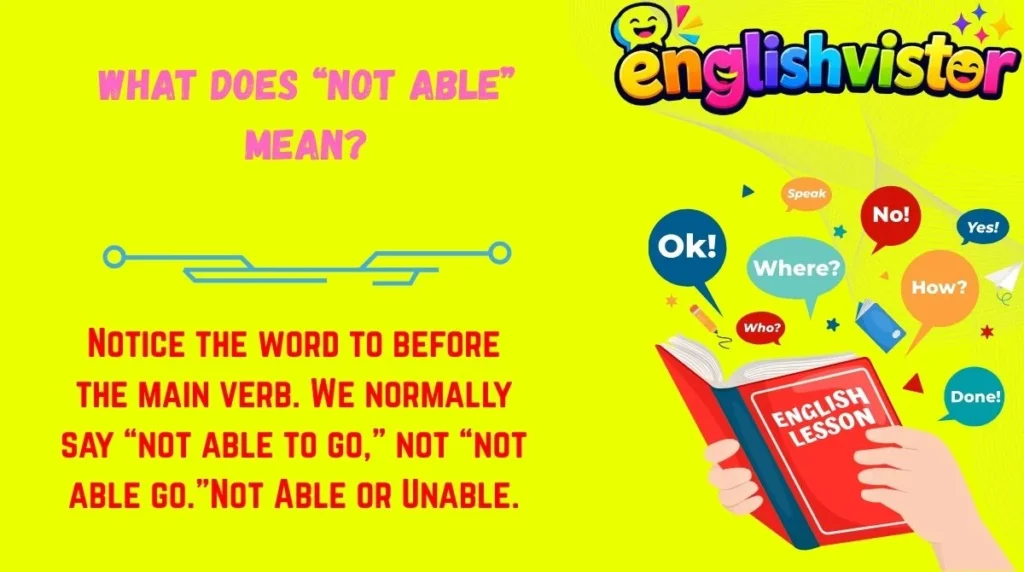
Not able means that someone does not have the ability, opportunity, permission, strength, or possibility to do something.
The basic structure is:
Subject + be + not able + to + verb
Examples:
- I am not able to come tonight.
- She is not able to walk without help.
- We are not able to finish the project today.
- He was not able to answer the question.
- They were not able to find the missing file.
- You are not able to change the password right now.
- My brother is not able to drive yet.
- I was not able to sleep last night.
Notice the word to before the main verb. We normally say “not able to go,” not “not able go.”Not Able or Unable.
The expression can describe many different situations. A person may lack physical ability, knowledge, time, money, permission, or simply the opportunity to do something.Not Able or Unable.
For example:
I am not able to lift this box.
Here, the problem may be physical strength.Not Able or Unable.
I am not able to understand this question.
Here, the problem may be knowledge or understanding.
I am not able to attend the meeting.
Here, the problem may be time, availability, or another circumstance.
When Should You Use “Not Able”?
Not able is especially natural when you want to speak in a simple, direct, everyday way.
Imagine a friend invites you to dinner:
“Sorry, I’m not able to come tonight.”
This sounds perfectly understandable. In casual conversation, you might also hear “I can’t come tonight,” which is even more natural and shorter.Not Able or Unable.
Not able can also be useful when you want to put special focus on the negative situation.Not Able or Unable.
Compare:
I am unable to help.
I am not able to help.
Both are correct. The second can place a little more emphasis on the fact that the person is not able to help.Not Able or Unable.
Another useful feature is that not able works comfortably with different forms of the verb be:
- am not able
- is not able
- are not able
- was not able
- were not able
- will not be able
For example:
She was not able to contact her parents.Not Able or Unable.
We will not be able to join you tomorrow.
That last structure is very common. Notice that after “will,” we use be able, not “will able.”
What Does “Unable” Mean?
Unable is an adjective meaning not having the ability or possibility to do something.Not Able or Unable.
It is normally followed by to + base verb.
The common structure is:
Subject + be + unable + to + verb
Examples:
- I am unable to attend the meeting.
- She is unable to answer the question.
- He was unable to open the door.Not Able or Unable.
- We are unable to provide a refund.
- They were unable to reach the airport on time.
- The computer is unable to connect to the network.
- The doctor was unable to determine the cause.
- I will be unable to visit you tomorrow.
The meaning is closely connected to not able.Not Able or Unable.
For example:
She is unable to walk.
This means:
She is not able to walk.
The important difference is not usually the basic meaning. The difference is more about tone and usage.Not Able or Unable.
Unable often sounds more formal, concise, or professional. You may see it in emails, official notices, customer-service messages, reports, and formal announcements.Not Able or Unable.
For example:
We are unable to process your request at this time.
This sounds professional and official.
You could also say:
We are not able to process your request at this time.
That is grammatically correct, but unable makes the message shorter and more formal.
Grammar Rule for “Unable”
Do not normally put a noun directly after unable.
Incorrect:
She is unable the work.
Correct:
She is unable to do the work.
Also remember that unable is normally followed by an infinitive:
unable + to + verb
Examples:
- unable to go
- unable to speak
- unable to understand
- unable to work
- unable to attend
- unable to decide
A common learner mistake is to forget to.
Incorrect:
I am unable finish it.
Correct:
I am unable to finish it.
Difference Between “Not Able” and “Unable”
The easiest way to understand not able or unable is to remember that both can express a lack of ability, but they can create slightly different impressions.
| Point | Not Able | Unable |
|---|---|---|
| Basic meaning | Does not have the ability or possibility | Does not have the ability or possibility |
| Grammar | be + not able + to + verb | be + unable + to + verb |
| Tone | Often conversational | Often formal or professional |
| Common setting | Everyday speech and general writing | Formal, business, official, and professional writing |
| Example | I am not able to come. | I am unable to come. |
| Meaning | Cannot come | Cannot come |
| Emphasis | Can sometimes emphasize the negative | Usually states inability directly |
So, when considering not able or unable, do not assume that one is correct and the other is incorrect. Both are correct in the right grammatical structure.
Usage Difference
In everyday conversation, many speakers would simply use can’t:
I can’t come today.
But if you want to use one of the two expressions, not able can sound more conversational:
I’m not able to come today.
In formal writing, unable may be a better choice:
We are unable to accept applications after Friday.
This does not mean that not able is wrong in formal English. It simply means that unable is often more concise and formal.
Grammar Logic
Both expressions are connected to the adjective able.
Able means having the ability or opportunity to do something.
She is able to swim.
When we make it negative, we can say:
She is not able to swim.
Or we can use the adjective unable:
She is unable to swim.
The basic meaning remains very similar.
Sentence Structure
With not able, the negative word not appears separately:
He is not able to attend.
With unable, the negative meaning is already contained in the word:
He is unable to attend.
This is one reason unable can make a sentence more compact.
Meaning Comparison
Consider these two sentences:
I am not able to help you.
I am unable to help you.
Both normally mean that the speaker cannot help.
The first may feel slightly more conversational or may give more attention to the negative form. The second often sounds more formal and definite.
Therefore, if someone asks, “Which is correct: not able or unable?”, the best answer is:
Both are correct. Choose according to the sentence, tone, and context.
Grammar Rules You Must Remember
1. Use “to” after both forms
When able or unable is followed by an action verb, use to + base verb.
Correct:
I am not able to attend.
Correct:
I am unable to attend.
Incorrect:
I am unable attend.
The same rule applies to many verbs:
She is unable to drive.
We are not able to finish the work.
2. “Unable” already contains the negative idea
Do not normally add another negative word to unable.
Incorrect:
I am not unable to understand it.
This sentence is grammatically possible in a special context, but it changes the meaning and can confuse the reader.
If you simply mean that you cannot understand something, say:
I am unable to understand it.
Or:
I am not able to understand it.
When discussing not able or unable, this is one of the most useful rules to remember.
3. Use the correct form of “be”
Because able and unable are adjectives, they usually need a form of be.
Examples:
I am unable to go.
She is not able to come.
They are unable to help.
Past tense:
He was unable to attend.
We were not able to finish.
Future:
I will be unable to join you.
A common mistake is:
I will unable to come.
Correct:
I will be unable to come.
4. Do not use “can” directly with “unable”
Avoid combining can and unable in the normal structure.
Incorrect:
I can unable to do it.
Correct:
I am unable to do it.
Or:
I cannot do it.
Likewise, you generally do not need can before not able:
Incorrect:
I can not able to come.
Correct:
I am not able to come.
This rule makes choosing between not able or unable much easier.
Common Mistakes Students Make
Why Do These Mistakes Happen?
Learners often make mistakes because English has several ways to express the same basic idea.
For example, can’t, cannot, not able, and unable can all describe inability in different situations.
Students sometimes mix their grammar patterns.
Mistake 1: Forgetting “to”
Wrong:
She is unable finish the work.
Correct:
She is unable to finish the work.
The same applies to not able:
She is not able to finish the work.
Mistake 2: Using “will unable”
Wrong:
I will unable to attend.
Correct:
I will be unable to attend.
Another option is:
I will not be able to attend.
The future structure needs be.
Mistake 3: Using “unable” as a normal verb
Wrong:
I unable to go.
Correct:
I am unable to go.
Remember that unable is an adjective. It normally needs a form of be.
Mistake 4: Thinking “unable” is always better
Some learners believe that unable is more correct because it sounds formal.
That is not true.
Not able is also correct.
For example:
I am not able to come today.
There is nothing grammatically wrong with this sentence.
Do not replace every instance of not able with unable automatically. Think about the tone and meaning first.
Mistake 5: Thinking the two expressions always sound identical
Although not able or unable can have the same basic meaning, style matters.
Compare:
Sorry, I am not able to come to your party.
We regret that we are unable to attend the scheduled event.
The first feels more personal and conversational. The second sounds much more official.
The difference is often about register, not correctness.
Easy Trick to Remember the Difference
Here is a simple classroom trick for remembering not able or unable.
Think of unable as a short form of the idea “not able.”
able → has ability
not able → does not have ability
unable → does not have ability
So:
She is able to swim.
Negative:
She is not able to swim.
Alternative:
She is unable to swim.
Now think about tone.
If you are talking naturally with a friend, not able can feel comfortable:
I’m not able to come tonight.
If you are writing an official message, unable can sound more polished:
We are unable to accommodate your request.
There is one more trick.
Whenever you use either expression before another verb, remember:
NOT ABLE + TO + VERB
UNABLE + TO + VERB
For example:
not able to work
unable to work
not able to attend
unable to attend
not able to understand
unable to understand
This simple pattern will prevent many grammar mistakes.
Daily Life Examples
Real Conversations Using “Not Able” and “Unable”
Here are some natural examples that show how not able or unable works in everyday and professional situations.
1. Talking to a friend
“Are you coming to dinner?”
“Sorry, I’m not able to come tonight. I have too much work.”
This sounds natural and friendly.
2. Talking about transportation
“Why didn’t you come yesterday?”
“My car broke down, so I was not able to get there.”
The speaker explains why the trip was impossible.
3. Talking about work
“Can you finish this today?”
“I’m not able to finish it today, but I can send it tomorrow.”
This is a polite way to explain a limitation.
4. A professional email
“We are unable to approve your request at this time.”
Here, unable fits the formal business tone.
5. A customer-service message
“We are currently unable to process your payment.”
This sounds concise and professional.
6. Talking about health or physical ability
“He was unable to walk after the accident.”
The sentence clearly describes a lack of physical ability.
7. Talking about understanding
“I’m not able to understand this part of the lesson.”
A student might naturally say this to a teacher.
8. Talking about the future
“I will not be able to visit you next week.”
This is extremely common in everyday English.
You can also say:
“I will be unable to visit you next week.”
The second version sounds more formal.
9. Explaining a technical problem
“The app is unable to connect to the server.”
This style is common in technical messages.
10. Giving a polite refusal
“Unfortunately, we are unable to offer a refund after 30 days.”
The formal tone makes unable a natural choice.
These examples show why the question not able or unable cannot be answered simply by saying that one is correct and the other is wrong. Both have useful places in English.
Practice Section
Choose the Correct Option
Choose not able or unable to complete each sentence. In some cases, both may be grammatically possible, but choose the option that best fits the tone.
1. I am ______ to attend the meeting tomorrow.
a) unable
b) unable to
c) unable attend
Answer: b) unable to
Correct sentence:
I am unable to attend the meeting tomorrow.
2. Sorry, I am ______ to come tonight.
a) not able
b) not able to
c) not able come
Answer: b) not able to
Correct sentence:
Sorry, I am not able to come tonight.
3. We are ______ provide the requested information.
a) unable to
b) unable
c) not able
Answer: a) unable to
Correct sentence:
We are unable to provide the requested information.
4. She will ______ to join us tomorrow.
a) unable
b) not be able
c) not able
Answer: b) not be able
Correct sentence:
She will not be able to join us tomorrow.
Remember the future pattern:
will + be able to
or
will + not be able to
5. He was ______ answer the question.
a) unable to
b) unable
c) not able
Answer: a) unable to
Correct sentence:
He was unable to answer the question.
FAQs
1. What is the difference between “not able” and “unable”?
Both normally mean that someone does not have the ability or possibility to do something. Not able can sound more conversational, while unable is often more formal. The grammar pattern is also similar: be + not able/unable + to + verb.
2. Is “not able” grammatically correct?
Yes. Not able is completely correct when it is used in the proper structure. For example, “I am not able to attend the meeting” is grammatical. You should not assume that unable is the only correct form.
3. Is “unable” formal or informal?
Unable is generally more formal or neutral than not able. It is common in business writing, official notices, customer-service messages, reports, and professional emails. However, it can also appear in normal conversation.
4. Can I use “not able” in a formal email?
Yes. There is no grammar rule that forbids it. For example, “I am not able to attend the meeting” is perfectly correct. However, “I am unable to attend the meeting” may sound more concise and formal.
5. Can “unable” be used in questions?
Yes. For example, you can ask, “Why are you unable to attend?” The expression follows the normal question structure with the verb be before the subject.
You can also ask, “Why are you not able to attend?” Both questions are grammatical.
6. Which is better: “not able or unable”?
Neither is always better. Both are correct, but the best choice depends on context. Use not able when a conversational or straightforward tone works well, and consider unable when you want a concise, professional, or formal tone.
Conclusion
The choice between not able or unable is much easier once you stop thinking of it as a question of right versus wrong. Both expressions are grammatically correct when they are used in the right structure.
Not able means that someone does not have the ability or possibility to do something. It often feels natural in everyday English. Unable has almost the same basic meaning, but it can sound more formal, concise, and professional.
The most important grammar pattern to remember is simple:
not able + to + verb
unable + to + verb
For example:
I am not able to attend.
I am unable to attend.
Both sentences work.
Also remember to use the correct form of be, especially in the future: “I will not be able to come” or “I will be unable to come.”
Once you understand the small difference in tone, choosing not able or unable becomes much more natural. Practice both forms in real sentences, and soon you will use them without stopping to think.

Hi, I’m Isabella Foster, an English language writer passionate about making grammar, vocabulary, and communication skills easy to understand. At EnglishVistor, I create clear, practical, and engaging learning resources to help learners improve their English with confidence.