
Last updated on October 12th, 2026 at 12:03 pm
Many English learners feel unsure when talking about a particular day. They may know that Friday is a day of the week, but they still wonder which preposition should come before it.
Is it on Friday or in Friday? This small grammar choice can make a sentence sound natural or incorrect On Friday or In Friday.
The good news is that the rule is actually quite simple. Native English speakers normally use on with a specific day. So, we say “I will visit you on Friday,” not “I will visit you in Friday.”
The confusion often happens because English uses different prepositions for different kinds of time. We use in with months, years, seasons, and longer periods. We use on with days and dates. We use at with exact times and some fixed time expressions.
Understanding this rule can make your everyday English much clearer. You will hear it at school, at work, in messages, during phone calls, and in ordinary conversations.On Friday or In Friday.
By the end of this guide, you will clearly understand on Friday or in Friday, know why one form is correct, and learn how to use the correct preposition with other days and dates.
You will also see common mistakes, simple memory tricks, daily examples, and practice questions.
What Does “On Friday” Mean?
On Friday means that something happens or happened during the day of Friday.On Friday or In Friday.
The word on is the normal preposition used before a specific day. It does not matter whether you are talking about the past, present, or future.On Friday or In Friday.
For example:
- I went to the market on Friday.
- We have an English class on Friday.
- She will call me on Friday.
- They are getting married on Friday.
- My exam is on Friday.
- I usually visit my grandparents on Friday.
- He arrived on Friday.
- We will discuss the project on Friday.
In all these examples, Friday identifies a particular day. That is why on is used.
When students ask about on Friday or in Friday, the easiest answer is that on Friday is the standard and correct form when you mean a day of the week.
The Basic Grammar Rule
Use on + day when you name a particular day.On Friday or In Friday.
Structure:
subject + verb + on + day
Examples:
I work on Friday.
She is coming on Monday.
We met on Saturday.
The same rule applies to every day:
- on Monday
- on Tuesday
- on Wednesday
- on Thursday
- on Friday
- on Saturday
- on Sunday
You can also use on with a specific date:
- on July 10
- on August 17
- on December 25
- on Monday morning
- on Friday evening
So, when considering on Friday or in Friday, remember that Friday is a day, and days normally take on.On Friday or In Friday.
When Should You Use “On Friday”?
Use on Friday when you are talking about an event, action, meeting, visit, appointment, or situation connected with Friday.On Friday or In Friday.
For example:
I have a meeting on Friday.
Here, the meeting is scheduled for Friday.
We are going to Lahore on Friday.
The travel is planned for Friday.
He finished the work on Friday.
The work was completed during Friday.
You can also add parts of the day:
- on Friday morning
- on Friday afternoon
- on Friday evening
- on Friday night
For example:
I will call you on Friday morning.
We are meeting on Friday evening.On Friday or In Friday.
A Common Learner Confusion
Some learners think in Friday should work because they have learned phrases such as in June, in 2026, and in winter.
But these expressions describe longer periods. Friday is one particular day, so English normally uses on.
Compare:
I was born in June.On Friday or In Friday.
I was born on June 12.
The first sentence uses a month, while the second uses a specific date.On Friday or In Friday.
Similarly:
I will see you on Friday.
Not:
I will see you in Friday.
What Does “In Friday” Mean?
In Friday is not the normal English expression when you want to say that something happens on Friday.On Friday or In Friday.
For standard English, in is generally not used directly before a day of the week.On Friday or In Friday.
Therefore, a sentence such as:
I will come in Friday.
sounds incorrect to a native English speaker.
The natural sentence is:
I will come on Friday.
This is an important point when learning on Friday or in Friday. The issue is not really about the meaning of Friday. The problem is choosing the correct preposition of time.On Friday or In Friday.
When Do We Use “In” for Time?
We commonly use in before longer periods of time.On Friday or In Friday.
Examples include:
- in January
- in February
- in 2026
- in summer
- in winter
- in the morning
- in the afternoon
- in the evening
- in a few days
- in two weeks
Examples:
My birthday is in July.
She moved here in 2025.
We usually travel in summer.
I study in the evening.
Notice that these examples do not use in directly before a specific day such as Friday.On Friday or In Friday.
Why “In Friday” Sounds Wrong
English prepositions do not always follow a logical rule that can be translated directly from another language.
A learner may think:
in + time
Therefore:
in Friday
But English divides time expressions into different groups.On Friday or In Friday.
A simple pattern is:
At → exact times
at 5 o’clock
On → days and dates
on Friday
In → months, years, seasons, and longer periods
in July
in 2026
This is why choosing between on Friday or in Friday becomes much easier once you learn the three main time-preposition groups.
What Is the Difference Between ‘On Friday,’ ‘By Friday,’ and ‘Until Friday’ in Everyday English?
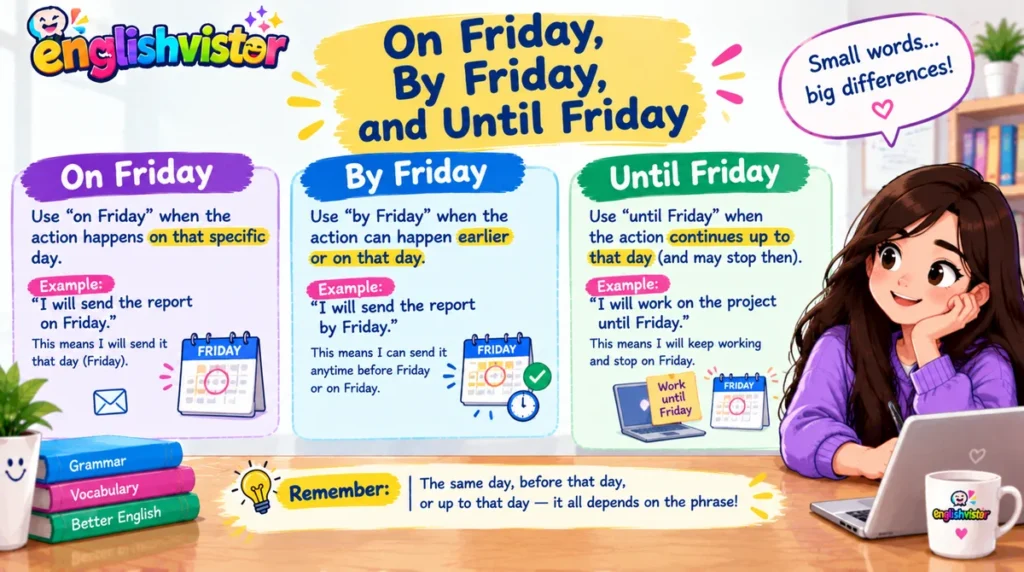
These three expressions have different meanings in English.
On Friday tells you when an event happens, by Friday means something must happen no later than Friday, and until Friday describes an action or situation that continues up to Friday.
For example, “I will send the report on Friday” means I will send it that day, while “I will send the report by Friday” means I can send it earlier or on Friday.
How Are You or How Are You Doing Today
Difference Between “On Friday” and “In Friday”
The main difference is simple: on Friday is correct for a day of the week, while in Friday is normally incorrect in standard English when used to mean a particular Friday.
| Expression | Correct? | Main Use | Example |
|---|---|---|---|
| on Friday | ✅ Yes | A specific day | I will call you on Friday. |
| in Friday | ❌ Normally no | Not used for a day | I will call you in Friday. |
| in June | ✅ Yes | A month | We arrived in June. |
| on June 12 | ✅ Yes | A specific date | We arrived on June 12. |
| in 2026 | ✅ Yes | A year | She graduated in 2026. |
| on Friday morning | ✅ Yes | Specific day + part of day | I work on Friday morning. |
Usage Difference
The word on connects an action to a particular day.On Friday or In Friday.
We have a test on Friday.
The word in usually places an event inside a longer period.
We have exams in June.
You can think of a month as a large time period and Friday as one particular day inside the calendar.
Grammar Logic
English treats days and dates differently from months and years.
Use:
on + day
on Friday
on + date
on August 17
Use:
in + month
in August
in + year
in 2026
in + season
in winter
This pattern explains most everyday questions about on Friday or in Friday.
Sentence Structure Difference
Correct:
Subject + verb + on Friday.
We are leaving on Friday.
Incorrect for the intended meaning:
Subject + verb + in Friday.
We are leaving in Friday. ❌
The problem is the preposition, not the verb or sentence structure.
Meaning Comparison
On Friday gives a clear day.
I will finish the report on Friday.
In Friday does not normally give a natural English time expression. A speaker would usually replace it with on Friday.
Grammar Rules You Must Remember
1. Use “On” With Days
The first rule is the most important one.
Use on before the name of a day:
- on Monday
- on Tuesday
- on Wednesday
- on Thursday
- on Friday
- on Saturday
- on Sunday
Example:
Our teacher gives us a test on Friday.
This rule is the key to understanding on Friday or in Friday.
2. Use “On” With Specific Dates
A specific calendar date also normally takes on.
Examples:
My appointment is on August 17.
The event is on December 25.
The school opens on September 1.
Here, the speaker gives a particular date rather than only a month or year.
3. Use “In” With Months and Years
Use in for months and years.
Examples:
I was born in May.
They moved here in 2024.
The company started in January.
We will finish the project in 2026.
This is different from a specific day.
4. Use “At” With Exact Clock Times
Another useful rule is to use at with exact times.
Examples:
The class starts at 8 a.m.
I wake up at 6 o’clock.
The train arrives at 7:30.
Now compare:
The train arrives on Friday at 7:30.
Both prepositions can appear in the same sentence because they describe different parts of time.
5. “On” Can Be Used With Parts of a Specific Day
You can say:
- on Friday morning
- on Friday afternoon
- on Friday evening
- on Friday night
Examples:
I have an appointment on Friday morning.
We are going out on Friday evening.
The word on still connects the expression to Friday.
Common Mistakes Students Make
Mistake 1: Using “In” Before Friday
A common sentence is:
I will see you in Friday. ❌
The correct form is:
I will see you on Friday. ✅
The mistake usually happens because students remember that in is used with time.
The correction is simple: do not think only about “time.” Think about the type of time.
Friday is a day, so use on.
Mistake 2: Using “At Friday”
Another incorrect form is:
We have a meeting at Friday. ❌
Use:
We have a meeting on Friday. ✅
At is generally used for exact clock times.
at 9 a.m.
at noon
at 6:30
Mistake 3: Saying “In Monday”
Students sometimes make the same mistake with other days.
I will go there in Monday. ❌
I will go there on Monday. ✅
Once you know the rule, you can apply it to every day.
Mistake 4: Forgetting the Preposition
Some learners say:
I will meet him Friday.
This can actually be acceptable, especially in informal American English, where speakers sometimes leave out the preposition with days.
However, for learners who want a clear standard pattern, on Friday is the safest form.
I will meet him on Friday.
Easy Correction Tip
Ask yourself one question:
“Am I naming a day?”
If the answer is yes, use on.
Friday → on Friday
Monday → on Monday
Sunday → on Sunday
This quick question can prevent many common mistakes.
Easy Trick to Remember the Difference
Think: “ON a Day”
Imagine a calendar.
Friday is shown as one day on the calendar.
So remember:
ON + DAY
Examples:
on Friday
on Monday
on Sunday
This is one of the easiest memory tricks for on Friday or in Friday.
Think About “IN” as a Bigger Box
Imagine a month as a large box.
A whole month contains many days, so we say:
in August
A year contains many months, so we say:
in 2026
A season covers a period of time, so we say:
in summer
But when you point to one specific day, use on:
on Friday
So the pattern looks like this:
IN → bigger time period
ON → day or date
AT → exact time
A Short Memory Sentence
You can memorize this:
In a month, on a day, at a time.
For example:
in August
on Friday
at 5 p.m.
This little sentence is useful for beginners and students.
Daily Life Examples
Real-Life Spoken English Examples
Here are natural examples you may hear in daily conversations.
1. Making a Plan
Ali: When are you free?
Ahmed: I am free on Friday.
This is a very common use. The speaker identifies a particular day for a plan.
2. Talking About School
We have our English test on Friday.
Students often use this expression when talking about schedules, classes, tests, or school activities.
3. Talking About Work
I have a meeting on Friday morning.
The speaker gives both the day and part of the day.
4. Talking About Travel
We are leaving on Friday.
The trip is scheduled for Friday.
5. Talking About a Visit
My uncle is coming on Friday.
This tells us when the visit will happen.
6. Talking About an Appointment
I have a doctor’s appointment on Friday.
The appointment is connected with a particular day.
7. Talking About a Party
Are you coming to the party on Friday?
Here, on is used naturally in a question.
8. Talking About Work Schedules
I don’t work on Friday.
This means Friday is not a working day for the speaker.
9. Talking About a Deadline
Please send me the document on Friday.
The speaker gives Friday as the expected day.
10. Making a Phone Plan
I will call you on Friday evening.
This is natural spoken English and combines the day with a part of the day.
When Should You Use ‘On Friday’ for One Date and ‘On Fridays’ for a Repeated Routine?
Use on Friday when talking about one particular Friday, such as a meeting, appointment, or planned visit.
Use on Fridays when describing something that happens regularly every Friday.
For example, “I have an English class on Friday” refers to a specific day, while “I have English classes on Fridays” describes a weekly routine.
Understanding this difference helps you use Friday expressions naturally and avoid common grammar mistakes.
Practice Section
Choose the Correct Option
Choose on or in.
1. I will visit my friend ___ Friday.
a) in
b) on
2. We have a meeting ___ Friday morning.
a) in
b) on
3. My birthday is ___ July.
a) in
b) on
4. The school event is ___ Friday.
a) in
b) on
5. They moved to this city ___ 2026.
a) in
b) on
Answers
1. on — I will visit my friend on Friday.
2. on — We have a meeting on Friday morning.
3. in — My birthday is in July.
4. on — The school event is on Friday.
5. in — They moved to this city in 2026.
The main lesson is clear: on is used with a day, while in is used with a month or year.
FAQs
What is the difference between “on Friday” and “in Friday”?
On Friday is the standard and correct expression for talking about a particular Friday. In Friday is not normally used in standard English for this meaning.
For example, say, “I will call you on Friday.”
Can we use “on Friday” in questions?
Yes. On Friday is commonly used in questions.
For example:
Are you free on Friday?
Will you come on Friday?
What are you doing on Friday?
These are natural everyday questions.
Is “on Friday” formal or informal?
On Friday works in both formal and informal English. You can use it in a classroom, business email, conversation, text message, or formal document.
For example:
The meeting will take place on Friday.
Is “in Friday” ever correct?
For ordinary time expressions, in Friday is not the normal choice. If you mean that something happens during Friday, use on Friday.
There may be unusual contexts where the words appear next to each other for a different grammatical reason, but that is not the normal time expression learners need.
Should I say “on Friday morning” or “in Friday morning”?
Say on Friday morning.
When you mention a particular day plus a part of that day, on is normally used:
I will see you on Friday morning.
She called me on Friday evening.
Do we use “on” with every day of the week?
Yes. The same basic rule applies to all named days.
Say:
on Monday
on Tuesday
on Wednesday
on Thursday
on Friday
on Saturday
on Sunday
So once you learn on Friday, you can easily apply the pattern to other days.
Conclusion
The correct choice is simple: on Friday is the normal English expression when you are talking about a particular Friday. We do not normally say in Friday for this meaning.
The reason is that English uses different prepositions for different types of time. We use on with days and dates, in with months, years, seasons, and longer periods, and at with exact times.
Remember the easy pattern:
in a month, on a day, at a time
So you can say:
I was born in May.
I will see you on Friday.
The class starts at 9 a.m.
Once this pattern becomes familiar, many time-preposition questions become much easier. Try using these expressions in your own conversations, messages, and writing. A few simple examples each day can help the rule become automatic.
If you ever hesitate between on Friday or in Friday, stop and ask yourself: “Is Friday a day?” Yes. Then choose on.

Hi, I’m Isabella Foster, an English language writer passionate about making grammar, vocabulary, and communication skills easy to understand. At EnglishVistor, I create clear, practical, and engaging learning resources to help learners improve their English with confidence.



3 thoughts on “On Friday or In Friday? The Correct Rule (Updated 2026)”