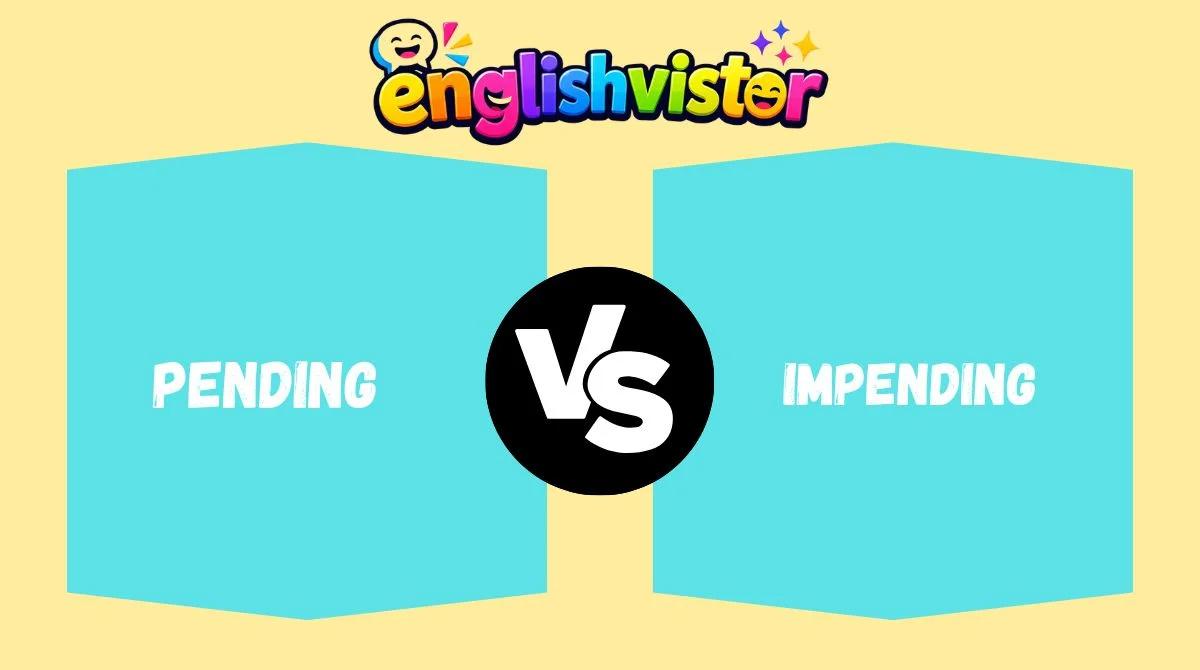
Many English learners feel confused when they see words that look and sound almost the same. Pending and impending are two such words. They both talk about something connected with time, but their meanings are quite different Pending vs Impending.
The confusion usually happens because both words describe something that has not fully happened yet. A student may think they can be used in the same situation, but using the wrong word can change the meaning of a sentence completely.Pending vs Impending.
For example, a person may say, “A storm is pending” when they actually mean “A storm is impending.” The sentence may sound close, but a native English speaker understands a different idea.Pending vs Impending.
Understanding the difference between pending vs impending is useful in everyday conversations, workplace English, news reports, emails, and formal writing. These words often appear in situations related to decisions, events, problems, and future actions.Pending vs Impending.
After learning this topic, you will understand:
- The exact meaning of pending and impending
- When to use each word correctly
- The grammar patterns behind them
- Common mistakes learners make
- Easy ways to remember the difference
- Real-life examples that improve your spoken English
Learning small differences between similar words can make your English sound clearer and more natural.Pending vs Impending.
What Does “Pending” Mean?
Pending means something is waiting to happen, waiting for a decision, or not completed yet.
It describes a situation that is unfinished or still under consideration. Something pending is usually waiting for another action, approval, result, or decision.
The word often suggests that something is paused until a condition is met.Pending vs Impending.
Simple Definition
Pending = waiting for something to happen or waiting for a final decision.
For example:
- A job application is pending because the company has not made a decision.
- A payment is pending because the bank has not completed the process.Pending vs Impending.
When to Use Pending
We use pending when:
- A decision has not been made.
- A process is not finished.
- Something is waiting for approval.
- An action is delayed until something else happens.
Grammar Rule for Pending
Pending can work as:
- An adjective before a noun:
- pending approval
- pending payment
- pending decision
- An adjective after a verb:
- The request is pending.
- The case remains pending.Pending vs Impending.
- A preposition meaning “until something happens”:
- Pending further information, we cannot continue.
Examples of Pending
- My application is still pending.
- The manager will review the pending requests tomorrow.Pending vs Impending.
- Your payment is pending confirmation from the bank.
- The final decision is pending.
- The project is pending approval from the director.
- Several customer complaints are still pending.
- The results of the exam are pending.
- The order status shows “pending.”
Common Learner Confusion
Many students think pending means something bad is about to happen. This is incorrect.
Pending does not show danger or fear. It only shows that something is waiting.Pending vs Impending.
Example:
- “The payment is pending.”
This means the payment is not finished yet.
It does not mean the payment will fail.
What Does “Impending” Mean?
Impending means something is about to happen soon, usually something important, serious, or unwanted.Pending vs Impending.
It creates a feeling that an event is coming closer.
Simple Definition
Impending = likely to happen very soon.Pending vs Impending.
The word often appears with situations like:
- danger
- problems
- storms
- changes
- crises
- deadlines
When to Use Impending
Use impending when:
- Something is approaching.
- Something will happen soon.
- The speaker feels that an event is coming.Pending vs Impending.
It often carries a serious or negative feeling.
Grammar Rule for Impending
Impending is usually an adjective placed before a noun.
Common patterns:
- impending danger
- impending storm
- impending disaster
- impending deadline
- impending change
It can also appear after linking verbs:
- A storm is impending.
- Major changes are impending.
Examples of Impending
- The dark clouds showed an impending storm.Pending vs Impending.
- The company prepared for the impending changes.
- People were worried about the impending crisis.
- We must finish the work before the impending deadline.
- The news reported an impending weather problem.
- The village prepared for the impending flood.
- The team discussed the impending competition.
- Everyone felt the pressure of the impending exam.
Common Learner Confusion
Many learners believe impending simply means “future.” However, it usually means very near in time.
Compare:
- A future meeting = a meeting that will happen later.Pending vs Impending.
- An impending meeting = a meeting that will happen soon.
Also, impending often has a serious tone.
Difference Between Pending and Impending
Although these words look similar, they describe different ideas.
| Feature | Pending | Impending |
|---|---|---|
| Basic meaning | Waiting for a decision or completion | About to happen soon |
| Main idea | Something is unfinished | Something is approaching |
| Time focus | No exact time; waiting period | Near future |
| Common situations | Applications, payments, approvals | Storms, problems, deadlines |
| Feeling | Neutral | Often serious or negative |
| Grammar use | Pending approval, pending request | Impending danger, impending change |
Usage Difference
The easiest way to separate them is to ask:
Is something waiting? Or is something coming?
If something is waiting for an action, use pending.Pending vs Impending.
Example:
- The loan request is pending.
The bank has not decided yet.
If something is coming soon, use impending.
Example:
- An economic crisis is impending.
The crisis is expected soon.
Grammar Logic
The words describe two different positions in time.
Pending looks backward at unfinished work.
Something started but is not complete.
Example:
- The application is pending.
The application already exists, but the process is incomplete.Pending vs Impending.
Impending looks forward at an approaching event.
Something has not happened yet, but it is coming.
Example:
- The storm is impending.
The storm has not arrived, but people expect it soon.
Sentence Structure Difference
Common pending structures:
- Subject + be + pending
Example:
The approval is pending.
- pending + noun
Example:
Pending documents must be submitted.
Common impending structures:
- impending + noun
Example:
An impending storm is approaching.
- Subject + be + impending
Example:
A major change is impending.
Grammar Rules You Must Remember
Rule 1: Use Pending for Waiting Situations
When a decision, result, or action is not complete, use pending.
Correct:
- My visa application is pending.
Incorrect:
- My visa application is impending.
Why? The application is waiting, not approaching.
Rule 2: Use Impending for Events Coming Soon
When something is expected to happen shortly, use impending.
Correct:
- The team is preparing for the impending match.
Incorrect:
- The team is preparing for the pending match.
The match is coming soon, not waiting for approval.
Rule 3: Pending Usually Needs a Process or Decision
Pending commonly appears with things that need completion.
Examples:
- pending payment
- pending approval
- pending review
- pending confirmation
These all involve unfinished steps.
Rule 4: Impending Often Appears With Events or Situations
Impending is common with events.
Examples:
- impending storm
- impending danger
- impending deadline
- impending changes
These describe things that are approaching.
Common Mistakes Students Make
Mistake 1: Using Pending for Future Events
Wrong:
- A storm is pending.
Better:
- A storm is impending.
A storm is not waiting for approval. It is approaching.
Mistake 2: Using Impending for Applications and Requests
Wrong:
- My job application is impending.
Correct:
- My job application is pending.
An application waits for a decision.
Mistake 3: Thinking Both Words Mean “Future”
Both words relate to the future, but they show different ideas.
Pending:
Something is incomplete.
Impending:
Something is coming soon.
Mistake 4: Ignoring the Feeling of the Word
Impending often creates a serious feeling.
Example:
- impending disaster
This sounds serious.
You normally would not say:
- impending birthday
A birthday is approaching, but it does not usually carry the same feeling.
Easy Trick to Remember the Difference
Use this simple memory trick:
Pending = Pause
Both words begin with the “P” sound.
Think:
Pending = Paused
Something is paused while waiting.
Example:
Your payment is pending.
The payment process is paused.
Impending = Incoming
Think:
Impending = Incoming event
Something is coming toward you.
Example:
An impending storm means a storm is coming.
Remember:
Pending waits. Impending arrives.
Daily Life Examples
Here are common spoken English examples:
- Customer: Why has my order not arrived?
Support: Your order is still pending. - The manager said my vacation request is pending approval.
- We should prepare because an impending storm may arrive tonight.
- My exam results are pending, so I am waiting for the announcement.
- The company announced some impending changes to its rules.
- Your account verification is pending.
- Everyone is talking about the impending deadline.
- The final decision is pending from the committee.
- The weather experts warned about an impending storm.
- The payment remains pending because the system is checking the information.
Practice Section
Choose the correct word: pending or impending.
- My university admission result is ______.
- The town prepared for the ______ storm.
- The manager has not approved the ______ request.
- The country faced an ______ economic problem.
- Your payment is still ______.
Answers
- pending
- impending
- pending
- impending
- pending
FAQs
What is the difference between pending and impending?
Pending means something is waiting for completion or a decision. Impending means something is expected to happen soon. Pending focuses on unfinished processes, while impending focuses on approaching events.
Can we use pending in questions?
Yes, pending can be used in questions.
Examples:
- Is my application still pending?
- Why is my payment pending?
It is common in customer service and official situations.
Can we use impending in questions?
Yes, but it is less common in everyday questions.
Examples:
- Are we facing an impending problem?
- Is there an impending storm?
It is often used in formal or serious discussions.
Is pending formal or informal?
Pending can be used in both formal and informal English. It is very common in business, banking, education, and daily conversations.
Is impending always negative?
Not always, but it often has a serious or worrying meaning. It is commonly used for problems or difficult situations. However, it can also describe neutral upcoming events.
Why do people confuse pending and impending?
People confuse them because both words describe something that has not happened yet. The key difference is that pending means “waiting,” while impending means “coming soon.”
Conclusion
Understanding the difference between pending vs impending can make your English much clearer. These two words may look similar, but they describe two completely different situations.
Use pending when something is unfinished, waiting, or needs a decision. Applications, payments, approvals, and results are often pending.
Use impending when something is approaching and likely to happen soon. Storms, deadlines, changes, and serious events are often described as impending.
A simple way to remember the difference is:
Pending waits. Impending comes.
When you learn these small differences and practice using them in real sentences, your vocabulary becomes stronger and your communication sounds more natural. Keep noticing how native speakers use these words, and soon choosing the correct one will become automatic.

Hi, I’m Isabella Foster, an English language writer passionate about making grammar, vocabulary, and communication skills easy to understand. At EnglishVistor, I create clear, practical, and engaging learning resources to help learners improve their English with confidence.