Many English learners become confused when they see the words widow and widower. Both words are connected with the death of a husband or wife, so it can be hard to remember which word describes which person. The difference is actually quite simple once you connect each word with the correct gender Widow vs Widower.
The phrase Widow vs Widower is especially useful when you are learning how English uses different nouns for men and women. You may see these words in news reports, family conversations, books, official forms, biographies, and everyday speech.Widow vs Widower.
A widow is a woman whose husband has died. A widower is a man whose wife has died. The words describe the surviving spouse. They do not describe the person who died.Widow vs Widower.
For example, if Sarah’s husband dies, Sarah is a widow. If John’s wife dies, John is a widower. This small difference is the key to remembering the two terms.
The topic Widow vs Widower also has an important grammar point: both words are nouns. They can be used as subjects, objects, or after linking verbs such as is, was, and became.Widow vs Widower.
By the end of this guide, you will know the meanings, grammar rules, common mistakes, sentence patterns, everyday uses, and easy memory tricks that make these two words much easier to use.Widow vs Widower.
What Does “Widow” Mean?
The first word in Widow vs Widower is widow.Widow vs Widower.
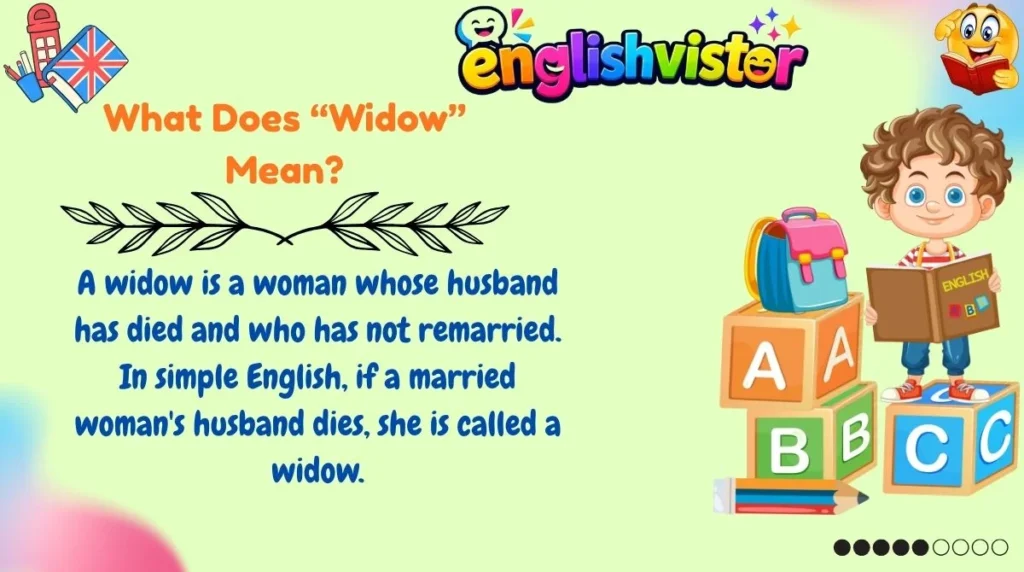
A widow is a woman whose husband has died and who has not remarried. In simple English, if a married woman’s husband dies, she is called a widow.
The word is a noun. It identifies a woman based on her marital situation after the death of her husband.Widow vs Widower.
For example:
Maria’s husband died last year, so Maria is a widow.Widow vs Widower.
Here, Maria is the woman whose husband has died. Therefore, widow is the correct noun.
When Do We Use “Widow”?
We use widow when talking about a woman whose husband has died.
It can be used in everyday conversations as well as formal writing. You might hear it in sentences about someone’s family, personal history, finances, legal matters, or life story.
Consider these examples:
- She became a widow at a young age.
- The widow lives with her two children.
- My neighbor is a widow.
- The elderly widow receives support from her family.
- She has been a widow for ten years.
- The widow spoke warmly about her late husband.
- Everyone helped the widow after her husband’s death.
- The woman is now a widow.
Notice that the word does not mean that the woman is unmarried because she has never married. It tells us that she was married and her husband died.Widow vs Widower.
Grammar Rule for “Widow”
Because widow is a noun, it can appear in several positions.Widow vs Widower.
As a subject:
The widow lives alone.
As an object:
The family helped the widow.
After “is”:
She is a widow.
After “became”:
She became a widow after her husband’s death.
The word widow can also be modified by adjectives.Widow vs Widower.
a young widow
an elderly widow
a grieving widow
a wealthy widow
a recent widow
The adjective comes before the noun, just as it normally does in English.Widow vs Widower.
A Common Confusion
One common mistake in Widow vs Widower questions is thinking that widow means any person whose spouse has died.
That is not correct in traditional English usage.Widow vs Widower.
Widow specifically refers to a woman whose husband has died.
If the surviving spouse is a man, the traditional word is widower.
What Does “Widower” Mean?
The second word in Widow vs Widower is widower.Widow vs Widower.
A widower is a man whose wife has died and who has not remarried. It is the male counterpart of widow.
This makes Widow vs Widower easier to understand if you focus on the person who is still alive.Widow vs Widower.
If a woman’s husband dies, she is a widow.
If a man’s wife dies, he is a widower.
The person described by the word is the surviving husband or wife, not the deceased person.
When Do We Use “Widower”?
Use widower when you are talking about a man whose wife has died.
Here are some simple examples:
- He became a widower after his wife’s death.
- The widower raised his children alone.
- My uncle is a widower.
- The elderly widower lives near his daughter.
- He has been a widower for five years.
- The widower talked about his late wife.
- The family offered help to the widower.Widow vs Widower.
- The man became a widower at the age of sixty.
Again, widower is a noun.
You can use it as a subject:
The widower moved to another city.
You can use it as an object:
They helped the widower.
You can use it after a linking verb:
He is a widower.
You can also use it after became:
He became a widower in 2024.
Grammar Rule for “Widower”
The basic structure is easy:
Subject + be + a/an + widower
He is a widower.
Subject + become + a/an + widower
He became a widower.
The + widower + verb
The widower lives with his son.
Because widower begins with a consonant sound, we normally use a, not an.Widow vs Widower.
Correct:
He is a widower.
Incorrect:
He is an widower.
The same rule applies to widow:
She is a widow.
A Common Confusion
A frequent problem in Widow vs Widower usage is using widower for a woman.
That is incorrect in standard traditional English.
❌ She is a widower.
✅ She is a widow.
For a man:
❌ He is a widow.
✅ He is a widower.
Difference Between Widow and Widower
The central difference in Widow vs Widower is the gender of the surviving spouse.
Widow refers to a woman whose husband has died.
Widower refers to a man whose wife has died.Widow vs Widower.
The easiest way to understand the difference is to ask one question:
Is the surviving spouse a woman or a man?
If the surviving spouse is a woman, use widow.
If the surviving spouse is a man, use widower.
Comparison Table
| Word | Person Described | Meaning | Example |
|---|---|---|---|
| Widow | Woman | A woman whose husband has died | She is a widow. |
| Widower | Man | A man whose wife has died | He is a widower. |
| Widow | Female surviving spouse | Husband has died | The widow lives nearby. |
| Widower | Male surviving spouse | Wife has died | The widower lives nearby. |
The difference is not about the age of the person.
A widow can be young, middle-aged, or elderly.
A widower can also be young, middle-aged, or elderly.
For example:
She became a widow at 30.
And:
He became a widower at 35.
The words are also not limited to people who have been married for a long time.Widow vs Widower.
A person may become a widow or widower after only a short marriage if their spouse dies.
The Grammar Logic
Both terms are countable nouns when referring to an individual person.
Therefore, singular forms normally need an article or another determiner.
She is a widow.
He is a widower.
The widow arrived early.
That widower lives next door.Widow vs Widower.
With plural subjects, you can simply use widows and widowers.
Many widows live with their children.
Several widowers attended the meeting.
Sentence Structure Difference
The sentence structure does not change much between the two words.Widow vs Widower.
The main difference is the noun you choose.
For a woman:
She is a widow.
For a man:
He is a widower.
With a longer sentence:
After her husband died, she became a widow.
After his wife died, he became a widower.
The grammar pattern is almost identical.
Meaning Comparison
It is important to understand that neither word means dead spouse.
The deceased husband or wife is not the widow or widower.
The surviving spouse is the widow or widower.
For example, imagine that David and Anna are married. David dies.
Anna is the widow.
David is the late husband or deceased husband.
Now imagine that Anna dies first.
David is the widower.
Anna is the late wife or deceased wife.
This distinction prevents many English-learning mistakes.
Grammar Rules You Must Remember
1. “Widow” Refers to a Woman
The first rule is simple: use widow for a woman whose husband has died.
Sarah is a widow.
The widow lives with her daughter.
Do not use widow simply because someone is no longer married. A divorced woman is not normally called a widow.
❌ She is a widow because she got divorced.
✅ She is divorced.
The word is connected specifically with the death of a husband.
2. “Widower” Refers to a Man
Use widower for a man whose wife has died.
Michael is a widower.
The widower lives with his son.
Being unmarried does not automatically make someone a widower.
A man who has never married is unmarried, single, or possibly a bachelor, depending on the context.
A divorced man is divorced, not a widower.
3. Use “A” With Singular Nouns
Because widow and widower are singular countable nouns, they usually need a determiner.
Correct:
She is a widow.
He is a widower.
Incorrect:
❌ She is widow.
❌ He is widower.
However, when the noun has a determiner such as the, my, that, or this, you do not add a.
She is my widow.
This particular sentence would normally be unnatural in ordinary English because my widow usually describes a woman after the speaker’s death in a legal or literary context. More natural examples are:
The widow arrived.
That widow lives nearby.
His widow received the letter.
4. Use Plural Forms Correctly
The plural of widow is widows.
The plural of widower is widowers.
Examples:
The charity supports widows.
The group helps widowers.
Do not write widowes or widowerss.
The spelling is straightforward:
widow → widows
widower → widowers
Common Mistakes Students Make
Mistake 1: Using “Widower” for a Woman
This is one of the most common errors when learning Widow vs Widower.
❌ My aunt is a widower.
✅ My aunt is a widow.
The word aunt tells us the person is female, so widow is correct.
Mistake 2: Using “Widow” for a Man
The opposite mistake also happens.
❌ My uncle is a widow.
✅ My uncle is a widower.
An uncle is male, so widower is the traditional term.
Mistake 3: Confusing Widowhood With Divorce
A divorced person is not automatically a widow or widower.
Compare:
Her husband died. She became a widow.
Her husband divorced her. She became divorced.
The cause is different, so the word is different.
Mistake 4: Thinking the Deceased Person Is the Widow
This mistake comes from focusing on the relationship instead of the surviving person.
Suppose Tom dies and his wife Lisa survives.
Lisa is the widow.
Tom is not the widow.
You can say:
Lisa is Tom’s widow.
But you cannot say:
Tom is the widow.
Mistake 5: Forgetting the Article
Students sometimes write:
❌ She is widow.
English normally requires an article here:
✅ She is a widow.
Likewise:
❌ He is widower.
✅ He is a widower.
Easy Correction Tip
When you are unsure, stop and ask:
“Who survived—the woman or the man?”
If the woman survived, choose widow.
If the man survived, choose widower.
This simple question solves most Widow vs Widower grammar problems.
Easy Trick to Remember the Difference
Here is a quick memory trick for Widow vs Widower.
Think:
WIDOW = WOMAN
Both words begin with a W, so you can connect widow with woman.
Then remember:
WIDOWER = MAN
The longer word can help you remember that it is the male form.
Another useful trick is to picture two families.
In Family A, the husband dies. The wife is still alive.
Wife → widow
In Family B, the wife dies. The husband is still alive.
Husband → widower
You do not need to memorize a complicated grammar rule.
Just remember the surviving person’s gender.
Real-Life Logic
Imagine you hear:
“Mary’s husband died.”
Who is Mary now?
She is a widow.
Now imagine:
“James’s wife died.”
Who is James now?
He is a widower.
The words describe the living spouse.
That is the most important idea behind Widow vs Widower.
Daily Life Examples
1. Talking About a Family Member
“Is your grandmother married?”
“No. She is a widow.”
This is a natural way to explain her family situation.
2. Talking About a Neighbor
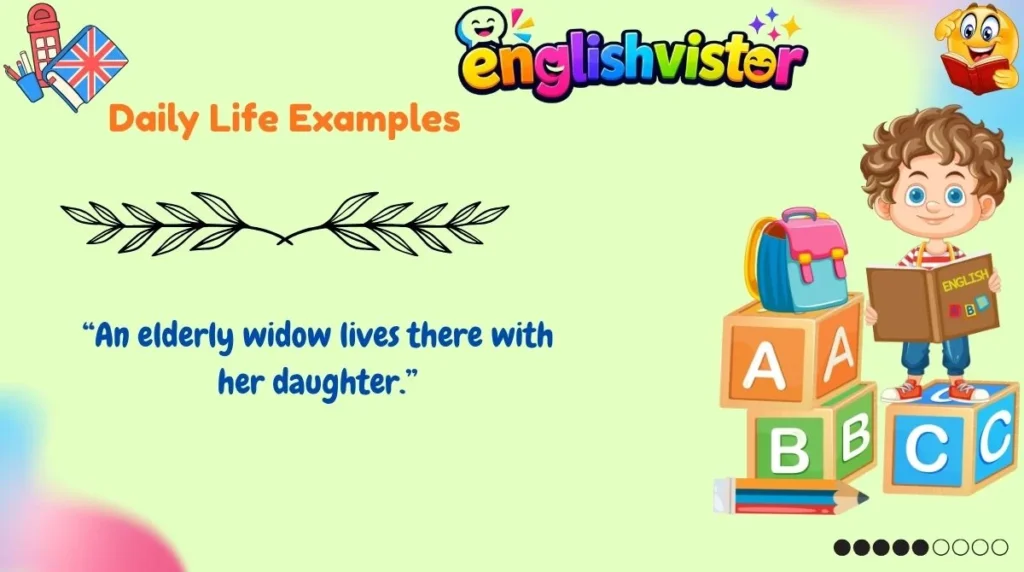
“Who lives in that house?”
“An elderly widow lives there with her daughter.”
Here, widow describes the woman.
3. Talking About a Man
“Does your uncle live alone?”
“Yes. He is a widower.”
The word widower tells us that his wife has died.
4. Talking About Children
“Who takes care of the children?”
“Their mother is a widow, so she takes care of them.”
The noun describes the mother.
5. Talking About a Friend
“Why does Daniel live with his son?”
“He became a widower several years ago.”
This sounds natural in both conversation and writing.
6. Talking About Someone’s Past
“She became a widow when she was young.”
This sentence focuses on the time when her husband died.
7. Talking About Support
“The organization provides support to widows and widowers.”
Here, both words are used together because the organization helps surviving women and men.
8. Talking About an Elderly Person
“The widower visits his grandchildren every weekend.”
The word identifies the man by his marital situation.
9. Talking About a Community
“Several widows live in the village.”
Because more than one woman is being discussed, the plural form widows is used.
10. Talking About Both Groups
“The program is open to widows and widowers.”
This is a useful sentence because it shows the difference clearly. Widows are women, while widowers are men.
Widow vs Widower in Formal and Informal English
The terms widow and widower are both standard English words. They can appear in casual conversations, newspapers, books, legal documents, biographies, and official writing.
For example:
She is a widow.
This is perfectly normal everyday English.
You might also see:
The widow of the former president attended the ceremony.
That sounds more formal because of the surrounding context, but the noun itself is not unusually formal.
Similarly:
He is a widower.
is normal English.
In some situations, people may prefer a more personal description, especially when discussing someone’s recent loss.
For example:
Her husband died last month.
Sometimes this sounds gentler than immediately labeling her as a widow.
The choice depends on context and personal preference. In sensitive conversations about grief, it is wise to speak with kindness.
Widow and Widower With Possessives
Possessive forms can make these words slightly confusing.
You may see:
John’s widow
This means the woman who was John’s wife when he died.
For example:
John’s widow attended the funeral.
You may also see:
Mary’s widower
This means the man who was Mary’s husband when she died.
For example:
Mary’s widower spoke to the family.
These structures are common in formal writing.
The possessive does not change the basic meaning of the words.
A man’s widow is the woman who survived him.
A woman’s widower is the man who survived her.
Can “Widow” and “Widower” Be Used in Questions?
Yes. Both words can appear naturally in questions.
For example:
Is she a widow?
Is he a widower?
You can also ask:
When did she become a widow?
When did he become a widower?
Another possibility is:
How long has she been a widow?
How long has he been a widower?
These questions use normal English grammar.
However, because the subject can be sensitive, the speaker should consider the situation. Asking a stranger about a spouse’s death may be inappropriate or uncomfortable.
Grammar may be correct, but social context matters too.
Widow vs Widower and “Late Husband/Wife”
Another useful distinction is between widow/widower and phrases such as late husband or late wife.
A widow is the surviving woman.
A widower is the surviving man.
The expression late husband refers to a husband who has died.
The expression late wife refers to a wife who has died.
For example:
She is a widow, and her late husband was a teacher.
Here, widow identifies the living woman, while late husband identifies the deceased man.
Similarly:
He is a widower, and his late wife was a doctor.
This sentence identifies the living man and the deceased woman.
These terms work together but do not mean the same thing.
Widow vs Widower and “Single”
Learners sometimes think that a widow or widower is simply another word for a single person.
That is not quite right.
Single is a broad word. It can describe someone who is not married.
A single person may:
- never have married,
- be divorced,
- have ended a relationship,
- or be unmarried for another reason.
A widow or widower has a much more specific history.
A widow is a woman whose husband has died.
A widower is a man whose wife has died.
Therefore:
She is single.
does not tell us why she is unmarried.
But:
She is a widow.
gives specific information about her marital history.
This distinction is important when choosing precise English words.
Widow vs Widower and “Divorced”
The same idea applies to divorced.
A divorced woman is not normally called a widow.
A divorced man is not normally called a widower.
Compare these examples:
Her marriage ended in divorce, so she is divorced.
Her husband died, so she is a widow.
And:
His marriage ended in divorce, so he is divorced.
His wife died, so he is a widower.
The event determines the correct word.
Death of spouse → widow/widower
Legal end of marriage through divorce → divorced
Never married → single/unmarried
Knowing this difference makes your English much more precise.
Practice Section
Choose the Correct Word
Choose widow or widower in each sentence.
1. After her husband died, Maria became a ________.
2. John’s wife died last year, so John is a ________.
3. My grandmother is a ________.
4. The man became a ________ after his wife’s death.
5. The charity helps both ________ and ________.
Answers
1. Widow
After her husband died, Maria became a widow.
Maria is a woman.
2. Widower
John’s wife died last year, so John is a widower.
John is a man.
3. Widow
My grandmother is a widow.
A grandmother is a woman.
4. Widower
The man became a widower after his wife’s death.
The surviving person is male.
5. Widows and widowers
The charity helps both widows and widowers.
Both groups are included.
A useful practice method is to cover the answers and say each sentence aloud. Speaking the words helps you remember the difference faster than simply reading the definitions.
FAQs
What is the difference between widow and widower?
The difference is the gender of the surviving spouse. A widow is a woman whose husband has died. A widower is a man whose wife has died. Both words describe the surviving spouse, not the person who died.
Can we use widow and widower in questions?
Yes. Both words can be used naturally in questions. For example, you can ask, “Is she a widow?” or “Is he a widower?” You can also ask when someone became a widow or widower, although such questions should be asked sensitively.
Is widow formal or informal?
Widow is a standard English noun that works in both everyday and formal situations. You can hear it in normal conversation, but it also appears in newspapers, biographies, legal documents, and official writing.
Is widower the male form of widow?
Yes. Widower is traditionally the male counterpart of widow. A widow is a woman whose husband has died, while a widower is a man whose wife has died. This is the easiest way to remember the distinction.
Can a divorced woman be called a widow?
Normally, no. A divorced woman is called divorced, not a widow. The word widow refers specifically to a woman whose husband has died. A similar rule applies to a divorced man, who is not normally called a widower.
Does widow mean the husband died?
Yes, when used in its traditional sense. A widow is a woman whose husband has died. However, remember that the word describes the surviving woman, not the deceased husband. The deceased person can be called her late or deceased husband.
Why This Difference Matters in Everyday English
Learning Widow vs Widower may seem like a small grammar lesson, but knowing the difference helps you communicate accurately.
English has many pairs of words that identify people in different ways. Some are connected with gender, while others describe jobs, relationships, age, or social roles.
Using the wrong word can change the meaning of a sentence.
If you say:
He is a widow.
a listener may understand what you meant, but the sentence is grammatically incorrect because widow traditionally describes a woman.
The natural sentence is:
He is a widower.
Likewise:
She is a widower.
should normally be:
She is a widow.
These are small corrections, but they make your English sound more accurate and confident.
A Quick Review for English Learners
Here is the whole idea in a few lines.
Widow = woman whose husband has died.
Widower = man whose wife has died.
Widow → female
Widower → male
Widows → plural women
Widowers → plural men
Both words are nouns.
Use a before a singular noun when there is no other determiner:
She is a widow.
He is a widower.
Use the when talking about a specific person:
The widow spoke to the reporter.
The widower spoke to the reporter.
Use plural forms when talking about more than one person:
The organization helps widows.
The organization helps widowers.
The key is always the surviving spouse.
Final Memory Exercise
Before finishing, test yourself without looking back.
Imagine that a woman’s husband has died.
What is she?
A widow.
Now imagine that a man’s wife has died.
What is he?
A widower.
Imagine that a woman and a man have both lost their spouses.
What can you call them?
A widow and a widower.
Imagine that several women have lost their husbands.
What is the plural?
Widows.
Imagine that several men have lost their wives.
What is the plural?
Widowers.
If you can answer these questions quickly, you understand the basic difference.
Conclusion
The main point of Widow vs Widower is very easy once you focus on the surviving spouse. A widow is a woman whose husband has died, while a widower is a man whose wife has died.
Both words are nouns, and both can be used in everyday conversation and formal writing. Remember to use the article a with a singular noun when appropriate: “She is a widow” and “He is a widower.”
Also remember that these words are not synonyms for single or divorced. They describe a specific situation in which a person’s spouse has died.
The fastest memory trick is simple: connect widow with woman, then remember widower as the male counterpart.
A little practice will make the difference automatic. Once you remember who survived and whether that person is a man or woman, choosing the correct word becomes easy.

Hi, I’m Isabella Foster, an English language writer passionate about making grammar, vocabulary, and communication skills easy to understand. At EnglishVistor, I create clear, practical, and engaging learning resources to help learners improve their English with confidence.