Last updated on October 8th, 2026 at 02:14 pm
Many English learners feel confused when they see the words seen and saw because both words are connected to the verb “see.” They both talk about using our eyes to notice something, but they are not used in the same way Seen vs Saw.
A common mistake is saying sentences like “I have saw that movie” or “I seen him yesterday.” These sentences may sound close to correct, but they break important grammar rules.
Understanding the difference between these two words will help you speak and write English more naturally.Seen vs Saw.
The good news is that the difference is simple once you understand one key idea: saw is a past tense verb, while seen is a past participle that needs a helping verb.Seen vs Saw.
This small grammar point appears in everyday conversations, movies, books, emails, and exams.
Native speakers use these forms all the time, so learning them can make your English sound clearer and more confident.Seen vs Saw.
After understanding this topic, you will know:
- When to use saw in a sentence
- When to use seen correctly
- Why “have seen” is correct but “have saw” is wrong
- How to avoid common mistakes
- How to use both words naturally in daily conversations
Let’s make this confusing grammar point easy.
What Does “Saw” Mean?
Saw is the simple past form of the verb see.Seen vs Saw.
The verb see means to notice something with your eyes. When this action happened in the past and is finished, we use saw.Seen vs Saw.
Grammar Rule
See → Saw → Seen
- Present: I see
- Past: I saw
- Past participle: I have seen
We use saw when we talk about a specific moment or time in the past.Seen vs Saw.
The basic sentence structure is:
Subject + saw + object
Examples:
- I saw a beautiful bird in the garden yesterday.Seen vs Saw.
- She saw her teacher at the shopping mall last week.
- We saw a great movie on Saturday night.Seen vs Saw.
- He saw an accident while walking home.
- They saw a rainbow after the rain.
- I saw your message this morning.
- My brother saw that famous singer at the airport.
- Sarah saw the new restaurant near her house.Seen vs Saw.
In all these examples, the seeing happened at a known time in the past.
Words like these often appear with saw:
- yesterday
- last night
- last week
- two days ago
- this morning
- when I was young
For example:
“I saw him yesterday.”
The action happened yesterday and is finished.
Common Learner Confusion with Saw
Many students think “saw” can be used after words like have, has, or had because they are talking about the past.Seen vs Saw.
However, this is incorrect.
Wrong:
- I have saw that film.
Correct:
- I have seen that film.
The reason is simple: have, has, and had need the past participle form, not the simple past form.Seen vs Saw.
What Does “Seen” Mean?
Seen is the past participle form of the verb see.
Unlike saw, we usually cannot use seen alone as the main verb in a sentence.Seen vs Saw.
Seen needs a helping verb such as:
- have
- has
- had
The most common structures are:
Subject + have/has + seen + object
or
Subject + had + seen + object
Examples:
- I have seen that movie many times.
- She has seen this place before.
- We have seen many changes in our city.
- They have seen the new building.
- He has seen my new computer.
- I had seen that picture before you showed it to me.
- The students have seen this lesson already.
- My parents have seen my work.
When Do We Use Seen?
We use seen mainly in perfect tenses.
The present perfect tense talks about experiences or actions connected to the present.Seen vs Saw.
Example:
“I have seen that movie.”
This means the experience happened sometime before now. The exact time is not important.Seen vs Saw.
Another example:
“She has seen Paris.”
This means Paris is part of her life experience.
We also use seen with “had” for the past perfect tense.
Example:
“I had seen the place before I moved there.”
This means seeing the place happened before another past action.Seen vs Saw.
Common Learner Confusion with Seen
Many learners drop the helping verb and say:
Wrong:
- I seen him yesterday.
Correct:
- I saw him yesterday.
Wrong:
- She seen that movie.
Correct:
- She has seen that movie.
Remember: seen usually cannot stand alone.
Difference Between Seen and Saw (Detailed)
Both words come from the verb see, but their grammar roles are different.Seen vs Saw.
| Feature | Saw | Seen |
|---|---|---|
| Verb form | Simple past | Past participle |
| Main verb use | Can be used alone | Needs a helping verb |
| Time meaning | Finished past action | Past experience or action connected to another time |
| Common helpers | Usually no helper | Have, has, had |
| Example | I saw him yesterday. | I have seen him before. |
Usage Difference
The biggest difference is the time idea.
Saw = A Finished Past Event
Use saw when you know when something happened.Seen vs Saw.
Example:
“I saw John at the store yesterday.”
The speaker gives a clear past time.
Another example:
“We saw a football match last night.”
The event happened and ended.
Seen = Experience or Connection With Another Time
Use seen when talking about an experience or when the exact time is not important.Seen vs Saw.
Example:
“I have seen that movie.”
The speaker does not say when. The important thing is the experience.
Another example:
“She has seen many countries.”
The focus is on her life experience.Seen vs Saw.
Grammar Logic
English verbs often have three forms:
- Base form
- Past form
- Past participle
For the verb see:
- See = present
- Saw = past
- Seen = past participle
Different tenses require different forms.
Simple past:
- I saw
Present perfect:
- I have seen
Past perfect:
- I had seen
The helping verb controls the tense, and the main verb uses the correct form.
Sentence Structure Difference
Saw Structure:
Subject + saw + object
Examples:
- I saw a dog.
- She saw the accident.
- They saw the show.
Seen Structure:
Subject + helping verb + seen + object
Examples:
- I have seen a dog like that before.
- She has seen the accident report.
- They had seen the show before.
Can Saw and Seen Be Used in Questions?
Yes, both forms can be used in questions, but the grammar structure is different.
Seen vs Saw depends on the helping verb and the tense of the sentence.
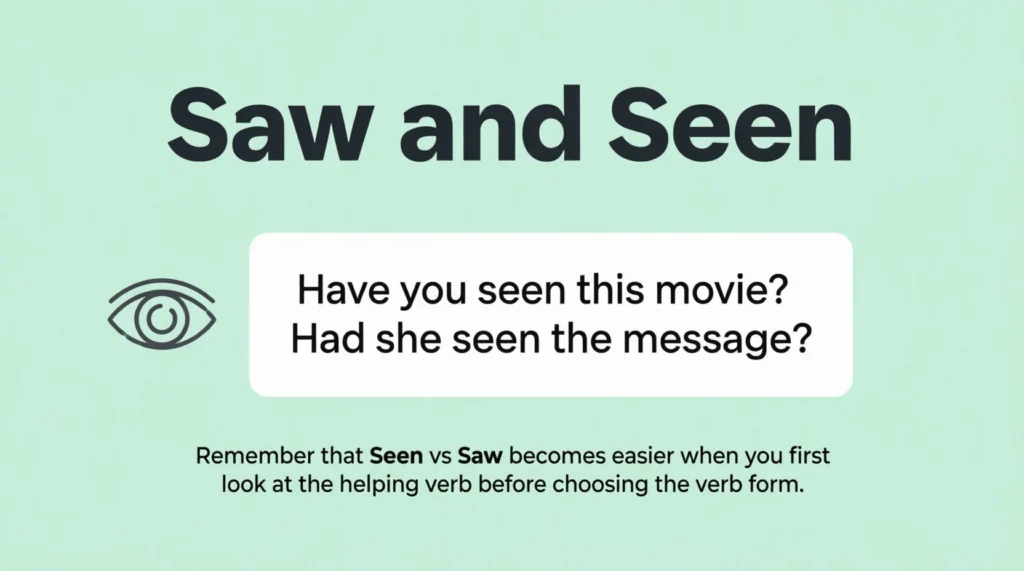
Use saw after “did” because “did” already shows the past tense, so the main verb returns to its base form: “Did you see him?” Do not say “Did you saw him?” Use seen after helping verbs such as “have,” “has,” or “had”:
“Have you seen this movie?” or “Had she seen the message?” Remember that Seen vs Saw becomes easier when you first look at the helping verb before choosing the verb form.
Grammar Rules You Must Remember
Rule 1: Use Saw for Simple Past Actions
When something happened and finished in the past, use saw.
Example:
Correct:
- I saw Tom at school yesterday.
Incorrect:
- I seen Tom at school yesterday.
The word “yesterday” shows a finished past time, so saw is needed.
Rule #2: Use Seen After Have, Has, or Had
Whenever you use these helping verbs, choose seen.
Examples:
Correct:
- I have seen this movie.
Correct:
- She has seen my new house.
Correct:
- They had seen the problem before.
Do not say:
- I have saw
- She has saw
- They had saw
Rule 3: Do Not Use Seen Alone
Seen needs support from a helping verb.
Incorrect:
- I seen a bird.
Correct:
- I saw a bird.
Incorrect:
- He seen the message.
Correct:
- He has seen the message.
Rule 4: Use Time Words to Choose Correctly
Time expressions can help you decide.
Use saw with clear past times:
- yesterday
- last year
- two hours ago
Example:
“I saw her two hours ago.”
Use seen when talking about experiences:
“I have seen that place before.”
Common Mistakes Students Make
Mistake 1: Using Seen Instead of Saw
Wrong:
- I seen my friend yesterday.
Why it happens:
Many learners hear native speakers say “seen” and think it works everywhere.
Correct:
- I saw my friend yesterday.
Tip:
If you mention a finished past time, choose saw.
Mistake 2: Using Saw After Have
Wrong:
- I have saw this movie.
Why it happens:
Students know the sentence talks about the past, so they choose the past form.
Correct:
- I have seen this movie.
Tip:
After have, has, or had, always check for the past participle.
Mistake 3: Confusing “I Saw” and “I Have Seen”
These sentences have different meanings.
“I saw that movie yesterday.”
Meaning:
The exact time is known.
“I have seen that movie.”
Meaning:
It is an experience. The time is not important.
Mistake 4: Forgetting Helping Verbs
Wrong:
- She seen the teacher.
Correct:
- She has seen the teacher.
The helping verb is necessary.
Easy Trick to Remember the Difference
Here is a simple memory trick:
Saw = Specific time
Think:
“I saw it on Monday.”
You can usually add a past time.
Seen = Supported by a helper
Think:
“I have seen it.”
The word seen needs a friend: have, has, or had.
A simple classroom trick:
- If you can say “yesterday,” use saw.
- If you can say “have/has/had,” use seen.
Examples:
Yesterday → I saw him.
Have before → I have seen him.
This small trick helps many learners remember the difference quickly.
Why Is “Did You See” Correct Instead of “Did You Saw”?
The sentence “Did you see?” is correct because “did” already carries the past tense, so the main verb must stay in its base form.
Seen vs Saw can be confusing here because learners often think every past question should use “saw.”
However, after “did,” we use “see,” not “saw” or “seen.”
For example, say “Did you see the movie?” and “Did she see John yesterday?” but not “Did you saw the movie?”
Understanding this rule makes Seen vs Saw much easier and helps prevent a very common grammar mistake.
Daily Life Examples

Here are natural spoken English examples:
- A: Did you watch that new movie?
B: Yes, I saw it last weekend. - A: Have you ever visited London?
B: Yes, I have seen many places there. - I saw my old friend at the supermarket yesterday.
- She has seen that video many times.
- We saw a beautiful sunset during our trip.
- Have you seen my phone anywhere?
- My father saw a strange bird outside this morning.
- I have seen this problem before.
- They saw the announcement on television last night.
- He has seen better days.
These examples show how both forms appear naturally in everyday English.
Practice Section
Choose the correct option.
1. I ______ my teacher yesterday.
a) seen
b) saw
2. She has ______ that movie before.
a) saw
b) seen
3. We ______ a beautiful place during our vacation.
a) saw
b) seen
4. Have you ever ______ this building?
a) seen
b) saw
5. They ______ the accident last night.
a) saw
b) seen
Answers:
- saw
- seen
- saw
- seen
- saw
FAQs
What is the difference between seen and saw?
Saw is the simple past form of “see” and is used for completed actions in the past. Seen is the past participle form and needs a helping verb like have, has, or had.
Can we use seen in questions?
Yes, we can use seen in questions when it comes after a helping verb.
Examples:
- Have you seen this movie?
- Has she seen the message?
But we do not say:
- Did you seen it?
The correct sentence is:
- Did you see it?
Is saw formal or informal?
Saw is neither formal nor informal. It is the normal past form of the verb “see” and is used in all types of English.
Is seen always used with have or has?
Usually, yes. Seen commonly appears with have, has, or had.
Examples:
- I have seen it.
- She has seen it.
- They had seen it.
Why do people say “I seen” in some conversations?
Some speakers use “I seen” in certain dialects or informal speech, but it is not considered standard English. For correct English writing and formal speaking, use “I saw” or “I have seen.”
Which is correct: “I saw it” or “I have seen it”?
Both can be correct, but they have different meanings.
“I saw it” talks about a specific past event.
“I have seen it” talks about an experience without focusing on when it happened.
Conclusion
Understanding the difference between seen and saw becomes easy when you remember one simple rule: saw is used for a finished past action, while seen needs a helping verb like have, has, or had.
Use “I saw” when you talk about a specific moment in the past, such as yesterday or last week. Use “I have seen” when you talk about an experience or something connected to the present.
Many English learners make mistakes with these words because they look similar, but practice can quickly fix the confusion. Pay attention to the sentence structure, especially the words around the verb.
The best way to improve is to use these forms in your daily conversations. Write your own examples, listen to native speakers, and practice a little every day.
Once this grammar point becomes natural, your English will sound smoother, clearer, and more confident.

Hi, I’m Isabella Foster, an English language writer passionate about making grammar, vocabulary, and communication skills easy to understand. At EnglishVistor, I create clear, practical, and engaging learning resources to help learners improve their English with confidence.



2 thoughts on “Seen vs Saw: Difference, Rules, and Examples (Updated 2026)”