Last updated on October 8th, 2026 at 03:38 pm
Many English learners feel confused when they see sentences like “I worked,” “I was working,” and “I have been working.” All three sentences talk about work, but they do not give the same meaning.
The small grammar changes can completely change the time, focus, and feeling of a sentence I Worked vs I Was Working vs I Have Been Working.
This confusion happens because many languages do not use time expressions in the same way as English. Learners often translate directly from their first language and choose the wrong tense. As a result, sentences may sound unnatural or unclear. I Worked vs I Was Working vs I Have Been Working.
Understanding these three forms is important because they are used in everyday conversations. Native speakers use them when talking about jobs, studies, hobbies, past events, and daily activities. I Worked vs I Was Working vs I Have Been Working.
“I worked” usually talks about a finished action in the past. I Worked vs I Was Working vs I Have Been Working.
“I was working” focuses on an activity that was happening at a specific time in the past.
“I have been working” connects a past activity with the present. I Worked vs I Was Working vs I Have Been Working.
After learning the differences, you will know when to use each form, how to build correct sentences, and how to avoid common mistakes.
These grammar patterns will help you speak and write English more naturally. I Worked vs I Was Working vs I Have Been Working.
What Does “I Worked” Mean?
“I worked” is the simple past tense. It describes an action that started and finished in the past. I Worked vs I Was Working vs I Have Been Working.
The speaker is mainly interested in the completed action. The sentence does not focus on how long the action continued or whether it was happening at a certain moment. I Worked vs I Was Working vs I Have Been Working.
Grammar Rule
The structure is:
Subject + past form of verb + object
Examples:
- I worked at a restaurant last year.
- She visited her grandmother yesterday.
- They played football after school.
For the verb work, the past form is worked.
When to Use “I Worked”
Use “I worked” when:
- The action is completed.
- The time is finished.
- You are talking about a past experience.
- You mention a specific past time.
Example Sentences
- I worked in London for three years.
This means the job happened in the past and is now finished.
- I worked late last night.
The action of working happened and ended last night.
- I worked on my project yesterday.
The project work happened yesterday.
- I worked with many talented people at my old company.
This talks about a past experience.
- I worked hard to pass my exam.
The effort happened in the past.
- I worked as a teacher before moving to another city. I Worked vs I Was Working vs I Have Been Working.
The teaching job was a finished period.
- I worked there when I was young.
The speaker describes a past situation.
Common Learner Confusion
Many students use “I worked” when they want to describe an activity happening at a particular moment. I Worked vs I Was Working vs I Have Been Working.
For example:
❌ I worked when you called me.
This sounds like the working action simply happened. It does not clearly show that the action was already in progress.
Better:
✅ I was working when you called me.
The simple past shows a completed event. The continuous forms show an action in progress. I Worked vs I Was Working vs I Have Been Working.
What Does “I Was Working” Mean?
“I was working” is the past continuous tense. It describes an action that was happening at a specific time in the past.
The focus is not on completion. The focus is on the activity in progress. I Worked vs I Was Working vs I Have Been Working.
Grammar Rule
The structure is:
Subject + was/were + verb-ing
Examples:
- I was reading.
- She was cooking.
- They were playing.
For “I,” we use was:
I was working.
When to Use “I Was Working”
Use this form when:
- An action was happening at a certain past time.
- Another event interrupted an activity. I Worked vs I Was Working vs I Have Been Working.
- You want to describe the background of a past story.
- You want to show a temporary past activity.
Example Sentences
- I was working at 8 o’clock last night.
The action was happening at that exact time.
- I was working when my friend called me.
The phone call interrupted the activity.
- I was working on a report all afternoon.
The sentence focuses on the ongoing activity.
- I was working in the garden when it started raining.
The rain happened during the activity.
- I was working with my team yesterday morning.
The activity was in progress during that time.
- I was working while my brother was studying.
Two activities were happening together. I Worked vs I Was Working vs I Have Been Working.
- I was working late because we had an important deadline. I Worked vs I Was Working vs I Have Been Working.
The sentence describes a temporary situation.
Common Learner Confusion
Students often think “was working” means the work was completed. I Worked vs I Was Working vs I Have Been Working.
It does not.
“I was working” only tells us that the activity was happening. It does not tell us whether the person finished the work.
Example:
I was working on my assignment.
We know the person was doing it, but we do not know if it was completed. I Worked vs I Was Working vs I Have Been Working.
When Should You Use Each Work Tense?
Choosing between I Worked vs I Was Working vs I Have Been Working depends mainly on the time and focus of the action.
In I Worked vs I Was Working vs I Have Been Working, “I worked” is best for a finished past action, while “I was working” describes an activity that was in progress at a particular past moment.
I Worked vs I Was Working vs I Have Been Working also includes “I have been working,” which connects a past activity to the present.
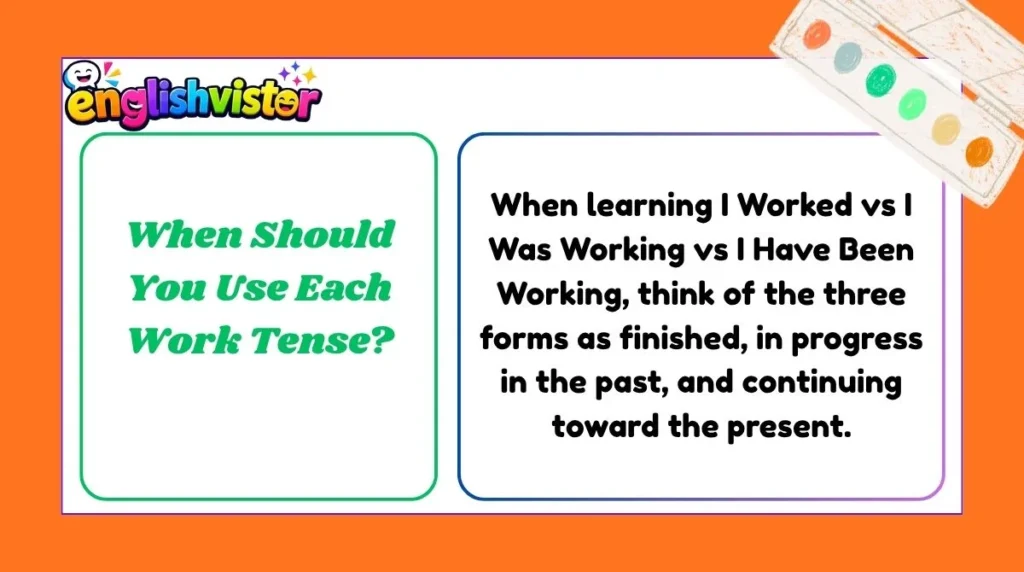
When learning I Worked vs I Was Working vs I Have Been Working, think of the three forms as finished, in progress in the past, and continuing toward the present.
This makes I Worked vs I Was Working vs I Have Been Working easier to understand and use naturally.
In everyday I Worked vs I Was Working vs I Have Been Working situations, the correct tense depends on whether the action ended, was happening at a past moment, or continues now.
Difference Between “I Worked” and “I Was Working”
| Point | I Worked | I Was Working |
|---|---|---|
| Tense | Simple past | Past continuous |
| Main idea | Finished action | Action in progress |
| Focus | Result or completion | Activity during a time |
| Structure | I + past verb | I + was + verb-ing |
| Time meaning | Completed past | Continuing past moment |
| Example | I worked yesterday. | I was working at 5 PM yesterday. |
Usage Difference
Compare these sentences:
I worked yesterday.
This tells us that work happened yesterday. The action is complete.
I was working yesterday at 3 PM.
This tells us that at 3 PM, the person was in the middle of working. I Worked vs I Was Working vs I Have Been Working.
The difference is the speaker’s focus.
Simple past answers:
What happened?
Past continuous answers:
What was happening at that time?
Grammar Logic
Think about a timeline.
“I worked” is like a finished dot on a timeline.
“I was working” is like a line showing an activity continuing over a period.
Example:
- I worked from home yesterday.
- I was working from home when the internet stopped.
The first sentence gives information about a completed day.
The second sentence creates a scene where another event happened during the activity. I Worked vs I Was Working vs I Have Been Working.
What Does “I Have Been Working” Mean?
“I have been working” is the present perfect continuous tense. I Worked vs I Was Working vs I Have Been Working.
It describes an activity that started in the past and continues until now, or has recently stopped but has a connection with the present. I Worked vs I Was Working vs I Have Been Working.
Grammar Rule
The structure is:
Subject + have/has been + verb-ing
Examples:
- I have been studying.
- She has been learning.
- They have been waiting.
For “I,” we use:
I have been working.
When to Use “I Have Been Working”
Use this form when:
- An activity started in the past and continues now. I Worked vs I Was Working vs I Have Been Working.
- You want to emphasize duration. I Worked vs I Was Working vs I Have Been Working.
- A past activity has a present result.
Example Sentences
- I have been working here for five years.
The job started five years ago and continues now.
- I have been working on this project since Monday.
The project began Monday and is still important now.
- I have been working hard recently. I Worked vs I Was Working vs I Have Been Working.
The effort happened over a recent period. I Worked vs I Was Working vs I Have Been Working.
- I have been working all morning.
The activity continued during the morning and may still continue.
- I have been working with this company since 2022.
The connection with the company continues.
- I have been working to improve my English skills.
The effort is ongoing.
- I have been working from home this month. I Worked vs I Was Working vs I Have Been Working.
This describes a recent continuing situation. I Worked vs I Was Working vs I Have Been Working.
Common Learner Confusion
Many learners use “I worked” for situations that are still continuing.
Example:
❌ I worked here for five years.
This usually suggests the job is finished.
If you still have the job:
✅ I have been working here for five years.
Grammar Rules You Must Remember
Rule 1: Use “I Worked” for Finished Past Actions
Example:
✅ I worked at a bank in 2020.
The time is finished, so simple past is correct.
Rule 2: Use “I Was Working” for an Action Happening at a Past Moment
Example:
✅ I was working when you sent the message.
The message arrived during the activity.
Rule 3: Use “I Have Been Working” for Past-to-Present Activities
Example:
✅ I have been working here since January.
The action started before now and continues.
Rule 4: Time Words Can Help You Choose the Correct Form
Common words with simple past:
- yesterday
- last year
- two days ago
- in 2015
Example:
I worked there last year.
Common words with present perfect continuous:
- since
- for
- recently
- all day
- this week
Example:
I have been working here since June.
How Do You Choose Between These Three Tenses in Real Conversations?
When comparing I Worked vs I Was Working vs I Have Been Working, first ask yourself when the activity happened and whether it is connected to the present.
I Worked vs I Was Working vs I Have Been Working becomes easier when you identify whether you are describing a completed past event, an activity happening during another past event, or an activity that began earlier and continues now.
In I Worked vs I Was Working vs I Have Been Working, “I worked” can describe a finished job or past experience, while “I was working” sets the background for another past event.
By contrast, I Worked vs I Was Working vs I Have Been Working uses “I have been working” when the activity continues or has a clear present connection.
Remembering these differences makes I Worked vs I Was Working vs I Have Been Working much easier to apply in natural conversations.
Common Mistakes Students Make
Mistake 1: Using Simple Past for Current Situations
Wrong:
❌ I worked here for three years. (when you still work here)
Correct:
✅ I have been working here for three years.
The first sentence sounds like the job ended.
Mistake 2: Forgetting “Been”
Wrong:
❌ I have working here since Monday.
Correct:
✅ I have been working here since Monday.
Present perfect continuous always needs have/has + been + verb-ing.
Mistake 3: Using “Was Working” for Present Activities
Wrong:
❌ I was working here since 2020.
Correct:
✅ I have been working here since 2020.
“Was working” stays in the past.
Mistake 4: Confusing Finished and Ongoing Actions
Wrong:
❌ I have been working yesterday.
Correct:
✅ I worked yesterday.
“Yesterday” is a finished time, so use simple past.
Easy Trick to Remember the Difference
Use this simple memory trick:
Worked = Finished
Was working = In the middle of something
Have been working = Started before and continues now
Imagine three pictures:
I worked: A completed photo.
“I worked at a school.”
The experience is finished.
I was working: A video playing.
“I was working at 6 PM.”
You see the activity happening.
I have been working: A road from the past to today.
“I have been working here for five years.”
The journey continues.
Daily Life Examples
- Friend: What did you do yesterday?
You: I worked from home yesterday.
- Friend: Why didn’t you answer my call?
You: I was working when you called.
- Friend: How long have you had this job?
You: I have been working here for two years.
- Friend: What were you doing at midnight?
You: I was working on my assignment.
- Friend: Did you enjoy your old job?
You: Yes, I worked with great people there.
- Friend: Why are you tired?
You: I have been working all day.
- Friend: Where were you last summer?
You: I worked in a small office near my home.
- Friend: What happened when I visited?
You: I was working in the kitchen.
- Friend: How is your new project going?
You: I have been working on it for three weeks.
- Friend: What did you do after college?
You: I worked for a company for two years.
Practice Section
Choose the correct option:
- I ______ at the company since 2021.
(a) worked
(b) have been working - I ______ when the manager arrived.
(a) was working
(b) have been working - I ______ there last year.
(a) worked
(b) have been working - I ______ on my computer all morning.
(a) have been working
(b) worked - I ______ late yesterday.
(a) worked
(b) was working
Answers:
- have been working
- was working
- worked
- have been working
- worked
FAQs
What is the difference between “I worked” and “I was working”?
“I worked” describes a completed action in the past. “I was working” describes an activity that was happening at a specific past time. The first focuses on completion, while the second focuses on the process.
Can we use “I was working” in questions?
Yes. You can ask:
“Were you working yesterday evening?”
This asks whether the activity was happening at that time.
Is “I have been working” formal or informal?
“I have been working” is used in both formal and informal English. It is common in conversations, emails, interviews, and professional situations.
Can I say “I worked here for five years”?
Yes, but the meaning usually suggests that the work period is finished. If you still work there, “I have been working here for five years” is usually better.
Why do learners confuse these three forms?
The confusion happens because all three forms talk about work in the past. The main difference is the connection with time: finished, ongoing in the past, or continuing until now.
Which tense is best for daily conversation?
All three are common. The correct choice depends on your meaning. Choose “worked” for finished actions, “was working” for past activities in progress, and “have been working” for ongoing situations.
Conclusion
Understanding the difference between I worked, I was working, and I have been working can make your English much clearer. These three forms may look similar, but they tell different stories about time.
Remember the simple idea:
“I worked” means the action is finished.
“I was working” means the action was happening at a past moment.
“I have been working” means the activity started before and has a connection with now.
Do not worry if you make mistakes at first. Grammar improves through practice, listening, and regular use. Try making your own sentences about your job, studies, hobbies, and daily activities.
With time, choosing the correct tense will become natural. Keep practicing, and these confusing grammar patterns will become much easier.

Hi, I’m Isabella Foster, an English language writer passionate about making grammar, vocabulary, and communication skills easy to understand. At EnglishVistor, I create clear, practical, and engaging learning resources to help learners improve their English with confidence.


