Last updated on October 6th, 2026 at 03:44 pm
Many English learners feel confused when they see choose and chose because both words have the same basic meaning.
Both talk about making a decision, but they are used at different times. One word talks about the present or future, while the other talks about something that already happened Choose vs Chose.
This small difference can create big mistakes in everyday English. A student may say, “I chose this one” when talking about a future decision, or “I choose that yesterday” when describing a past action.
These mistakes are common because English verbs do not always change in a simple way.Choose vs Chose.
Understanding the difference between choose vs chose is important because these words appear in daily conversations, exams, emails, interviews, and professional communication. They are also common in spoken English, so learning the correct usage will help you sound more natural.Choose vs Chose.
After understanding this topic, you will know:
- what choose means and when to use it
- what chose means and when to use it
- the grammar rules behind both words
- common mistakes learners make
- easy ways to remember the difference
- how native speakers use these words in real conversations
The good news is that the difference is simple once you understand the idea of time in English grammar.Choose vs Chose.
What Does “Choose” Mean?
Choose means to select something or make a decision from different options. It is the base form of the verb and is used for the present and future.
When you choose something, you are making a decision now or talking about a decision that may happen later.Choose vs Chose.
Grammar Rule
Choose = present or future action
Common structures:
- Subject + choose + object
- Subject + will choose + object
- Subject + can/may choose + object
Examples:
- I usually choose tea instead of coffee in the morning.Choose vs Chose.
- She will choose a dress for the party tomorrow.
- Students can choose their favorite subjects.
- I always choose healthy food when I eat outside.
- They need to choose a new team leader.
- He wants to choose a different career path.
- You can choose any seat you like.Choose vs Chose.
- We will choose the best option after discussing it.
When to Use Choose
Use choose when:
- the decision is happening now
- the decision is a regular habit
- the decision will happen in the future
- you are giving advice or permission
Examples:
Present decision:
“I choose the blue shirt.”
This means the person is deciding right now.Choose vs Chose.
Habit:
“I choose fresh fruit for breakfast.”
This means it is a regular choice.
Future:
“I will choose my university next month.”
This means the decision has not happened yet.
Common Learner Confusion
Many learners confuse choose with chose because the spelling looks similar. They also forget that English uses different verb forms for different times.Choose vs Chose.
A useful question is:
“Has the decision already happened?”
If the answer is no, use choose.Choose vs Chose.
Example:
“I will choose a movie tonight.”
The choice has not happened yet, so choose is correct.Choose vs Chose.
What Does “Chose” Mean?
Chose is the past form of the verb choose. It means someone selected something or made a decision in the past.Choose vs Chose.
The action is already finished.Choose vs Chose.
Grammar Rule
Chose = past action
Common structure:
- Subject + chose + object
Examples:
- I chose the blue jacket yesterday.
- She chose a new phone last week.
- They chose the wrong answer in the test.
- He chose a different route to avoid traffic.
- We chose that restaurant for our dinner.
- My parents chose my name when I was born.
- The team chose a new captain last year.Choose vs Chose.
- Sarah chose a beautiful gift for her friend.
When to Use Chose
Use chose when:
- the decision happened before now
- you mention a past time
- the action is completed
Examples:
With a specific past time:
“I chose this book yesterday.”
The choice happened yesterday.
Without a time word:
“She chose the red one.”
The listener understands that the choice happened before now.Choose vs Chose.
Common Learner Confusion
A common mistake is using choose for past events.
Incorrect:
“I choose a new laptop last month.”
Correct:
“I chose a new laptop last month.”
The word “last month” shows past time, so the verb must also be in the past form.Choose vs Chose.
Remember:
- Today → choose
- Yesterday → chose
Choose vs Chose in Everyday Conversation
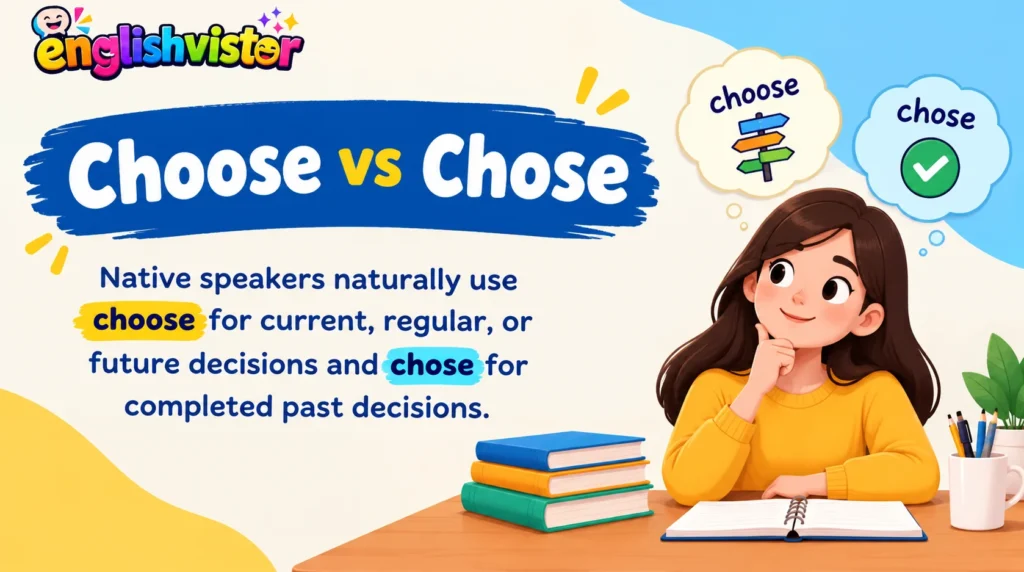
In everyday English, choose vs chose depends mainly on whether the decision is happening now, will happen later, or has already happened.
Native speakers naturally use choose for current, regular, or future decisions and chose for completed past decisions.
For example, “I need to choose a restaurant” refers to a decision that is still open, while “We chose a restaurant yesterday” describes a finished decision.
Paying attention to time words can make the correct form much easier to identify.
Choose vs Chose in Questions and Negative Sentences
Choose vs Chose ka correct use questions aur negative sentences mein bhi important hai. Present or future questions mein choose use hota hai, while past questions usually did + choose follow karti hain, not “did + chose.”
For example, “Which option will you choose?” is correct, while “What did you choose?” is correct for the past.
In negative sentences, use helping verbs such as “do,” “does,” “did,” or “will” with the base form choose.
or example, “I did not choose that option” is correct, not “I did not chose that option.”
Difference Between Choose and Chose
The main difference between choose and chose is time.
Choose is used for present or future decisions.
Chose is used for decisions that happened in the past.
| Word | Meaning | Verb Form | Time Used | Example |
|---|---|---|---|---|
| Choose | Select or decide | Base form | Present/Future | I choose this option. |
| Chose | Selected or decided | Past form | Past | I chose this option yesterday. |
Usage Difference
Look at these examples:
Present:
“I choose chocolate ice cream.”
The person is making a choice now.
Past:
“I chose chocolate ice cream yesterday.”
The person made that decision before now.
Grammar Logic
English verbs often change according to time. This helps listeners understand when something happened.
The verb choose changes into chose when talking about the past.
Similar examples:
- go → went
- see → saw
- take → took
- choose → chose
These are called irregular verbs because they do not follow the normal “-ed” pattern.
We do not say:
“I choosed a book.”
The correct past form is:
“I chose a book.”
Sentence Structure Difference
Present/Future:
Subject + choose + object
Example:
“She chooses a new outfit every week.”
Past:
Subject + chose + object
Example:
“She chose a new outfit yesterday.”
Grammar Rules You Must Remember
Rule 1: Use Choose for Present Decisions
When someone is deciding now, use choose.
Example:
“I choose the black shoes.”
The speaker is making the choice at this moment.
Rule 2: Use Chose for Completed Past Decisions
When the decision happened before now, use chose.
Example:
“They chose a new house last year.”
The action is finished.
Rule 3: Never Add “-ed” to Choose
Choose is an irregular verb.
Wrong:
“I choosed a different answer.”
Correct:
“I chose a different answer.”
The past form changes completely.
Rule 4: After “Will,” Use Choose
After helping verbs like will, always use the base verb.
Wrong:
“I will chose a book tomorrow.”
Correct:
“I will choose a book tomorrow.”
The word “will” already shows future time, so the verb stays in its original form.
Common Mistakes Students Make
Mistake 1: Using Choose for Past Events
Wrong:
“She choose a new dress yesterday.”
Correct:
“She chose a new dress yesterday.”
Why?
The word “yesterday” tells us the action happened in the past.
Mistake 2: Using Chose After Will
Wrong:
“I will chose my subject next week.”
Correct:
“I will choose my subject next week.”
Why?
After “will,” use the base form of the verb.
Mistake 3: Writing Choosed
Wrong:
“He choosed the wrong answer.”
Correct:
“He chose the wrong answer.”
Why?
Choose is an irregular verb. It does not take “-ed.”
Mistake 4: Confusing Choice and Choose
Some learners also confuse choose with choice.
Choose = verb
Example:
“I choose this book.”
Choice = noun
Example:
“This was a good choice.”
A verb shows an action. A noun names a thing or idea.
Easy Trick to Remember the Difference
The easiest way to remember choose vs chose is to focus on the last letter sound.
Think about time:
Choose = Future shoes
Imagine you are choosing shoes tomorrow.
“Tomorrow I will choose my shoes.”
Chose = Yesterday’s choice
Imagine you already bought shoes yesterday.
“Yesterday I chose my shoes.”
Another simple trick:
Ask yourself:
Is the decision finished?
- Not finished → choose
- Finished → chose
Examples:
“I need to choose a birthday gift.”
The decision is still open.
“I chose a birthday gift yesterday.”
The decision is complete.
Daily Life Examples
Here are common spoken English examples using both words.
1. Shopping
“I will choose a jacket after I compare the prices.”
“I chose this jacket because it was comfortable.”
2. Food
“I usually choose vegetables with my lunch.”
“I chose pizza for dinner last night.”
3. School
“Students can choose their project topics.”
“She chose science as her favorite subject.”
4. Work
“We need to choose a new plan.”
“The manager chose the best candidate.”
5. Travel
“I will choose a hotel after checking reviews.”
“They chose a beach destination for their holiday.”
6. Friends and Activities
“I choose my friends carefully.”
“He chose to join the football club last year.”
7. Technology
“I need to choose a new laptop.”
“She chose a phone with a better camera.”
8. Everyday Decisions
“You can choose any color you want.”
“I chose the blue color yesterday.”
Practice Section
Choose the correct word: choose or chose.
- I will ______ a new book tomorrow.
- She ______ the red dress last weekend.
- They usually ______ healthy meals.
- We ______ that restaurant yesterday.
- He needs to ______ a career path.
Answers:
- choose
- chose
- choose
- chose
- choose
FAQs
What is the difference between choose and chose?
Choose is the present or future form of the verb. Chose is the past form. Use choose for decisions happening now or later, and chose for decisions that already happened.
Can we use choose in questions?
Yes. Choose can be used in present and future questions.
Examples:
“Which dress will you choose?”
“Do you choose tea or coffee?”
For past questions, use “did” with the base form:
“What did you choose?”
Is chose formal or informal?
Chose is neither formal nor informal. It is simply the correct past tense form of choose. It can be used in casual conversations, school writing, and professional communication.
Can I say “I choosed”?
No. “Choosed” is incorrect. Choose is an irregular verb, so its past form is “chose.”
Correct:
“I chose a new computer.”
Is choose used only for things?
No. Choose can be used for things, people, actions, and ideas.
Examples:
“I chose a book.”
“She chose a leader.”
“He chose to study medicine.”
What is the difference between choose and choice?
Choose is a verb that shows an action.
Example:
“I choose this option.”
Choice is a noun that means a decision or selected thing.
Example:
“That was a smart choice.”
Conclusion
Understanding the difference between choose and chose becomes easy when you remember one simple idea: time controls the verb form.
Use choose when a decision is happening now, happens regularly, or will happen in the future. Use chose when the decision has already happened and is finished.
Many English learners make mistakes with these words because they look almost the same. However, a little practice can make the difference clear. Pay attention to time words like yesterday, last week, tomorrow, and next month. They often give you the answer.
Try using these words in your daily conversations. The more you hear and speak English, the more natural these verb forms will feel.
A small grammar difference can make a big improvement in your communication. Keep practicing, and soon choosing the correct word will become easy.

Hi, I’m Isabella Foster, an English language writer passionate about making grammar, vocabulary, and communication skills easy to understand. At EnglishVistor, I create clear, practical, and engaging learning resources to help learners improve their English with confidence.



6 thoughts on “Choose vs Chose: Meaning, Difference & Examples (Updated 2026)”