Last updated on October 5th, 2026 at 03:39 pm
English has many words that talk about more than one person or thing. The confusing part is that these words do not all mean exactly the same thing.
Couple, few, some, several, and many can all show an amount, but the amount and feeling can change from one word to another Couple or Few or Some or Several or Many.
For example, you may say, “I need a couple of minutes,” “I need a few minutes,” or “I need several minutes.” All three sentences are possible, but they do not give exactly the same idea.Couple or Few or Some or Several or Many.
This is why couple or few or some or several or many can be difficult for English learners. A learner may know the basic meaning of each word but still wonder which one sounds natural in a particular sentence.
The good news is that the difference becomes much easier when you think about quantity and context. You do not always need an exact number.
Sometimes you want to show a small amount, sometimes an unclear amount, and sometimes a large amount.
This guide explains couple or few or some or several or many in simple English. You will learn their meanings, grammar rules, common mistakes, everyday uses, and the small differences that native speakers notice.
By the end, you should feel much more confident choosing the right word when talking about people, objects, time, tasks, and other countable things.Couple or Few or Some or Several or Many.
What Does “Couple” Mean?
The word couple usually means two people or two things considered together.Couple or Few or Some or Several or Many.
When we talk about two people in a relationship, “couple” has its normal dictionary meaning:
- They are a married couple.
- The young couple moved into a new house.
But in everyday English, especially in the expression “a couple of,” the word often means two or approximately two.
For example:
I need a couple of minutes.
The speaker usually means about two minutes. In casual speech, the exact number may not be important.Couple or Few or Some or Several or Many.
The important grammar point is that we normally use a couple of + plural countable noun.
Examples
- I bought a couple of books yesterday.
- Please wait for a couple of minutes.
- We invited a couple of friends to dinner.
- She asked me a couple of questions.
- I need a couple of days to finish the work.
- He made a couple of mistakes in the test.
- They stayed there for a couple of hours.
- I have a couple of ideas for the project.
A common learner mistake is using “couple” without “of” before a plural noun.Couple or Few or Some or Several or Many.
Incorrect:
I bought couple books.
Correct:
I bought a couple of books.
In informal speech, especially when the noun is understood, “a couple” can sometimes stand alone:
I’ll have a couple.
Here, the listener understands what the speaker means from the conversation.Couple or Few or Some or Several or Many.
When comparing couple or few or some or several or many, remember that couple normally points to the smallest clear quantity: two or around two.Couple or Few or Some or Several or Many.
What Does “Few” Mean?
Few means a small number of people or things. It is used with plural countable nouns.
For example:
I have a few questions.
This means I have a small number of questions. It does not tell us exactly how many, but the number is probably small.
The word few is important because adding the article a can change the feeling.
Compare:
I have a few friends in London.
This usually means I have some friends in London, and the speaker sees this positively or neutrally.Couple or Few or Some or Several or Many.
But:
I have few friends in London.
This suggests that I have almost no friends there. It has a more negative feeling.
So a few and few should not be treated as exactly the same.Couple or Few or Some or Several or Many.
Examples with “a few”
- I need a few minutes.
- We bought a few apples.
- She has a few questions.
- I invited a few classmates.
- He stayed for a few days.
- There are a few chairs in the room.
- I made a few changes to the document.
- We have a few options.
Examples with “few”
- Few students understood the difficult question.
- Few people know the answer.
- He has few friends in the city.
- Few customers complained.
- There are few opportunities in that small town.
- Few workers arrived early.
The difference between couple or few or some or several or many becomes clearer when you understand that “few” normally describes a small number, while “many” describes a large number.Couple or Few or Some or Several or Many.
Can Couple, Few, Some, Several, and Many Be Used With People?
Yes, these quantity words can be used with people, but the meaning changes depending on the word you choose.
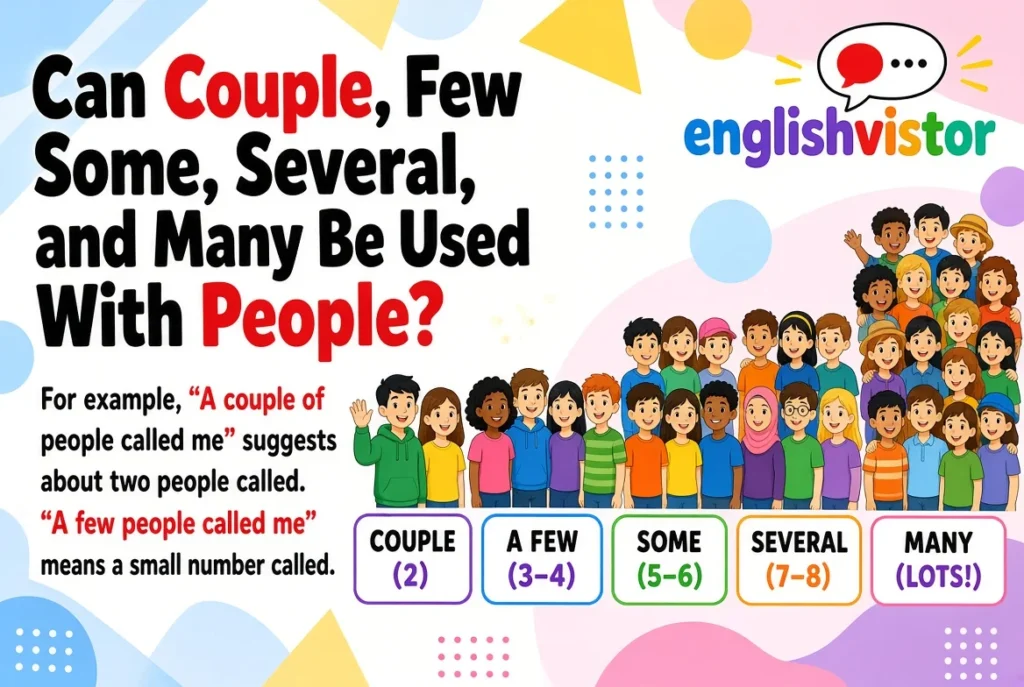
For example, a couple of people usually means about two people, while a few people means a small number of people. Several people suggests more than two but not a very large group, while many people means a large number.
Some people is more general because it does not tell us the exact size of the group.
For example, “A couple of people called me” suggests about two people called. “A few people called me” means a small number called.
“Several people called me” suggests a somewhat larger group, while “Many people called me” suggests a large number. “Some people called me” simply tells us that an unspecified number of people called.
These expressions are especially common in everyday English. The best choice depends on whether you want to give a small, moderate, large, or unspecified quantity.
Remember that the exact number is often flexible, so context and the speaker’s intention help determine the most natural word.
Wracking My Brain or Racking My Brain
Leave It As It Is or Leave It As Is
Do Couple, Few, Some, Several, and Many Have the Same Meaning?
No, these words do not have exactly the same meaning, even though they can all describe more than one person or thing. The main difference is the quantity or feeling each word communicates. A couple of usually points to about two, a few means a small number, some gives an unspecified amount, several generally means more than two but not a large number, and many suggests a large number.
There can be some overlap between these words. For example, “a few” and “several” may sometimes describe a similar number, depending on the situation. However, replacing one word with another can change the listener’s idea of the quantity.
Compare “I have a couple of questions” with “I have many questions.” The first suggests about two questions, while the second suggests a much larger number. Similarly, “I have few friends” and “I have a few friends” have different meanings because few often suggests not many, while a few normally means some.
So, these words are related, but they should not be treated as exact synonyms. Choose the word that best matches the quantity and meaning you want to express.
What Does “Some” Mean?
Some means an unspecified amount or number. It is useful when the exact quantity is not known, not important, or simply not given.Couple or Few or Some or Several or Many.
We can use some with plural countable nouns:
I bought some books.
We can also use it with uncountable nouns:
I bought some milk.
This makes “some” different from words such as couple and few, which normally relate to countable plural nouns.Couple or Few or Some or Several or Many.
Examples
- I need some information.
- She bought some flowers.
- We invited some friends.
- Can I have some water?
- He gave me some advice.
- There are some problems with the computer.
- I need some help.
- They found some old photos.
“Some” does not normally tell us whether the amount is small or large. Context gives us that information.Couple or Few or Some or Several or Many.
For example:
I have some books.
Maybe you have three books. Maybe you have thirty. The word itself does not tell us.
This is an important difference when studying couple or few or some or several or many. “Some” is often the most general choice when you simply want to say an amount or number without being specific.
What Does “Several” Mean?
Several means more than two but not a very large number. It is used with plural countable nouns.
The exact number represented by “several” is not fixed. Depending on context, it may mean around three, four, five, or more.
For example:
Several students stayed after class.
The sentence tells us that more than two students stayed, but it does not give an exact number.Couple or Few or Some or Several or Many.
Examples
- I visited several countries last year.
- She asked several questions.
- We waited for several minutes.
- He has worked here for several years.
- Several students volunteered.
- They made several changes.
- I have read several books by that author.
- Several people called this morning.
“Several” is often stronger than “a couple” and can suggest a larger number than “a few,” although there is no strict mathematical boundary.
That is why context matters when comparing couple or few or some or several or many.
What Does “Many” Mean?
Many means a large number of people or things. It is used with plural countable nouns.
Examples include:
- many students
- many books
- many people
- many questions
- many days
- many problems
Examples
- Many students use English every day.
- She has many books at home.
- Many people attended the event.Couple or Few or Some or Several or Many.
- We received many questions.
- He has visited many countries.
- There are many reasons for this decision.
- Many children enjoy playing outside.
- I have made many friends through work.
“Many” is especially common in questions and negative sentences:
How many people came?
I don’t have many friends here.
It is also perfectly normal in formal writing:
Many researchers have studied this problem.
In everyday positive speech, native speakers may often use a lot of instead:
I have a lot of books.
But “many” is still correct:
I have many books.
When comparing couple or few or some or several or many, “many” normally gives the strongest idea of a large quantity.Couple or Few or Some or Several or Many.
Difference Between Couple or Few or Some or Several or Many
The easiest way to understand couple or few or some or several or many is to think of them as different ways of describing quantity.
| Word | Basic idea | Typical quantity | Countable nouns? | Example |
|---|---|---|---|---|
| couple | two or around two | 2 | Yes | a couple of days |
| a few | a small number | small | Yes | a few days |
| few | almost none / not many | very small | Yes | few people |
| some | an unknown amount/number | unclear | Yes + uncountable | some books |
| several | more than two, not many | moderate | Yes | several days |
| many | a large number | large | Yes | many days |
There is no exact mathematical scale that always works. For example, three things might be called a few in one situation and several in another.
1. Couple vs. A Few
I need a couple of minutes.
This suggests about two minutes.
I need a few minutes.
This suggests a small number of minutes, perhaps three or four.
The difference is small in casual conversation, so native speakers may use them loosely.
2. A Few vs. Few
This difference is more important.
I have a few friends.
Positive or neutral: I have some friends.
I have few friends.
Negative or limiting: I do not have many friends.
The article a matters.
3. Some vs. A Few
I bought some apples.
The number is not stated.
I bought a few apples.
The speaker suggests that the number is small.
So “some” is less specific about quantity.
4. Several vs. A Few
Both can describe a small-to-moderate number.
I made a few changes.
I made several changes.
The second sentence may suggest more changes, but the difference depends on context.
5. Several vs. Many
Several people attended.
This suggests a moderate number.
Many people attended.
This suggests a large number.
So several generally sounds smaller than many.
My Father and I or My Father and Me
Grammar Rules You Must Remember
Rule 1: Use “a couple of” with plural countable nouns
Correct:
I need a couple of pens.
Correct:
She stayed for a couple of days.
Avoid:
a couple water
For an uncountable noun, use another expression:
I need some water.
Rule 2: Use “a few” with plural countable nouns
Correct:
I have a few questions.
Incorrect:
I have a few money.
“Money” is uncountable. Say:
I have some money.
Rule 3: “Some” works with countable and uncountable nouns
Plural countable:
I bought some apples.
Uncountable:
I bought some rice.
This makes “some” very flexible.
Rule 4: “Many” takes plural countable nouns
Correct:
many students
Correct:
many books
Incorrect:
many information
Instead, say:
a lot of information
or:
much information
Rule 5: “Few” without “a” can sound negative
Compare:
A few people came.
This is a simple statement about a small number.
Few people came.
This suggests that almost nobody came or that the number was disappointing.
This small grammar point is extremely useful for English learners.
Rule 6: Do not assume every quantity word has an exact number
The expressions couple or few or some or several or many are often flexible in everyday English.
For example, “several” does not always mean exactly three. “A few” does not always mean exactly three. Context decides the intended quantity.
Common Mistakes Students Make
Mistake 1: Saying “couple books”
Many learners forget a and of.
Wrong:
I bought couple books.
Correct:
I bought a couple of books.
The full phrase is normally a couple of + plural noun.
Mistake 2: Confusing “few” and “a few”
Wrong meaning:
I have few good friends.
If you mean you have some good friends, say:
I have a few good friends.
Without “a,” the sentence sounds more negative.
Mistake 3: Using “many” with uncountable nouns
Wrong:
many information
Correct:
a lot of information
or:
much information
Remember that information is uncountable in standard English.
Mistake 4: Thinking “some” always means a small number
It does not.
I bought some books.
This could mean three books or thirty books. The exact amount is unknown from the sentence.
Mistake 5: Thinking “several” has one fixed number
It does not.
The word gives a general idea of more than two but not a huge number. The exact quantity depends on context.
Mistake 6: Treating “couple” and “few” as identical
They are close in some situations, but they are not identical.
a couple of days
usually suggests about two days.
a few days
usually suggests a small number of days, often more than two.
The difference may be small, but the words are not interchangeable in every sentence.
Easy Trick to Remember the Difference
A simple quantity ladder can help you remember couple or few or some or several or many.
Think of it like this:
Couple → A few → Several → Many
Now attach a simple idea to each word:
- Couple = about 2
- A few = a small number
- Several = more than two, but not a lot
- Many = a large number
Where does some fit?
Think of some as a flexible word. It does not clearly tell you whether the number is small, medium, or large.
For example:
I need some chairs.
You do not know the exact number.
But:
I need a couple of chairs.
Now you expect about two.
I need a few chairs.
Now you expect a small number.
I need several chairs.
Now you expect more than two, but probably not a huge number.
I need many chairs.
Now the speaker clearly suggests a large number.
There is another useful trick:
“A few” is positive; “few” is negative or limited.
Remember:
A few = some
Few = not many
This one rule can prevent a lot of mistakes.
Daily Life Examples
Real-Life Spoken English Examples
Here are natural examples showing how people use couple or few or some or several or many in everyday conversations.
1. At a restaurant
A: How many people are coming?
B: Just a couple of friends.
Here, the speaker means about two friends.
2. At work
A: Do you have time to talk?
B: Yes. Give me a few minutes.
The speaker needs a short amount of time.
3. At home
A: Do we have any eggs?
B: Yes, we have some eggs in the fridge.
The exact number is not important.
4. At school
Teacher: Did you understand the lesson?
Student: I have a few questions.
The student has a small number of questions.
5. Talking about travel
I have visited several cities in my country.
The speaker has visited more than two cities but is not saying exactly how many.
6. Talking about an event
Many people came to the wedding.
This tells us that the number was large.
7. Talking about time
I’ll call you in a couple of hours.
The speaker means approximately two hours.
8. Talking about problems
We have a few problems with the new system.
There are some problems, but the speaker suggests the number is small.
9. Talking about experience
She has worked with many companies.
This suggests a large number of companies.
10. Talking about friends
I know several people who can help you.
The speaker knows more than two people who may be able to help.
These examples show why couple or few or some or several or many should be selected according to the meaning you want to communicate, not simply according to the noun that follows.
Practice Section
Choose the Correct Option
Choose the best word or phrase in each sentence.
1. I need ___ minutes to finish this.
A. a couple of
B. many
C. information
2. She bought ___ apples from the market.
A. some
B. much
C. a little
3. ___ people came to the meeting, so the room was almost empty.
A. Few
B. Many
C. A lot of
4. He has visited ___ countries in Europe.
A. several
B. much
C. a little
5. There were ___ students at the event. The hall was completely full.
A. many
B. a couple of
C. few
Answers
1. A — a couple of
“I need a couple of minutes” means approximately two minutes.
2. A — some
“Apples” is a plural countable noun, so “some apples” is correct.
3. A — Few
“Few people came” suggests that not many people came.
4. A — several
“Several countries” means more than two but not an extremely large number.
5. A — many
The sentence says the hall was completely full, so “many” fits the meaning.
FAQs
What is the difference between couple or few or some or several or many?
These words show different kinds of quantity. A couple usually means about two, a few means a small number, some gives an unspecified amount, several usually means more than two but not a large number, and many means a large number.
Can we use “couple” in questions?
Yes. You can use a couple of in questions.
For example:
Can you give me a couple of minutes?
Did you buy a couple of books?
It is especially common in everyday spoken English.
Is “a couple of” formal or informal?
A couple of is common in everyday English and is not grammatically wrong in formal writing. However, when exact numbers are important, giving the actual number may be clearer.
For example, “two days” is more precise than “a couple of days.”
What is the difference between “few” and “a few”?
A few normally means some, and it has a positive or neutral feeling.
I have a few friends.
Few means not many and often has a negative or limited feeling.
I have few friends.
The small word a changes the meaning significantly.
Is “several” more than “a few”?
Usually, yes, although there is no strict numerical rule. A few normally suggests a small number, while several often suggests a somewhat larger number.
However, the exact meaning depends on the situation and the speaker.
Can “some” mean many?
Yes. Some only tells us that there is an unspecified amount or number. It does not automatically mean “a small number.”
For example, “some people” could refer to a few people or a much larger group, depending on context.
Conclusion
Understanding couple or few or some or several or many becomes much easier when you stop trying to give every word an exact mathematical number.
A couple of normally means about two. A few means a small number, while few without “a” often gives a negative or limited idea. Some is flexible and simply gives an unspecified amount or number. Several usually means more than two but not a large number, and many clearly suggests a large number.
The most useful thing is to pay attention to the meaning and context of your sentence.
If you are talking about approximately two things, choose a couple of. If you mean a small number, a few is often natural. If the exact amount is not important, some works well. For a moderate number, use several, and for a large number, use many.
With regular practice, choosing between couple or few or some or several or many will start to feel natural.
Read real English, listen to everyday conversations, and notice how native speakers use these words. Small differences like these are what make your English sound clearer and more natural.

Hi, I’m Isabella Foster, an English language writer passionate about making grammar, vocabulary, and communication skills easy to understand. At EnglishVistor, I create clear, practical, and engaging learning resources to help learners improve their English with confidence.



4 thoughts on “Couple vs Few vs Some vs Several vs Many (Updated 2026)”