Last updated on October 8th, 2026 at 01:55 pm
Many English learners pause when they want to say something such as, “___ went to the store,” or “The teacher spoke to ___.”
They know the words I and me, but they are not always sure which one sounds correct after a phrase such as my father and My Father and I or My Father and Me.
This is why the question my father and i or my father and me is so common. The confusion is not really about the word father. It is about understanding the difference between subject pronouns and object pronouns.
The good news is that the rule is quite simple. You do not need to memorize a long grammar lesson. You only need to understand what role I and me play in a sentence.My Father and I or My Father and Me.
For example:
- My father and I went to the market.
- The teacher called my father and me.
Both sentences are correct, but they use different forms because the grammar is different.My Father and I or My Father and Me.
Once you understand this small difference, you will know when to use my father and I and when to use my father and me.
You will also be able to check similar phrases such as my mother and I, my brother and me, or Sarah and I.
The key is to look at the job the pronoun is doing in the sentence—not simply at which phrase sounds more formal.My Father and I or My Father and Me.
What Does “My Father and I” Mean?
My father and I means that both the speaker and the speaker’s father are doing the action in the sentence. The phrase works as the subject.
A subject is the person or thing that performs an action or is described by the verb.My Father and I or My Father and Me.
For example:
My father and I went fishing.
Who went fishing? My father and I. Therefore, the phrase is the subject.
The word I is a subject pronoun. We use I when the speaker is the subject of a sentence.My Father and I or My Father and Me.
This gives us an important rule:
Use “my father and I” when the two people are the subject of the sentence.
Consider these examples:
- My father and I went to the park.
- My father and I watched a movie last night.
- My father and I are planning a trip.
- My father and I cooked dinner together.
- My father and I visited my grandmother.
- My father and I enjoy playing chess.
- My father and I were talking about school.
- My father and I bought a new table.
In every example, the phrase comes before the main verb and performs the action.
For example, in “My father and I bought a new table,” the people who bought the table were my father and me as the speaker. Grammatically, however, the correct subject form is I.My Father and I or My Father and Me.
A common learner mistake is to think that me sounds more natural because people often hear it in everyday speech. But natural-sounding English is not always a reliable grammar test.My Father and I or My Father and Me.
Compare:
My father and I went home.
My father and me went home.
The first sentence is standard English. The second is generally considered incorrect in careful standard English because me cannot normally be used as the subject here.My Father and I or My Father and Me.
There is an easy way to check this. Remove my father from the sentence:
I went home.
Me went home.
The first sentence is clearly correct. Therefore:
My father and I went home.
This simple test can help you solve many similar questions.
What Does “My Father and Me” Mean?
My father and me is correct when the phrase functions as the object of a verb or preposition.My Father and I or My Father and Me.
An object usually receives the action of a verb. An object can also come after a preposition such as for, to, with, between, from, about, or without.My Father and I or My Father and Me.
The word me is an object pronoun.
For example:
The teacher called my father and me.
Who did the teacher call? The teacher called my father and me. The phrase receives the action of called, so me is correct.
Here is the basic rule:
Use “my father and me” when the phrase is the object of a verb or preposition.
Look at these examples:
- The teacher spoke to my father and me.
- The doctor talked with my father and me.
- The manager thanked my father and me.
- The gift was for my father and me.
- They invited my father and me to dinner.
- The guide showed my father and me the museum.
- She sat between my father and me.
- The story was about my father and me.
Notice that the phrase is not doing the action. Something is happening to the people or being done for them.My Father and I or My Father and Me.
For example:
The coach invited my father and me.
The coach is doing the inviting. My father and me receive the action of the verb invited.My Father and I or My Father and Me.
Again, you can use the removal test:
The coach invited me.
That sounds correct.
But:
The coach invited I.
That is incorrect.
Therefore:
The coach invited my father and me.
This is one of the easiest ways to solve the my father and i or my father and me question.My Father and I or My Father and Me.
Another important point is that me is not an informal version of I. They have different grammatical jobs.My Father and I or My Father and Me.
You should not choose I simply because it sounds more formal, and you should not choose me simply because it sounds more natural in conversation. Choose the form according to its role in the sentence.My Father and I or My Father and Me.
Difference Between My Father and I and My Father and Me
The central difference is simple:
My father and I = subject
My father and me = object
Here is a quick comparison:
| Phrase | Grammar role | Basic use | Example |
|---|---|---|---|
| My father and I | Subject | Performs the action | My father and I traveled together. |
| My father and me | Object | Receives the action | They invited my father and me. |
| I | Subject pronoun | Used as a subject | I called him. |
| Me | Object pronoun | Used as an object | He called me. |
Look at the difference in sentence structure:
My father and I visited the museum.
The subject comes before the verb visited.
Now compare:
The guide welcomed my father and me.
The phrase comes after the verb welcomed and receives the action.
This distinction is exactly the same as the difference between I and me in shorter sentences.My Father and I or My Father and Me.
Compare:
I called my father.
My father called me.
The first sentence uses I because the speaker performs the action.My Father and I or My Father and Me.
The second uses me because the speaker receives the action.
Adding my father does not change the basic rule:
My father and I called the hotel.
The hotel called my father and me.
This is the most useful way to understand my father and i or my father and me. Do not treat the entire phrase as one special expression. Break it into its parts and identify the grammatical role.My Father and I or My Father and Me.
The Removal Test
One of the best classroom tricks is to remove the other person temporarily.My Father and I or My Father and Me.
Suppose you have:
My father and ___ went to the bank.
Remove my father:
I went to the bank.
Correct.
Me went to the bank.
Incorrect.
So the answer is:
My father and I went to the bank.
Now try:
The bank manager spoke to my father and ___.
Remove my father:
The bank manager spoke to me.
Correct.
The bank manager spoke to I.
Incorrect.
So the answer is:
The bank manager spoke to my father and me.
This test works with many people, not only fathers.
Can “My Father and I” and “My Father and Me” Ever Both Be Correct?
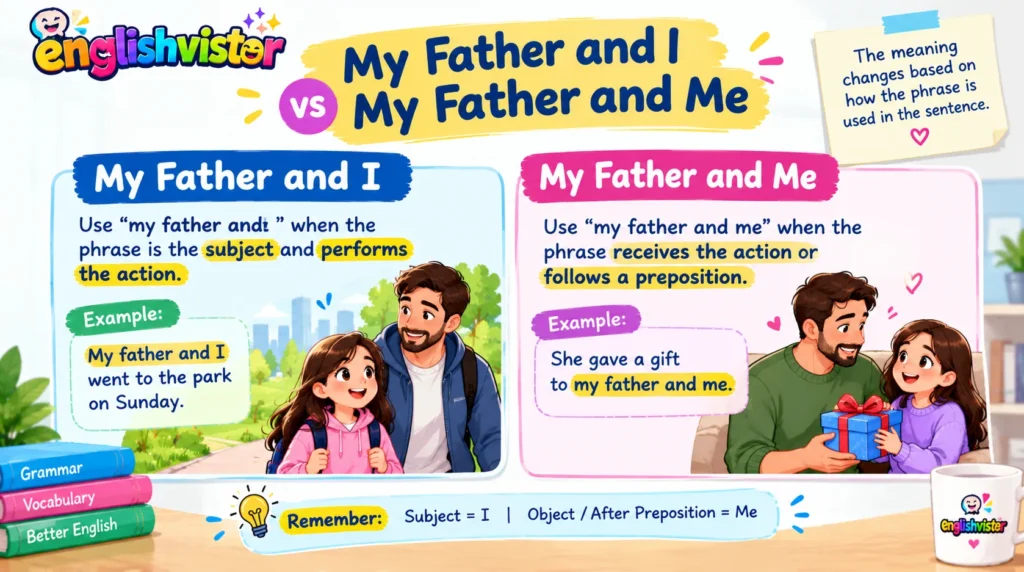
Yes, My Father and I or My Father and Me can both be correct, but they cannot normally be exchanged freely.
The correct choice depends on the grammatical role of the whole phrase in the sentence.
If the phrase is the subject and performs the action, use my father and I. If the phrase receives the action or follows a preposition, use my father and me.
For example, “My father and I visited the museum” uses the subject form because the two people performed the action of visiting.
However, “The guide showed the museum to my father and me” uses the object form because the phrase follows the preposition to.
This means My Father and I or My Father and Me is not really a matter of choosing the phrase that sounds more polite or educated. Both forms have a proper grammatical purpose.
The same pattern works with other combinations, such as “my mother and I” and “my mother and me.”
When you are unsure, remove “my father” and test the remaining sentence.
If you would say “I visited the museum,” use “my father and I.” If you would say “The guide spoke to me,” use “my father and me.”
Couple or Few or Some or Several or Many
What Happens When “My Father and I” or “My Father and Me” Comes After a Verb?
The position after a verb can help you understand My Father and I or My Father and Me, but you should still identify whether the phrase is performing or receiving the action.
Many learners assume that anything after a verb must use me, but that is not always true because some verbs can be followed by a subject in particular sentence structures.
In ordinary sentences such as “The teacher called my father and me,” the phrase is the object of called, so me is correct. Likewise, “The manager thanked my father and me” requires the object form.
However, when the phrase is performing the action, use I even if another phrase appears nearby.
For example, “My father and I called the manager” is correct because the two people are doing the calling.
The safest approach for My Father and I or My Father and Me is therefore not simply to look at the word immediately before the phrase.
Instead, ask who is performing the action and who is receiving it. Then use I for the subject and me for the object.
This method also helps with sentences that contain longer phrases.
For example, “My father and I decided to help them” uses I because the two people made the decision, while “They decided to help my father and me” uses me because the two people receive the help.
Grammar Rules You Must Remember
1. Use I as the subject
Use I when the speaker performs the action or is the subject of the sentence.My Father and I or My Father and Me.
For example:
My father and I work together.
Both people are the subject.
You can also say:
I work together with my father.
The important word is I, not the word father.
2. Use me as an object
Use me when the speaker receives an action.
For example:
The principal called my father and me.
The principal performed the action. The two people were called.My Father and I or My Father and Me.
Another example:
She invited my father and me.
The people receiving the invitation are the object.
3. Prepositions usually take me
After a preposition, use me, not I.
Common examples include:
- with me
- for me
- to me
- from me
- about me
- between me and him
Therefore:
This present is for my father and me.
Not:
This present is for my father and I.
The same rule applies when the phrase contains another person.
4. Do not choose I just because it sounds formal
Some speakers have been taught that I is always the “proper” choice. That is not true.My Father and I or My Father and Me.
For example:
The teacher spoke to my father and me.
Using I here does not make the sentence more educated or formal. It makes the grammar incorrect in standard English.
The correct choice depends on the sentence structure.
Common Mistakes Students Make
Mistake 1: Using “me” as the subject
A learner may say:
My father and me went shopping.
This mistake often happens because people hear me in everyday conversations. It may also happen because the speaker feels that my father and me sounds friendly or natural.My Father and I or My Father and Me.
The standard form is:
My father and I went shopping.
Use the removal test:
I went shopping.
That confirms the answer.
Mistake 2: Using “I” after a preposition
Another common mistake is:
The present is for my father and I.
The preposition for needs an object, so use me.
Correct:
The present is for my father and me.
A quick check gives:
The present is for me.
That is correct.
Mistake 3: Thinking “I” is always more polite
Some learners believe that I sounds more educated.
That idea can cause errors such as:
She invited my father and I.
The correct sentence is:
She invited my father and me.
Being grammatically correct is more important than trying to sound formal.
Mistake 4: Checking only how the whole phrase sounds
When you hear my father and I or my father and me, both may sound possible if you are still learning English.
Instead of asking, “Which sounds better?” ask:
What is the grammatical job of the phrase?
If it performs the action, use I.
If it receives the action, use me.
Mistake 5: Forgetting the word “and”
Some learners know that I is correct in “I went home” but become confused when another person is added.
Remember:
I went home.
becomes:
My father and I went home.
The grammar role of I has not changed. The phrase simply has another subject.
Likewise:
The teacher helped me.
becomes:
The teacher helped my father and me.
The role of me has not changed.
Easy Trick to Remember the Difference
Here is a very simple memory trick:
I = I do the action.
Me = the action happens to me.
Think of I as the person standing in front of the verb.
I opened the door.
Now add your father:
My father and I opened the door.
Think of me as the person receiving the action.
She helped me.
Add your father:
She helped my father and me.
You can also remember the sentence:
“I do; me receives.”
It is short, but it captures the main idea.
Another useful trick is to remove the other person. If you are unsure about my father and i or my father and me, temporarily remove my father.
Ask yourself:
Would I say I or me here?
For example:
My father and ___ are waiting outside.
Remove the first person:
I am waiting outside.
So:
My father and I are waiting outside.
Now try:
The waiter gave the menu to my father and ___.
Remove the first person:
The waiter gave the menu to me.
So:
The waiter gave the menu to my father and me.
This method is fast, practical, and useful in real conversations.
Daily Life Examples
10 Real-Life Spoken English Examples
Here are everyday examples that show how the rule works naturally.
1. Talking about a trip
My father and I are going to Lahore tomorrow.
The two people are doing the action of going, so I is correct.
2. Talking about an invitation
They invited my father and me to the wedding.
The people receiving the invitation are the object, so me is correct.
3. Talking to a teacher
The teacher spoke with my father and me after class.
The word with is a preposition, so the object form me is needed.
4. Talking about shopping
My father and I bought a new phone.
The two people performed the action of buying.
5. Talking about a gift
My uncle bought a gift for my father and me.
The gift is intended for the two people, so me is correct after for.
6. Talking about dinner
My father and I cooked dinner together.
The phrase is the subject.
7. Talking about a doctor
The doctor asked my father and me some questions.
The doctor asked the questions; the two people received that action.
8. Talking about a family photo
My father and I took this picture together.
The two people took the picture.
9. Talking about a conversation
She was talking about my father and me.
The phrase follows the preposition about, so me is correct.
10. Talking about work
My father and I finished the project yesterday.
The two people performed the action of finishing the project.
These examples show why my father and i or my father and me is not really a question about the word father. The same rule works with almost any person.
For example:
My mother and I went shopping.
They called my mother and me.
And:
My brother and I played football.
The coach spoke to my brother and me.
Once you understand the pattern, many grammar questions become easier.
Practice Section
Choose the Correct Option
Try these sentences before looking at the answers.
1. ___ went to the restaurant last night.
A. My father and I
B. My father and me
2. The teacher called ___.
A. my father and I
B. my father and me
3. This letter is for ___.
A. my father and I
B. my father and me
4. ___ are planning a family trip.
A. My father and I
B. My father and me
5. The doctor spoke with ___.
A. my father and I
B. my father and me
Answers
1. My father and I — The phrase is the subject and performs the action.
2. My father and me — The phrase receives the action of called.
3. My father and me — The phrase follows the preposition for.
4. My father and I — The phrase is the subject of are planning.
5. My father and me — The phrase follows the preposition with.
If you got all five right, you have understood the main rule very well.
FAQs
What is the difference between my father and I and my father and me?
My father and I is used when the phrase is the subject and performs the action. My father and me is used when the phrase is the object of a verb or preposition. For example, “My father and I went home” but “She called my father and me.”
Can we use my father and me in questions?
Yes. You can use my father and me in a question when the phrase is an object.
For example:
Did the teacher speak to my father and me?
But if the phrase is the subject, use my father and I:
Did my father and I miss the meeting?
Is my father and I more formal than my father and me?
No. The two forms have different grammatical functions. I is a subject pronoun, while me is an object pronoun. Choosing I simply to sound formal can lead to an incorrect sentence.
Is “my father and me went” correct?
In standard English, no. The correct sentence is:
My father and I went to the store.
The phrase is the subject of went, so the subject pronoun I is required.
Is “between my father and I” correct?
In standard English, the usual form is:
between my father and me
The word between is a preposition, and the pronoun following it should be the object form me.
How can I quickly decide between my father and I or my father and me?
Remove my father from the sentence. If the remaining sentence needs I, use my father and I. If it needs me, use my father and me.
For example, “___ went home” becomes “I went home,” while “She called ___” becomes “She called me.”
Conclusion
The difference between my father and I and my father and me becomes much easier when you stop thinking about which phrase sounds more formal and start looking at the grammar.
Use my father and I when the phrase is the subject and performs the action:
My father and I went shopping.
Use my father and me when the phrase is the object or follows a preposition:
The shopkeeper helped my father and me.
When you are unsure, use the removal test. Take away “my father” and see whether the sentence needs I or me. This small trick can prevent many common mistakes.
The same rule works with other people, too: my mother and I, my brother and me, Sarah and I, and many more.
Do not worry if you make this mistake at first. Even learners with good English sometimes pause over these forms. With a little practice, choosing between my father and I and my father and me will become automatic.

Hi, I’m Isabella Foster, an English language writer passionate about making grammar, vocabulary, and communication skills easy to understand. At EnglishVistor, I create clear, practical, and engaging learning resources to help learners improve their English with confidence.



2 thoughts on “My Father and I or My Father and Me? (Updated 2026)”