Last updated on October 6th, 2026 at 04:03 pm
Many English learners feel confused when they hear words that sound almost the same but have completely different meanings.
Wear, were, and where are three common words that often create problems for students because their pronunciation can be similar, especially in fast conversations Wear vs Were vs Where.
A learner may write “Where my shoes yesterday?” instead of “Were my shoes yesterday?” or use “I were a jacket” instead of “I wear a jacket.”
These mistakes are common because English spelling does not always match sound.Wear vs Were vs Where.
Understanding these three words is important because they appear in everyday conversations.
People use them when talking about clothes, locations, past events, questions, and personal experiences. A small spelling mistake can change the whole meaning of a sentence.Wear vs Were vs Where.
The good news is that these words follow clear grammar rules. Once you understand what each word does, choosing the correct one becomes much easier.Wear vs Were vs Where.
After learning the difference between wear vs were vs where, you will know:
- when to use each word correctly
- how their meanings are different
- how to avoid common grammar mistakes
- how to use them naturally in daily English conversations
Let’s learn these three confusing words in a simple way with examples and easy memory tips.
What Does “Wear” Mean?
Wear is a verb that means to have something on your body, usually clothes, shoes, glasses, jewelry, or other items.Wear vs Were vs Where.
We use wear when something is placed on the body and stays there for some time.Wear vs Were vs Where.
Examples of things we can wear:
- clothes
- shirts
- pants
- shoes
- hats
- watches
- glasses
- rings
The basic grammar rule is:
Subject + wear + clothing/item
Examples:
- I wear a blue shirt to school.
- She wears glasses when she reads.
- They wear uniforms at work.
- He wears a watch every day.
- We wear jackets in winter.
- My brother wears black shoes.
- Sarah wears a beautiful dress at parties.
- Many people wear comfortable clothes at home.
Remember that wear changes with the subject.Wear vs Were vs Where.
With I, you, we, they, we use wear:
- I wear a jacket.
- They wear uniforms.
With he, she, it, we usually add -s:
- He wears a jacket.
- She wears a hat.
Common Confusion With Wear
Many learners confuse wear with put on.
They are connected but not the same.
Put on means the action of placing something on your body.
Wear means having it on your body.Wear vs Were vs Where.
Example:
- I put on my shoes before leaving home. (The action)
- I wear my shoes all day. (The condition)
Think about this:
First, you put on your clothes. Then, you wear them.Wear vs Were vs Where.
What Does “Were” Mean?
Were is a form of the verb “be.” It is used to talk about the past.Wear vs Were vs Where.
The verb “be” has different forms:
Present:
- am
- is
- are
Past:
- was
- were
We use were with:
- you
- we
- they
We also use were with I in some special situations, especially unreal or imaginary situations.Wear vs Were vs Where.
The basic grammar structure is:
Subject + were + information about the past
Examples:
- You were very kind yesterday.
- We were tired after the trip.
- They were at the park last evening.
- You were right about the answer.
- My friends were happy during the party.
- The children were excited about the game.
- We were busy last week.
- They were students five years ago.
Were in Questions
We often use were at the beginning of questions.
Structure:
Were + subject + information?
Examples:
- Were you at school yesterday?
- Were they ready for the exam?
- Were we late for the meeting?
- Were your parents at home?
Common Confusion With Were
Many students confuse were with was.Wear vs Were vs Where.
The simple rule is:
Use was with:
- I
- he
- she
- it
Examples:
- I was tired.
- She was happy.
- He was at home.
Use were with:
- you
- we
- they
Examples:
- You were tired.
- We were happy.
- They were at home.
The word were never talks about clothes or places. It only works as a past form of the verb “be.”
What Does “Where” Mean?
Where is a question word used to ask about a place or location.Wear vs Were vs Where.
It helps us find out the position of someone or something.Wear vs Were vs Where.
We use where when asking:
- location
- direction
- place
- position
Examples:
- Where is my phone?
- Where do you live?
- Where are they going?
- Where is the nearest shop?
- Where did you buy that shirt?
- Where were you yesterday?
- Where can I find a good restaurant?
- Where is your classroom?
Where in Questions
Most commonly, where appears at the beginning of questions.
Structure:
Where + verb + subject?
Examples:
- Where is your book?
- Where are my keys?
- Where do they work?
- Where does she study?
We can also use where in longer sentences.
Examples:
- This is the place where we met.
- I know where he lives.Wear vs Were vs Where.
- Tell me where you found this information.
Common Confusion With Where
The biggest mistake happens because where sounds similar to were.
Compare:
- Where are you? (asking about location)
- Were you there? (asking about the past)
The meaning changes completely.
A simple trick:
If you are asking “what place?”, use where.
If you are talking about “past time,” use were.
Wear vs Were vs Where in Questions
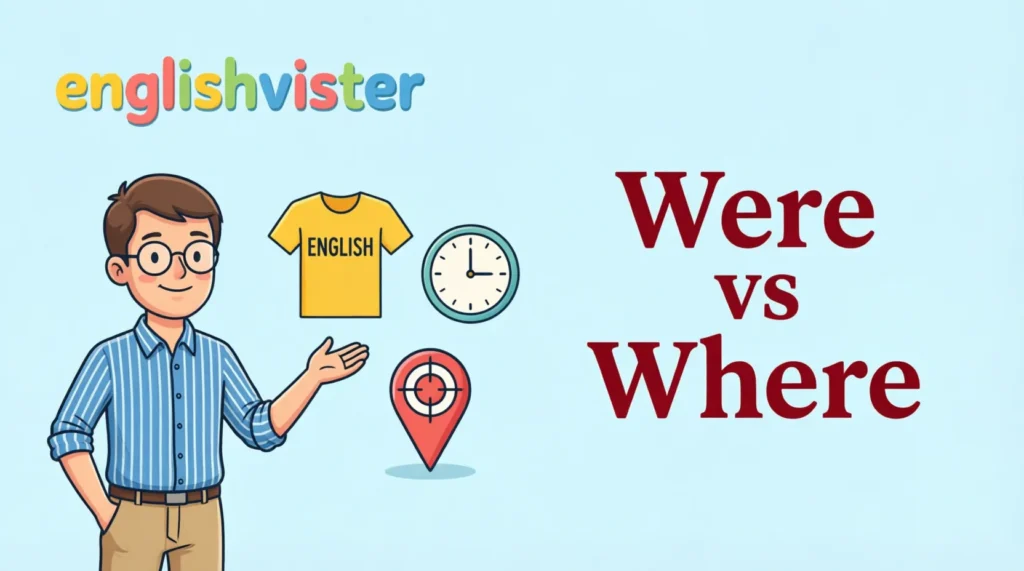
Wear vs Were vs Where ka correct use questions mein samajhna important hai because pronunciation similar hone ki wajah se learners spelling confuse kar sakte hain.
Where location ke liye use hota hai, were past situations ke liye, aur wear clothing ya items ke liye.
For example, “Where were you yesterday?” asks about a past location, while “What did you wear yesterday?” asks about clothing.
Difference Between Wear, Were, and Where
| Word | Type | Meaning | Main Use | Example |
|---|---|---|---|---|
| Wear | Verb | To have clothes or items on your body | Clothes and personal items | I wear a coat in winter. |
| Were | Past verb | Past form of “are” | Past situations | They were happy yesterday. |
| Where | Question word | A place or location | Asking about places | Where is my bag? |
Although these words look and sound similar, their jobs in a sentence are different.
Wear = Clothing or Items
Use wear when talking about something on your body.Wear vs Were vs Where.
Examples:
- She wears a necklace.
- I wear sneakers every day.
The sentence usually involves appearance or clothing.Wear vs Were vs Where.
Were = Past Time
Use were when talking about something that happened before now.
Examples:
- We were tired after work.
- They were in London last year.
The sentence usually talks about a past condition, feeling, or location.
Where = Place
Use where when asking or explaining about a location.
Examples:
- Where is the bathroom?
- I know where he lives.
The sentence connects to a place.
Grammar Rules You Must Remember
Rule 1: Use Wear for Clothes and Things on Your Body
If the sentence talks about clothing, accessories, or items you have on your body, use wear.
Correct:
- I wear a uniform at school.
Incorrect:
- I were a uniform at school.
The sentence is about clothing, so wear is correct.Wear vs Were vs Where.
Rule 2: Use Were for Past Situations
When talking about the past with you, we, or they, use were.
Correct:
- They were excited yesterday.
Incorrect:
- They where excited yesterday.
The sentence describes a past feeling, so were is needed.Wear vs Were vs Where.
Rule 3: Use Where for Questions About Places
When you need to know a location, use where.
Correct:
- Where is my notebook?
Incorrect:
- Were is my notebook?
The question asks about a place, so use where.
Rule 4: Check the Meaning Before Choosing the Word
Do not choose a word only because it sounds right.
Ask yourself:
- Is it about clothes? → Wear
- Is it about the past? → Were
- Is it about a place? → Where
Example:
“I don’t know ___ my keys are.”
The sentence asks about location, so:
“I don’t know where my keys are.”
Common Mistakes Students Make
Mistake 1: Using Were for Clothing
Wrong:
- I were a new jacket.
Correct:
- I wear a new jacket.
Why?
Because the sentence talks about clothing, not the past.
Mistake 2: Using Where for Past Events
Wrong:
- We where happy yesterday.
Correct:
- We were happy yesterday.
Why?
The sentence describes a past feeling. It does not ask about a place.
Mistake 3: Using Wear for Location
Wrong:
- Wear is my school?
Correct:
- Where is my school?
Why?
The speaker wants to know a place.
Mistake 4: Forgetting the “s” in Wears
Wrong:
- She wear a red dress.
Correct:
- She wears a red dress.
With he, she, and it in present tense, add -s.
Easy Correction Tips
Before writing the word, think about the sentence meaning.
Ask:
Can I replace it with clothing?
If yes, use wear.
Example:
“I ___ glasses.”
→ Clothing/item? Yes.
→ “I wear glasses.”
Can I replace it with a past form of are?
If yes, use were.
Example:
“They ___ happy.”
→ Past “are.”
→ “They were happy.”
Can I replace it with a place question?
If yes, use where.
Example:
“___ is the station?”
→ Place question.
→ “Where is the station?”
Easy Trick to Remember the Difference
Use this simple memory method:
Wear = Wear clothes
Both words start with “W,” and the idea is connected to what you put on your body.
Example:
“I wear my shoes.”
Were = Was in the past
Think:
“Were” is a past-time word.
Example:
“They were here yesterday.”
Where = Where is the place?
Think about location.
Example:
“Where is my bag?”
A quick memory line:
Wear it. Were there. Where is it?
This short sentence can help you remember the difference.
Daily Life Examples

Here are natural examples from everyday English conversations.
- Friend: Why are you wearing a jacket?
Answer: I wear it because the weather is cold. - Teacher: Where is your homework?
Student: It is in my bag. - Friend: Were you at the party yesterday?
Answer: Yes, I was there. - Mother: You wear your blue shirt a lot.
Answer: Yes, because it is comfortable. - Person: Where do you work?
Answer: I work at a small company. - Friend: Were they happy with the result?
Answer: Yes, they were very happy. - Shopkeeper: Where did you buy those shoes?
Customer: I bought them online. - Teacher: Why were you late today?
Student: I missed the bus. - Friend: Do you wear glasses?
Answer: Yes, I wear glasses when I read. - Person: Where are your friends?
Answer: They are at the library.
Wear vs Were vs Where in Negative Sentences
Negative sentences mein Wear vs Were vs Where ko choose karne ke liye sentence ka meaning dekhein.
Wear clothing ke context mein “do not wear” ya “does not wear” ke saath aa sakta hai, while were past negative sentences mein “were not” ke form mein use hota hai.
Where usually place-related negative statements mein appear hota hai, such as “I do not know where they are.”
Is tarah grammar structure aur meaning dono correct word choose karne mein help karte hain.
Practice Section
Choose the correct word: wear, were, or where
- I always ______ comfortable shoes.
- ______ you at home last night?
- ______ is my mobile phone?
- They ______ very excited about the trip.
- She likes to ______ beautiful dresses.
Answers:
- wear
- Were
- Where
- were
- wear
FAQs
What is the difference between wear and were?
Wear is a verb related to clothing or items placed on your body. Were is the past form of “are” and talks about past situations. They have different meanings and grammar uses.
Can we use where in questions?
Yes. Where is commonly used at the beginning of questions when asking about a place or location. Examples include “Where are you?” and “Where is my book?”
Is wear formal or informal?
Wear is a normal English verb used in both formal and informal situations. It appears in daily conversations, writing, and professional communication.
Why do wear, were, and where sound similar?
These words have similar pronunciation in many accents, which makes them confusing for learners. However, their spelling and meanings are different.
Can were be used for the present tense?
No. Were usually refers to the past. For present situations, we use words like am, is, and are.
How can I remember the difference between where and were?
Remember that where is connected to places and questions. Were is connected to past events. If you ask “what place?” choose where. If you talk about the past, choose were.
Conclusion
Learning the difference between wear vs were vs where can make your English writing and speaking much clearer. These three words may look similar, but each one has a special job.
Use wear when talking about clothes, shoes, glasses, or things you put on your body. Use were when describing past situations, especially with you, we, and they. Use where when asking about a place or location.
The best way to remember these words is to focus on their meaning, not only their sound. Every time you write a sentence, ask yourself what idea you want to express.
English becomes easier when you learn small differences step by step. Practice these words in your daily conversations, read examples, and do not worry about making mistakes. With regular practice, choosing the correct word will become natural.

Hi, I’m Isabella Foster, an English language writer passionate about making grammar, vocabulary, and communication skills easy to understand. At EnglishVistor, I create clear, practical, and engaging learning resources to help learners improve their English with confidence.



4 thoughts on “Wear vs Were vs Where: Meaning, Difference & Examples (Updated 2026)”