Last updated on October 13th, 2026 at 01:21 pm
Many English learners feel confused when they see the words fair and just because both words can mean “right” or “correct.” In many situations, they look similar, and sometimes native speakers use them in ways that make learning harder. However, these two words have different ideas behind them Fair vs Just.
Understanding the difference between fair vs just is important because these words appear often in daily conversations, school, work, news, and relationships.
A person can talk about a fair decision, a fair price, a just law, or a just society. Choosing the wrong word may not completely change the meaning, but it can make your English sound less natural.Fair vs Just.
The main difference is simple: fair usually focuses on equal treatment and reasonable results, while just often focuses on what is morally right according to rules, laws, or principles.Fair vs Just.
After learning this topic, you will understand when to use each word, how they work in sentences, common mistakes learners make, and how native speakers think about these words. You will also learn easy examples that you can use in real conversations.Fair vs Just.
Learning small differences like this can make your English clearer and more natural. These small grammar and vocabulary choices help you communicate with confidence.Fair vs Just.
What Does “Fair” Mean?
The word fair means treating people equally, honestly, or without giving unfair advantage to someone. It is often connected with ideas like balance, equal chances, and reasonable decisions.Fair vs Just.
When something is fair, people usually feel that everyone has received proper treatment.
For example, if a teacher gives every student the same amount of time to complete a test, students may say the test rules are fair. If a shop sells a product at a reasonable price, customers may call the price fair.Fair vs Just.
Fair is commonly used when we compare people, situations, choices, or results.Fair vs Just.
When to Use “Fair”
Use fair when talking about:
- Equal treatment
- Equal opportunities
- Reasonable prices or decisions
- Honest competition
- Balanced situations
Examples:
- The teacher gave all students a fair chance to answer the questions.
- Everyone should receive fair treatment at work.
- The price of this phone is fair for its quality.Fair vs Just.
- The referee made a fair decision during the game.
- It is not fair to blame one person for everyone’s mistake.
- The competition was fair because all players followed the same rules.
- My parents try to be fair when they make decisions about my brother and me.
- The company offers fair wages to its employees.
Grammar Rules for “Fair”
Fair is an adjective in most common uses.
Common structures:
- Fair + noun
Example: a fair decision - Be + fair
Example: The teacher is fair.Fair vs Just. - Be fair to + person
Example: You should be fair to your classmates. - It is fair/unfair + to + verb
Example: It is fair to give everyone a chance.
Common Learner Confusion About “Fair”
Many students think fair always means “good.” This is not true.
Something can be fair but not enjoyable.Fair vs Just.
Example:
“The punishment was fair.”
This means the punishment was reasonable and deserved. It does not mean the punishment was pleasant.Fair vs Just.
Another confusion happens because fair has another meaning: light in color.
Example:
“She has fair hair.”
Here, fair does not mean equal or reasonable. It describes appearance.Fair vs Just.
What Does “Just” Mean?
The word just has several meanings in English, but when we compare it with fair, it usually means morally right, based on rules, laws, or strong principles.Fair vs Just.
Something that is just follows what is right and acceptable. It is often connected with justice, law, and morality.
For example, a judge tries to make a just decision. A society wants just laws that protect people’s rights.Fair vs Just.
When to Use “Just”
Use just when talking about:
- Justice
- Morality
- Laws
- Correct punishment
- Right actions
- Ethical decisions
Examples:
- The judge made a just decision after hearing both sides.Fair vs Just.
- Everyone deserves a just and equal society.Fair vs Just.
- The law should protect people in a just way.Fair vs Just.
- The punishment was just because the person broke the rules.
- Many people fight for just causes around the world.
- A good leader should make just decisions.Fair vs Just.
- The workers wanted a just solution to the problem.
- The court tried to provide justice for the victims.Fair vs Just.
Grammar Rules for “Just”
Just is often an adjective when it means morally right.
Common structures:
- Just + noun
Example: a just law - Be + just
Example: The decision was just. - A just person
Example: He is known as a just leader.
However, just also works as an adverb with other meanings.Fair vs Just.
Examples:
- I have just finished my homework.
- She just arrived.
In these sentences, just means “a short time ago” or “only.” This meaning is different from the fair vs just comparison.
Common Learner Confusion About “Just”
Many learners use just and fair in the same way because both can mean “right.”
However, the focus is different.
Example:
“The teacher was fair.”
Meaning: The teacher treated students equally.
“The teacher was just.”
Meaning: The teacher followed moral rules and made a right decision.
A teacher can be fair and just at the same time, but the ideas are slightly different.
Difference Between Fair and Just (Detailed Comparison)
Although fair and just are close in meaning, they focus on different things.
| Fair | Just |
|---|---|
| Focuses on equal treatment | Focuses on moral correctness |
| Common in daily conversations | More common in formal situations |
| Connected with balance and equality | Connected with laws and principles |
| Often used for people and situations | Often used for decisions, laws, and systems |
| Means everyone gets proper treatment | Means something follows what is right |
Usage Difference
The easiest way to understand the difference is to ask two questions:
Fair: “Did everyone receive equal treatment?”
Just: “Was the decision morally right?”
Example:
A teacher gives every student the same amount of time for a test.
This is fair because everyone gets equal opportunity.
Now imagine a student cheats and receives a punishment according to school rules.
This punishment is just because it follows a correct principle.
Grammar Logic
Both words are adjectives and can describe nouns.
Examples:
- a fair decision
- a fair competition
- a just decision
- a just law
However, they are usually used with different types of nouns.
Common with fair:
- price
- chance
- treatment
- competition
- judgment
Common with just:
- law
- society
- punishment
- cause
- action
Meaning Comparison
Consider this sentence:
“The manager made a fair decision.”
This means the manager treated people equally.
“The manager made a just decision.”
This means the manager made a decision that was morally correct.
Sometimes both words can work:
“The court made a fair decision.”
“The court made a just decision.”
Both are possible, but the focus changes.
The first focuses on equal treatment. The second focuses on justice.
What Are Common Synonyms and Opposites of Fair and Just?
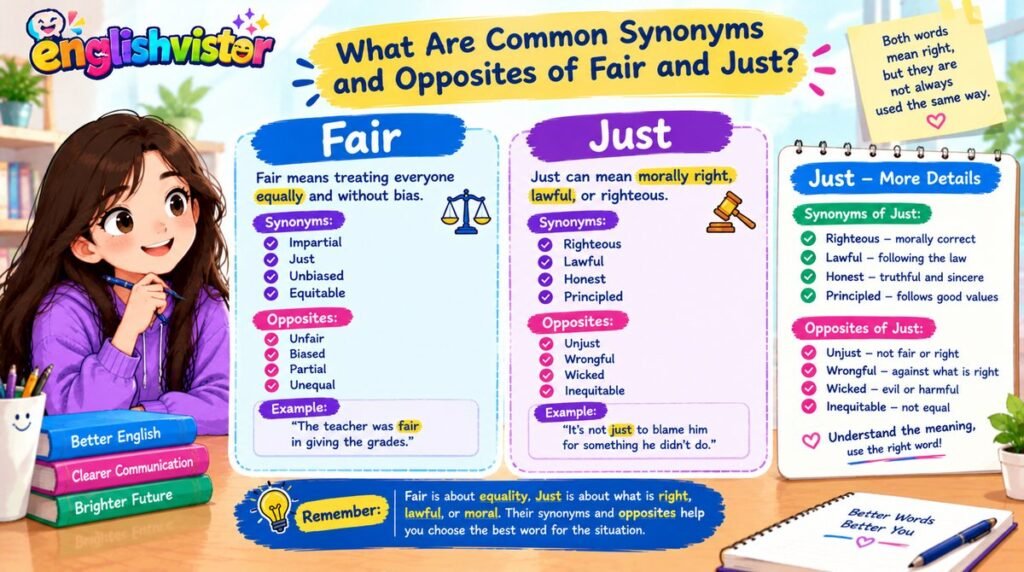
Understanding synonyms and opposites can make Fair vs Just easier to remember.
The word fair can mean equal, reasonable, impartial, or unbiased, while its opposites include unfair, unequal, and biased.
The word just can mean morally right, lawful, or righteous, while its opposites include unjust, wrongful, and inequitable.
When comparing Fair vs Just, remember that synonyms may overlap without having exactly the same meaning.
For example, an impartial decision treats people without bias, while a just decision follows moral principles.
Learning these related words helps clarify Fair vs Just in everyday English.
When you study Fair vs Just, focus on the context instead of replacing one word with another automatically.
This vocabulary distinction makes Fair vs Just easier to use accurately in conversations and writing.
Grammar Rules You Must Remember
Rule 1: Use “Fair” for Equal Treatment
When the main idea is about giving people the same opportunity or treatment, use fair.
Example:
“Every student should have a fair chance to succeed.”
The focus is equal opportunity.
Rule 2: Use “Just” for Moral or Legal Rightness
When the idea is about laws, ethics, or what is right, use just.
Example:
“The judge gave a just decision.”
The focus is justice.
Rule 3: A Situation Can Be Fair Without Being Just
Sometimes equal treatment does not always create the best moral result.
Example:
“Everyone received the same punishment, but the decision was not just.”
Why?
Because one person may have had a smaller role in the problem.
Fairness looks at equality. Justice looks deeper at what is right.
Rule 4: Notice the Context Before Choosing the Word
Always think about the situation.
Example:
“This is a fair price.”
You are talking about reasonableness.
“This is a just law.”
You are talking about morality and rights.
The surrounding words often help you choose correctly.
Common Mistakes Students Make
Mistake 1: Using “Just” for Every Situation
Incorrect:
“The shopkeeper gave me a just price.”
Correct:
“The shopkeeper gave me a fair price.”
A price is usually about being reasonable, so fair is better.
Mistake 2: Using “Fair” When Talking About Laws
Incorrect:
“We need fair laws.”
This sentence is not always wrong, but just laws is often more natural when discussing morality and rights.
Better:
“We need just laws that protect everyone.”
Mistake 3: Thinking Both Words Always Have the Same Meaning
Incorrect thinking:
“Fair and just are exactly the same.”
They overlap, but they have different focuses.
Remember:
- Fair = equal and reasonable
- Just = morally right
Mistake 4: Forgetting the Other Meaning of “Just”
Incorrect:
“I just decision was made.”
Correct:
“A just decision was made.”
Here, just is an adjective.
But:
“I just made a decision.”
Here, just means recently.
Easy Trick to Remember the Difference
Use this simple memory trick:
Fair = Fair for everyone
The word fair reminds you of a fair game where everyone follows the same rules and gets an equal chance.
Example:
“A fair competition gives every player the same opportunity.”
Just = Justice
The word just is connected to justice.
Think about courts, laws, and doing what is morally right.
Example:
“A just law protects people’s rights.”
A quick reminder:
Fair asks: “Is everyone treated equally?”
Just asks: “Is it the right thing to do?”
Daily Life Examples
Here are common spoken English examples:
- That is not fair. You gave him more time than me.
Meaning: The treatment was unequal.
- The teacher was fair to all students.
Meaning: The teacher treated everyone equally.
- We need a just system that helps everyone.
Meaning: We need a morally correct system.
- The price seems fair for such a good product.
Meaning: The price is reasonable.
- The judge made a just decision.
Meaning: The decision followed justice.
- Parents should be fair when solving problems between children.
Meaning: Parents should treat children equally.
- People want a just society where everyone has rights.
Meaning: People want a morally correct society.
- It is fair to give everyone another chance.
Meaning: Everyone deserves equal opportunity.
- The company created a fair workplace policy.
Meaning: The policy treats employees properly.
- The punishment was just because the person broke the rules.
Meaning: The punishment was deserved and correct.
How Do “Fair Enough” and “Just in Time” Use These Words Differently?
Some common English expressions use fair and just with meanings beyond their main comparison.
In Fair vs Just, the phrase “fair enough” often means that something is acceptable or reasonable, as in “Fair enough, I understand your point.”
By contrast, “just in time” means arriving or completing something at the last possible moment before it is too late.
Understanding these expressions helps you recognize why Fair vs Just depends on context.
For example, “That sounds fair enough” expresses acceptance, while “I arrived just in time for the exam” describes timing.
When learning Fair vs Just, remember that just can also mean “only” or “recently,” depending on the sentence.
These additional meanings make Fair vs Just more interesting than a simple comparison of fairness and justice.
Practicing phrases such as “fair enough” and “just in time” will help you understand Fair vs Just more naturally in everyday conversations.
Practice Section
Choose the correct word: fair or just.
- The teacher gave every student a ______ chance to participate.
- The country needs ______ laws to protect citizens.
- The price of the service is very ______.
- The judge made a ______ decision.
- It is not ______ to ignore one person’s opinion.
Answers:
- fair
- just
- fair
- just
- fair
FAQs
What is the difference between fair and just?
Fair means equal, balanced, or reasonable treatment. Just means morally right or based on justice. Fair focuses more on equality, while just focuses more on what is right according to principles.
Can we use fair and just in questions?
Yes. Both words can appear in questions.
Examples:
“Was the decision fair?”
“Was the punishment just?”
The meaning depends on what you want to ask about.
Is fair formal or informal?
Fair is used in both formal and informal English. It is common in daily conversations, business, education, and social situations.
Is just more formal than fair?
Usually, yes. Just is often used in formal discussions about laws, rights, and society. However, it is also used in normal conversations.
Can a decision be both fair and just?
Yes. A decision can be both fair and just when it treats people equally and follows moral principles.
Why do English learners confuse fair and just?
They are confusing because both words can mean something is right. The main difference is the focus: fair is about equal treatment, while just is about moral correctness.
Conclusion
Understanding the difference between fair vs just helps you choose better words and communicate more naturally in English. These words are similar, but they are not always interchangeable.
Remember the simple idea:
Fair means equal and reasonable.
Just means morally right and connected with justice.
When you talk about chances, prices, treatment, or competition, fair is usually the better choice. When you talk about laws, rights, punishment, or moral decisions, just is often the better choice.
The best way to learn this difference is through practice. Pay attention to how these words appear in conversations, books, and news stories. Over time, choosing the correct word will become natural.
Small vocabulary differences can make a big improvement in your English. Keep learning, keep practicing, and do not worry about making mistakes. Every mistake helps you become a stronger English speaker.

Hi, I’m Isabella Foster, an English language writer passionate about making grammar, vocabulary, and communication skills easy to understand. At EnglishVistor, I create clear, practical, and engaging learning resources to help learners improve their English with confidence.



4 thoughts on “Fair vs Just: Meaning, Rules and Examples (Updated 2026)”