Last updated on October 6th, 2026 at 04:17 pm
Many English learners feel confused when they see “getaway” and “get away” because these two expressions look almost the same.
The only difference is a small space, but that small space changes the meaning completely Getaway vs Get.
English has many word pairs that look similar but work differently. Sometimes a single word is a noun, while the same words written separately become a verb phrase.
This happens with “getaway” and “get away,” and understanding the difference can make your English sound much more natural. Getaway vs Get.
The good news is that the difference is simple. Getaway usually talks about a short trip or a break from normal life. Get away usually means to escape, leave a place, or move away from someone or something. Getaway vs Get.
These words appear often in everyday conversations, travel blogs, movies, songs, and social media posts.
Knowing when to use each one will help you write better sentences and avoid common grammar mistakes. Getaway vs Get.
After learning this topic, you will understand the meaning, grammar rules, sentence patterns, common errors, and real-life uses of both expressions.
You will also learn an easy memory trick that makes choosing the correct form much easier. Getaway vs Get.
What Does “Getaway” Mean?
Getaway is a noun. It means a short trip, holiday, or break that someone takes to relax or enjoy time away from their normal routine.
People often use “getaway” when talking about vacations, weekend trips, or relaxing breaks. Getaway vs Get.
Simple definition:
Getaway = a short trip or escape for relaxation or enjoyment
Examples:
- We are planning a weekend getaway to the mountains.
- She needs a quiet getaway after a busy month at work. Getaway vs Get.
- The hotel is perfect for a romantic getaway.
- They enjoyed a family getaway near the beach. Getaway vs Get.
- My parents booked a summer getaway in another city.
- This small island is a popular holiday getaway.
- We are looking for a peaceful getaway from city life. Getaway vs Get.
When to use “getaway”
Use getaway when you are naming a thing, especially a trip or break.
Because it is a noun, it often comes after words like:
- a
- the
- my
- your
- our
- their
Examples:
- We need a getaway.
- This is the perfect getaway.
- Their weekend getaway was amazing.
Grammar rule:
Getaway = noun (one word)
The word acts like a person, place, thing, or idea. Getaway vs Get.
Sentence pattern:
Subject + verb + a/the + getaway
Examples:
- They planned a getaway.
- She wants a relaxing getaway.
- We enjoyed the getaway.
Common learner confusion
Many learners think “getaway” means “leave quickly” because it contains the word “get.” However, as one word, it usually refers to a trip or break. Getaway vs Get.
Compare:
- We need a getaway. (We need a short holiday.)
- We need to get away. (We need to leave.)
The meaning changes because the grammar changes.
What Does “Get Away” Mean?
Get away is a verb phrase made of two words: the verb get and the adverb away. Getaway vs Get.
It means to leave a place, escape from a person or situation, or move somewhere else. Getaway vs Get.
Simple definition:
Get away = to leave, escape, or move away
Examples:
- I want to get away from the noise.
- The bird got away from the cage.
- We should get away before it gets late.
- She wants to get away from stress.
- The thief tried to get away.
- He got away safely after the accident.
- They get away every summer for a few days.
When to use “get away”
Use get away when you are talking about an action.
It describes something someone does.
Common meanings:
1. To leave a place
Example:
- We need to get away before midnight. Getaway vs Get.
Meaning: We need to leave.
2. To escape
Example:
- The dog got away from its owner.
Meaning: The dog escaped.
3. To take a break
Example:
- I want to get away for a few days.
Meaning: I want to take a short break.
Grammar rule:
Get away = verb phrase (two words)
It can change according to tense:
- get away
- gets away
- got away
- getting away
Examples:
- I want to get away.
- She gets away every winter.
- They got away early. Getaway vs Get.
- We are getting away tomorrow.
Common learner confusion
Students often write “getaway” when they need a verb.
Wrong:
- I want to getaway from work.
Correct:
- I want to get away from work.
Here, “want to” is followed by a verb, so we need get away.
Getaway vs Get Away in Different Sentence Patterns
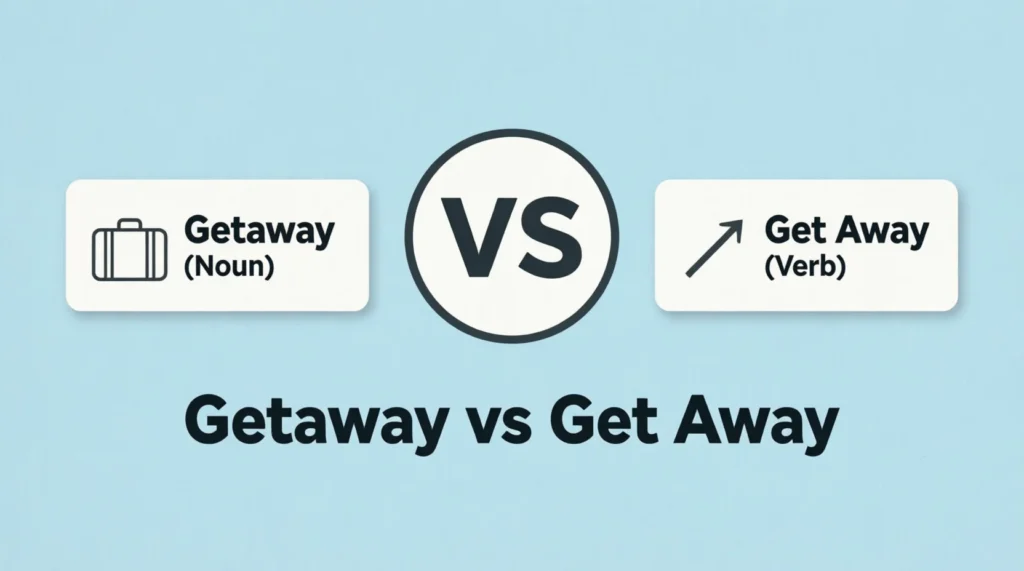
Getaway and get away can appear in different sentence patterns because they have different grammatical roles.
“Getaway” works as a noun, so it can follow words such as “a,” “the,” “our,” or “their.”
“Get away” works as a verb phrase and can follow structures such as “want to,” “need to,” or “try to.” Recognizing the sentence pattern makes the correct form easier to choose.
Difference Between Getaway and Get Away
Although these expressions look similar, their grammar and meanings are different. Getaway vs Get.
| Point | Getaway | Get Away |
|---|---|---|
| Type | Noun | Verb phrase |
| Number of words | One word | Two words |
| Main meaning | A short trip or break | To leave or escape |
| Grammar role | Names something | Shows an action |
| Common use | Travel and holidays | Leaving places or situations |
| Example | We planned a getaway. | We want to get away. |
Usage difference
The easiest way to understand the difference is to ask:
Are you talking about a thing or an action?
If you are talking about a trip, use getaway.
Example:
- Our beach getaway was wonderful. Getaway vs Get.
The getaway is the trip.
If you are talking about leaving or escaping, use get away.
Example:
- We want to get away from the busy city. Getaway vs Get.
Getting away is the action.
Grammar logic
English often changes meaning when words join together. Getaway vs Get.
Compare:
- a blackboard = a board used for writing
- a black board = a board that is black
The same idea applies here:
- getaway = a noun
- get away = a verb phrase
The space between the words matters. Getaway vs Get.
Sentence structure difference
Getaway structure:
Subject + verb + getaway
Examples:
- They planned a getaway.
- She enjoyed her getaway.
Get away structure:
Subject + verb + to get away / get away + from place
Examples:
- I want to get away.
- He got away from the crowd.
Grammar Rules You Must Remember
Rule 1: Use “getaway” as a noun
When you can replace the word with “trip,” “holiday,” or “break,” use getaway.
Example:
- We had a relaxing getaway.
You can say:
- We had a relaxing trip.
Both work because “getaway” is a thing.
Rule 2: Use “get away” when it shows an action
If someone is leaving, escaping, or moving away, use two words.
Example:
- She wants to get away from the city.
The person is doing an action.
Rule 3: Verb forms can change, but “getaway” does not
Because “getaway” is a noun, it does not become “gotaway” or “gettingaway.”
Correct:
- We enjoyed our getaway.
Incorrect:
- We enjoyed our get away.
For verbs:
- I get away.
- I got away.
- I am getting away.
Rule 4: Look at the words before the expression
Words before the expression often give clues.
If you see:
- a
- the
- my
- your
- their
you probably need getaway.
Example:
- Our weekend getaway was fun.
If you see:
- want to
- need to
- try to
- plan to
you probably need get away.
Example:
- I need to get away.
Common Mistakes Students Make
Mistake 1: Using “getaway” as a verb
Wrong:
- I want to getaway from my problems.
Correct:
- I want to get away from my problems.
Why?
Because “want to” needs an action verb.
Mistake 2: Writing “get away” when talking about a trip
Wrong:
- Our weekend get away was amazing.
Correct:
- Our weekend getaway was amazing.
Why?
The sentence talks about a trip, not an action.
Mistake 3: Confusing escape with vacation
Sometimes “get away” and “getaway” are connected, but they are not always the same.
Example:
- The prisoner got away.
This means escaped.
Example:
- They enjoyed a romantic getaway.
This means a trip.
Mistake 4: Forgetting the space
Small spaces can change meanings in English.
Wrong:
- I want a get away.
Correct:
- I want a getaway.
Wrong:
- I need to getaway.
Correct:
- I need to get away.
A simple spelling check can prevent the mistake.
Easy Trick to Remember the Difference
Use this simple memory trick:
Getaway = Get + Holiday
Think:
“Where is my getaway?”
Answer:
“A place or trip.”
Example:
- My getaway was relaxing.
Get away = Get + Leave
Think:
“Do I need to leave?”
Answer:
“Yes, I need to get away.”
Example:
- I need to get away from this noise.
Another easy trick:
If you can put “a” before it, use getaway.
- a getaway ✅
- a get away ❌
If you can put “to” before it, use get away.
- to get away ✅
- to getaway ❌
Daily Life Examples
Here are common spoken English examples:
- I need to get away for a few days.
Meaning: I need a short break.
- We booked a weekend getaway at the beach.
Meaning: We booked a short holiday.
- She wants to get away from the busy city.
Meaning: She wants to leave the city.
- Their family getaway was full of fun activities.
Meaning: Their family trip was enjoyable.
- Can we get away this weekend?
Meaning: Can we leave or take a short break?
- The mountain cabin was the perfect getaway.
Meaning: The cabin was a perfect relaxing place.
- He tried to get away from the conversation.
Meaning: He tried to leave the situation.
- Our summer getaway created many good memories.
Meaning: Our summer trip was memorable.
- I just want to get away and relax.
Meaning: I want to leave my current situation.
- They planned a romantic getaway for their anniversary.
Meaning: They planned a special trip.
Getaway vs Get Away in Travel and Escape Contexts
In travel-related sentences, getaway usually describes a short trip, holiday, or relaxing break, while get away describes the action of leaving or escaping.
For example, “We planned a weekend getaway” names the trip, while “We want to get away this weekend” describes the action of leaving for a break.
This distinction is useful in everyday English.
Practice Section
Choose the correct option: getaway or get away
- We are planning a weekend ______ to the countryside.
- I need to ______ from all this stress.
- Their holiday ______ was amazing.
- She wants to ______ for a few days.
- This island is a beautiful ______.
Answers:
- getaway
- get away
- getaway
- get away
- getaway
FAQs
What is the difference between getaway and get away?
Getaway is a noun that means a short trip or break. Get away is a verb phrase that means to leave, escape, or move away. The correct choice depends on whether you mean a thing or an action.
Can we use “get away” in questions?
Yes. It is common in questions.
Examples:
- Can we get away this weekend?
- When do you want to get away?
It asks about leaving or taking a break.
Is getaway formal or informal?
“Getaway” is common in both everyday and professional writing. Travel companies often use it when describing holidays and trips.
Can getaway mean escape?
Sometimes. A getaway can describe an escape, especially in phrases like “a quick getaway.” However, for the action of escaping, use “get away.”
Why do learners confuse getaway and get away?
They look almost identical and sound the same when spoken. Many learners forget that one is a noun and the other is a verb phrase.
Which one should I use for vacation?
Use getaway when you mean the vacation itself.
Example:
- We enjoyed our beach getaway.
Use get away when you mean the action of leaving.
Example:
- We want to get away next month.
Conclusion
Understanding the difference between getaway and get away becomes easy when you focus on grammar.
Remember one simple idea: getaway is a thing, while get away is an action.
A getaway is a short trip, holiday, or relaxing break. You can plan it, enjoy it, or talk about it. Get away means leaving, escaping, or taking a break from a place or situation.
Small grammar differences like this can make a big difference in your English accuracy. When you learn to notice spaces between words and understand their roles in a sentence, many confusing word pairs become much easier.
Practice using these expressions in your own sentences. Try writing about your last trip, your dream vacation, or a time when you wanted to leave a busy place.
With regular practice, choosing between “getaway” and “get away” will become natural, and your everyday English will sound clearer and more confident.

Hi, I’m Isabella Foster, an English language writer passionate about making grammar, vocabulary, and communication skills easy to understand. At EnglishVistor, I create clear, practical, and engaging learning resources to help learners improve their English with confidence.



1 thought on “Getaway vs Get Away: Difference and Usage (Updated 2026)”